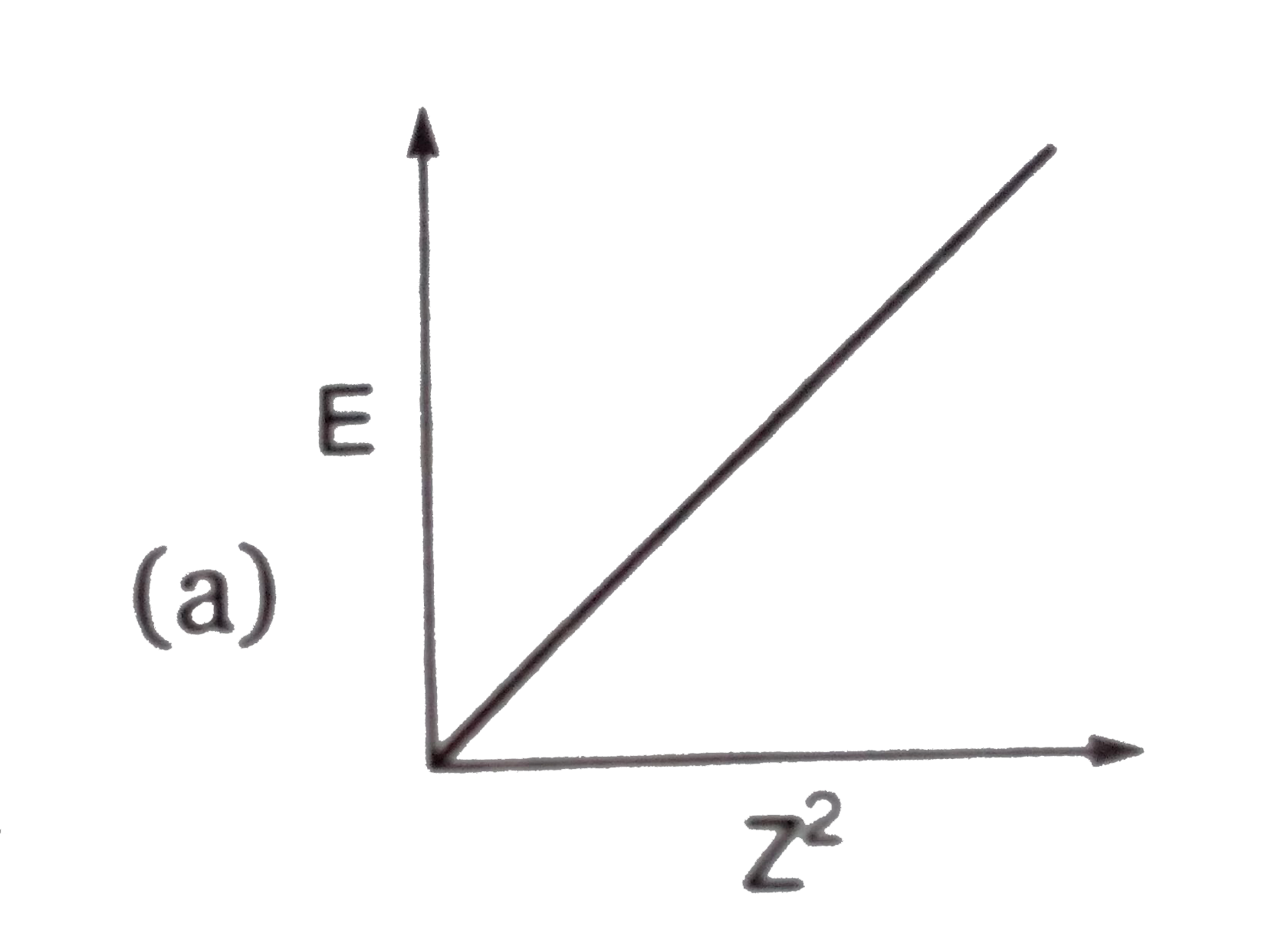
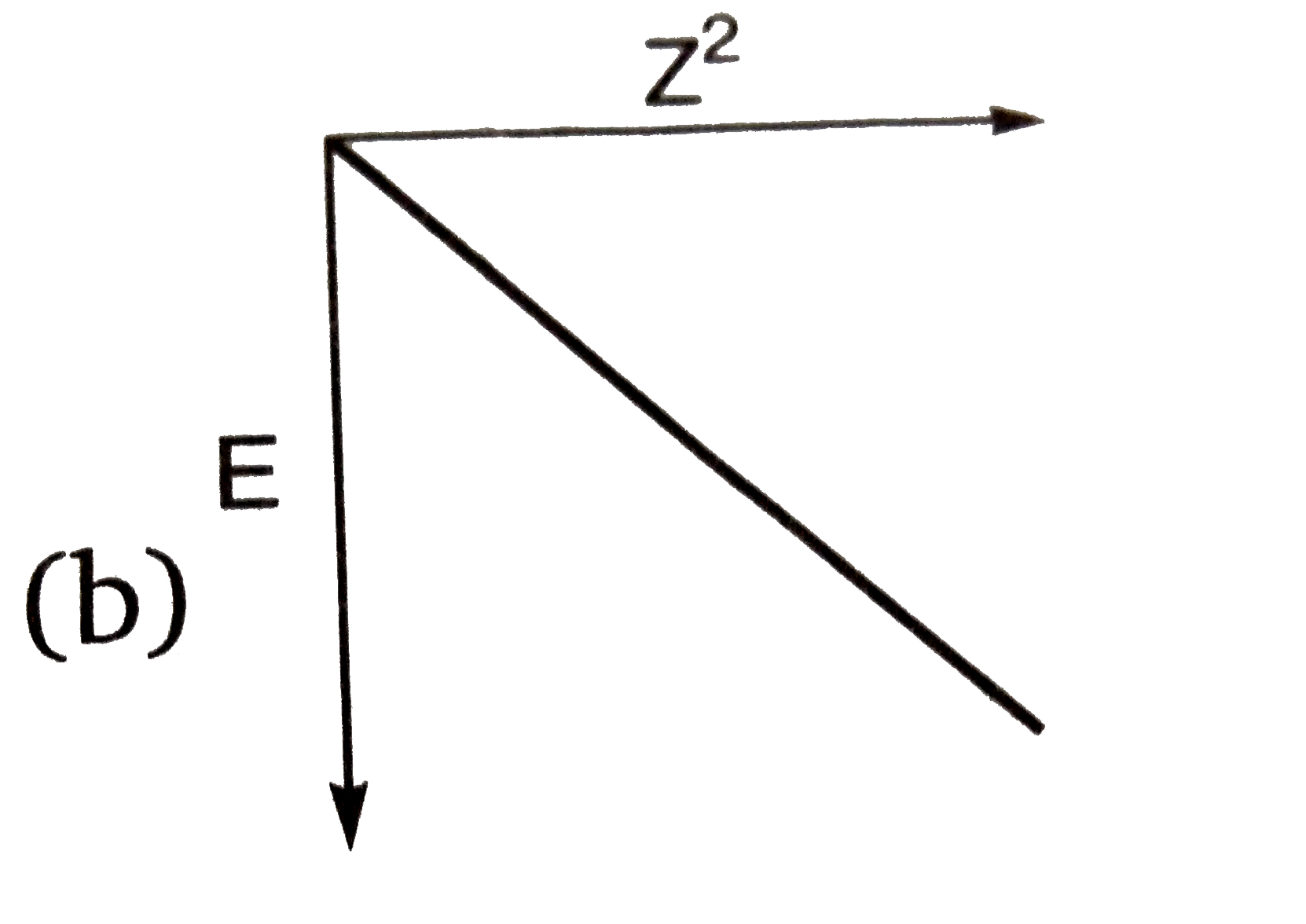
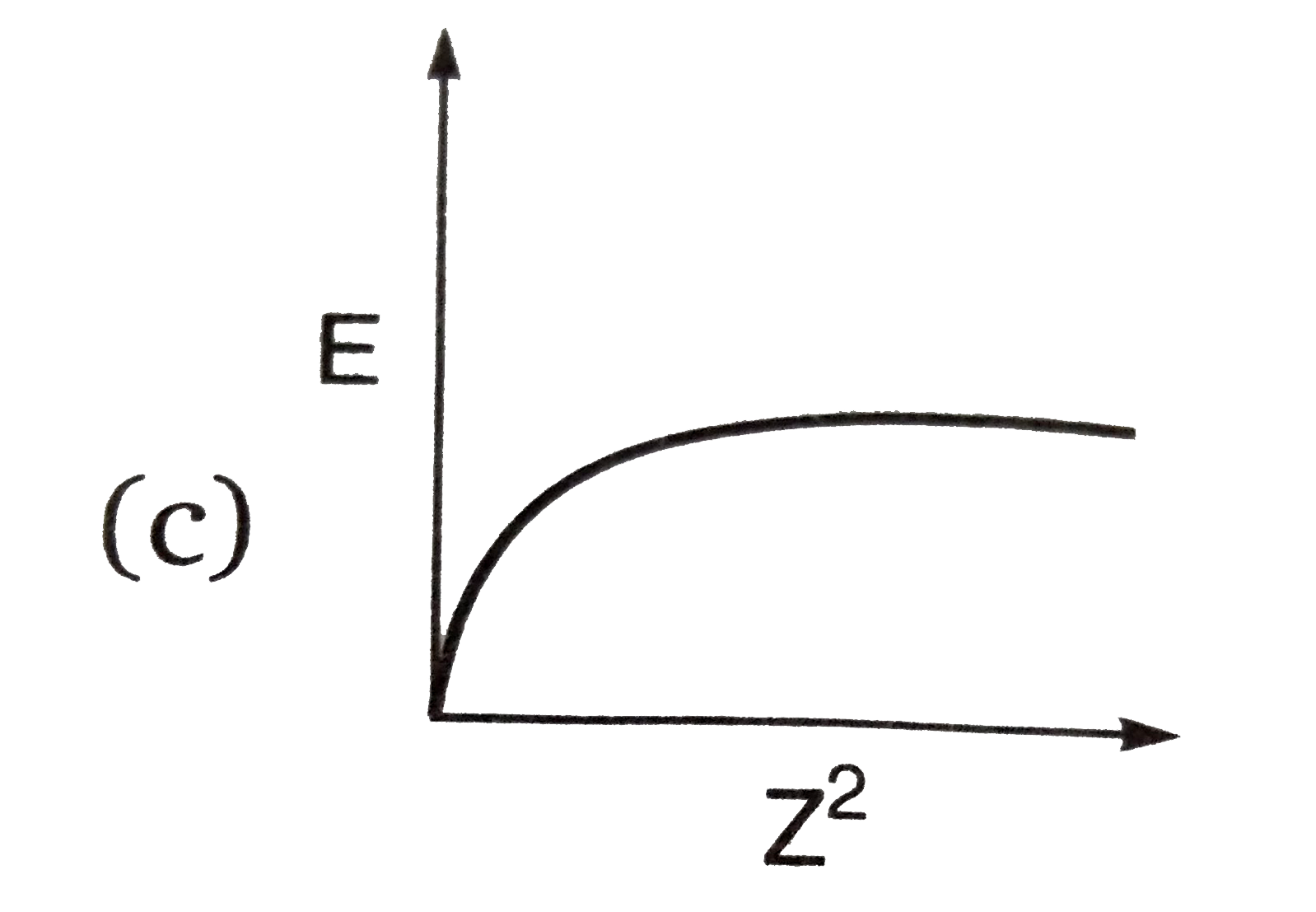
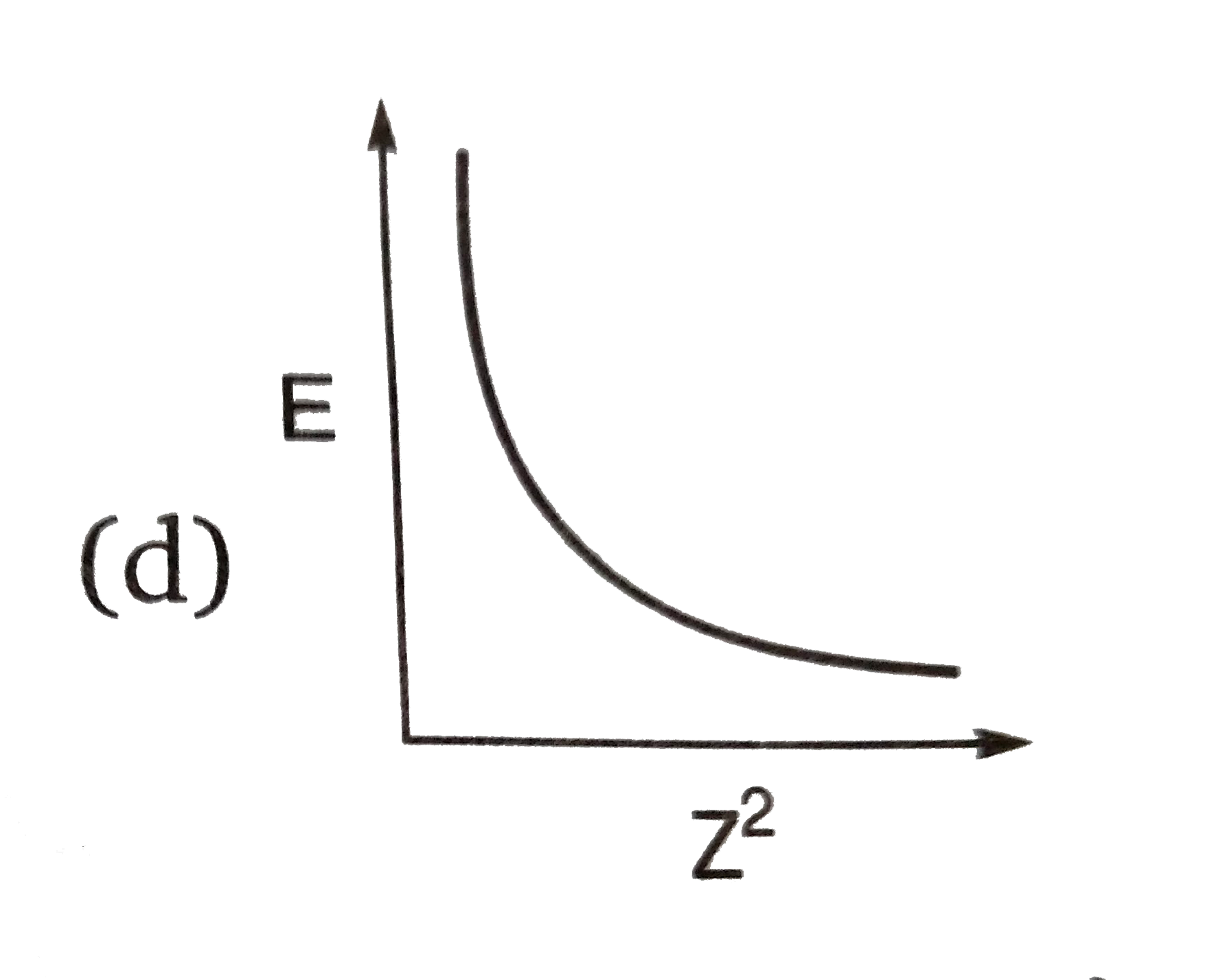
The energy of an electron moving in `n^(th)` Bohr's orbit of an element is given by `E_(n)=(-13.6)/n^(2)Z^(2)` eV/ atom (Z=atomic number). The graph of E vs. `Z^(2)` (keeping "n" constant) will be :
A
B
C
D
Text Solution
AI Generated Solution
The correct Answer is:
To solve the problem, we need to analyze the relationship between the energy of an electron in the nth Bohr orbit and the atomic number (Z) as given by the formula:
\[ E_n = \frac{-13.6}{n^2} Z^2 \]
### Step-by-Step Solution:
1. **Identify the relationship**:
The formula indicates that the energy \( E_n \) is proportional to \( Z^2 \). This can be expressed as:
\[ E_n \propto -Z^2 \]
This means that as \( Z^2 \) increases, \( E_n \) becomes more negative.
2. **Rearranging the equation**:
We can rewrite the equation in terms of \( Z^2 \):
\[ E_n = \frac{-13.6}{n^2} Z^2 \]
Here, we can see that if we plot \( E_n \) on the y-axis and \( Z^2 \) on the x-axis, we can identify the slope of the line.
3. **Identifying the slope**:
The equation can be rearranged to the form:
\[ E_n = m \cdot Z^2 \]
where \( m = \frac{-13.6}{n^2} \). Since \( m \) is negative, this indicates that the slope of the line is negative.
4. **Graph characteristics**:
Since the relationship is linear and the slope is negative, the graph of \( E \) versus \( Z^2 \) will be a straight line that slopes downwards from left to right.
5. **Conclusion**:
Therefore, the graph of \( E \) versus \( Z^2 \) (keeping \( n \) constant) will be a straight line with a negative slope.
### Final Answer:
The correct graph of \( E \) versus \( Z^2 \) is a straight line with a negative slope.
NARENDRA AWASTHI ENGLISH|Exercise Match the column|1 Videos
Similar Questions
Explore conceptually related problems
Time period of revolution of an electron in n^(th) orbit in a hydrogen like atom is given by T = (T_(0)n_(a))/ (Z^(b)) , Z = atomic number
The angular speed of the electron in the n^(th) Bohr orbit of the hydrogen atom is proportional to
Energy of the electron in nth orbit of hydrogen atom is given by E_(n) =-(13.6)/(n^(2))eV . The amount of energy needed to transfer electron from first orbit to third orbit is
When an electron jumps from n_(1) th orbit to n_(2) th orbit, the energy radiated is given by
Derive an expression for the radius of n^(th) Bohr’s orbit in Hydrogen atom.
Prove that E_(n)=-13.6xxz^(2)/n^(2) eV//atom for n^(th) orbit in single electron species.
According to Bohr's theory, the electronic energy of an electron in the n^(th) orbit is given by E_(n) = (-2.17 xx 10^(-18))xx(z^2)/(n^(2)) J Calculate the longest wavelength of light that will be needed in remove an electron from the third Bohr orbit of He^(o+)
In the nth orbit, the energy of an electron E_(n)= -( 13.6)/(n^(2)) eV for hydrogen atom. The energy required to take the electron from first orbit to second orbit will be
Energy of electron in its nth orbit is given by (E_n=-(13.6)/n^2 xxz)ev . Consider a hydrogen atom , find the amount of energy needed to transfer electron from 1st orbit to 3rd orbit:
The energy of an electron in first Bohr's orbit of H atom is -13.6eV . The energy value of electron in the first excited state of Li^(2+) is :