Home
Class 11
CHEMISTRY
For the dissociation of PCl(5) into PCl(...

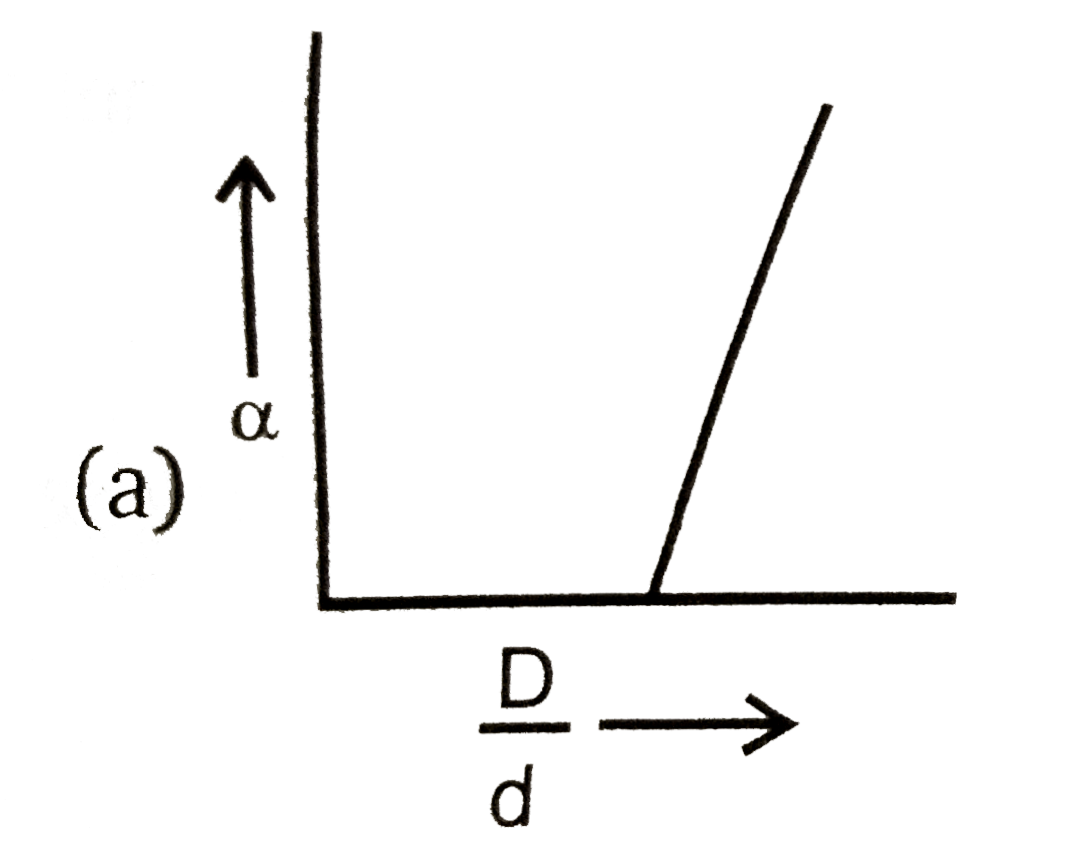
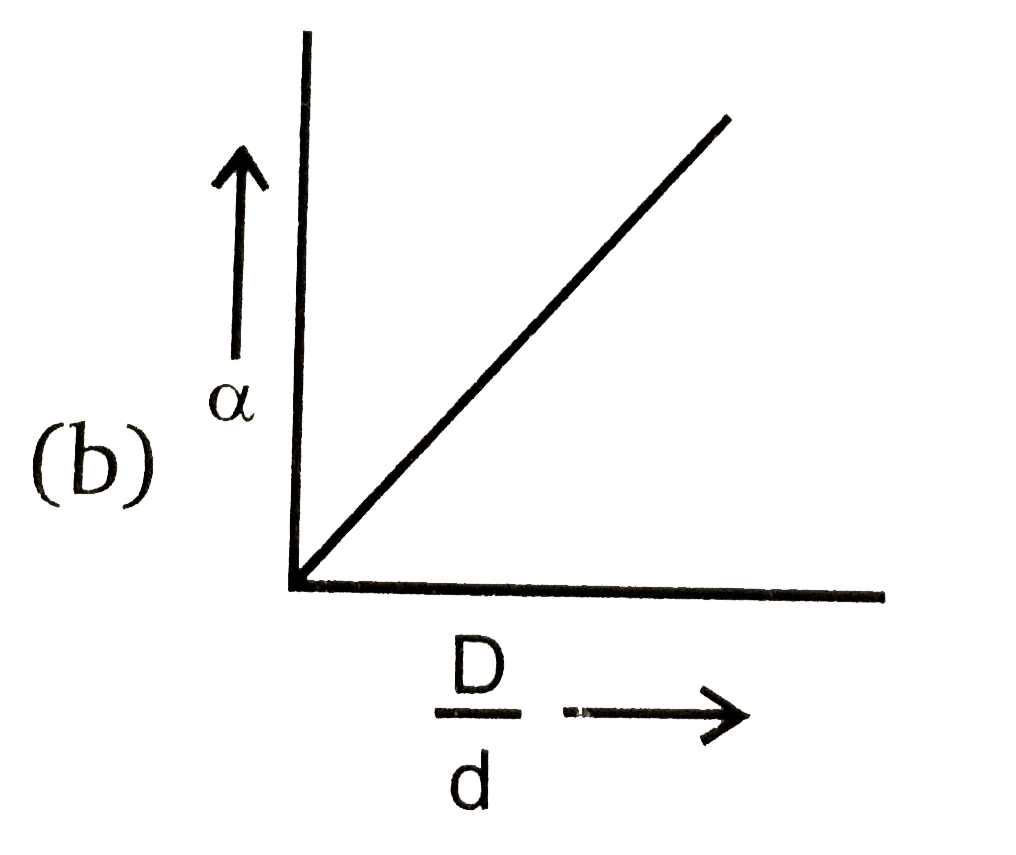
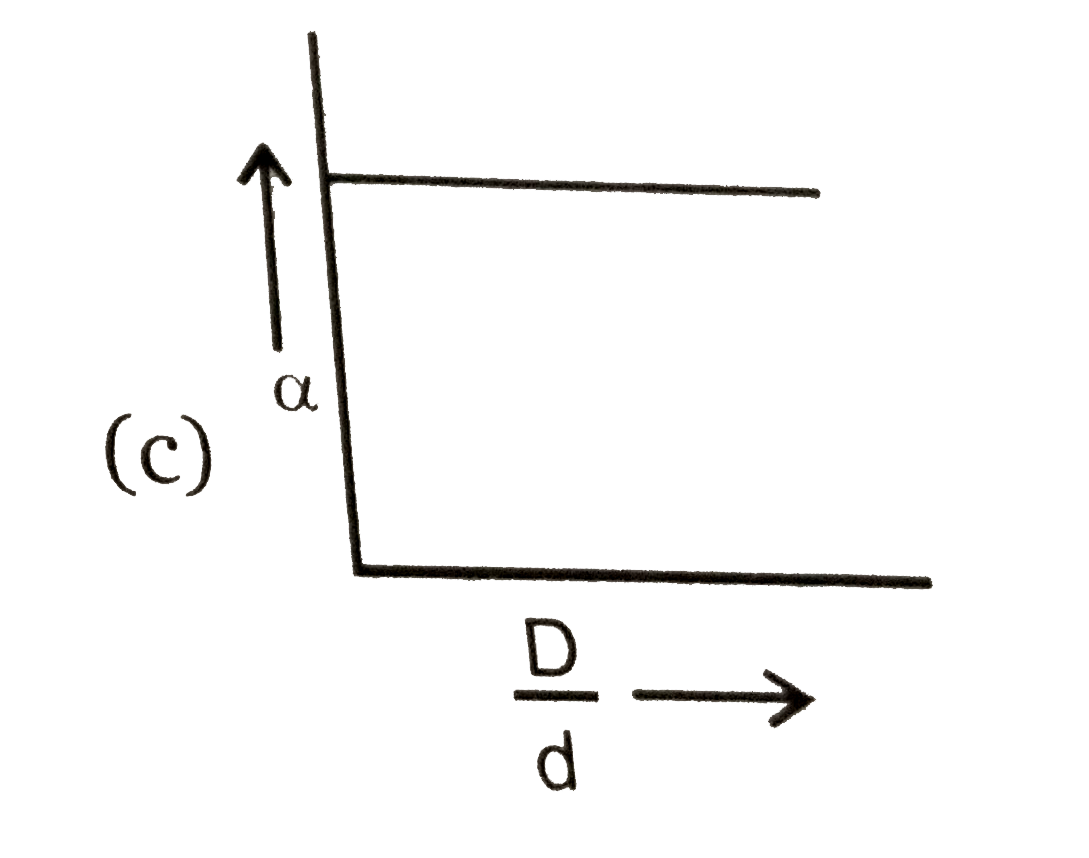
For the dissociation of `PCl_(5)` into `PCl_(3)` and `Cl_(2)` in gaseous phase reaction , if d is the observed vapour density and D the theoretical vapour density with `'alpha'` as degree of dissociation ,variaton of D/d with `'alpha'` is given by ?

A

(a)

B

(b)

C

(c)

D

(d) none of these

Text Solution

AI Generated Solution

The correct Answer is:

To solve the problem regarding the dissociation of \( PCl_5 \) into \( PCl_3 \) and \( Cl_2 \) in the gaseous phase, we need to derive the relationship between the degree of dissociation (\( \alpha \)), the observed vapor density (\( d \)), and the theoretical vapor density (\( D \)). ### Step-by-Step Solution: 1. **Understanding the Reaction**: The dissociation reaction can be represented as: \[ PCl_5(g) \rightleftharpoons PCl_3(g) + Cl_2(g) \] Here, one mole of \( PCl_5 \) produces one mole of \( PCl_3 \) and one mole of \( Cl_2 \). Thus, the total number of moles after dissociation is \( n = 2 \). 2. **Defining Degree of Dissociation**: The degree of dissociation (\( \alpha \)) is defined as the fraction of the original substance that has dissociated. If we start with 1 mole of \( PCl_5 \), after dissociation: - Moles of \( PCl_5 \) left = \( 1 - \alpha \) - Moles of \( PCl_3 \) produced = \( \alpha \) - Moles of \( Cl_2 \) produced = \( \alpha \) Therefore, the total moles at equilibrium: \[ \text{Total moles} = (1 - \alpha) + \alpha + \alpha = 1 + \alpha \] 3. **Calculating Theoretical Vapor Density**: The theoretical vapor density (\( D \)) is calculated using the formula: \[ D = \frac{M}{2} \quad \text{(where \( M \) is the molar mass)} \] For \( PCl_5 \), the molar mass is 208.24 g/mol, hence: \[ D = \frac{208.24}{2} = 104.12 \text{ g/L} \] 4. **Calculating Observed Vapor Density**: The observed vapor density (\( d \)) can be related to the degree of dissociation: \[ d = \frac{M}{2(1 + \alpha)} \] Where \( M \) is the molar mass of the products. Since we have \( PCl_3 \) and \( Cl_2 \), we can calculate the effective molar mass at equilibrium. 5. **Relating \( D \) and \( d \)**: We can express the relationship between \( D \) and \( d \) in terms of \( \alpha \): \[ \alpha = \frac{D - d}{(n - 1)d} \] Substituting \( n = 2 \): \[ \alpha = \frac{D - d}{d} \] Rearranging gives: \[ \alpha = \frac{D}{d} - 1 \] 6. **Final Relationship**: The relationship can be expressed as: \[ \frac{D}{d} = \alpha + 1 \] This shows that as \( \alpha \) increases, \( \frac{D}{d} \) also increases linearly. ### Conclusion: The variation of \( \frac{D}{d} \) with \( \alpha \) is linear, with a slope of 1 and an intercept of 1 on the graph of \( \frac{D}{d} \) versus \( \alpha \).
Promotional Banner

Similar Questions

Explore conceptually related problems

For the dissociation of PCI_(5) into PCI_(3) and Cl_(2) in gaseous phase reaction, If "d' is the observed vapour density and 'D' theoretical vapour density with 'alpha' as degree of dissociation. Variation of (D)/(d) with 'alpha' is given by which graph?

For a very small extent of dissociation of PCl_(5) into PCl_(3) and Cl_(2) is a gaseous phase reaction then degree of dissociation , x :

For the reaction PCl_(5)(g) rightarrow PCl_(3)(g) + Cl_(2)(g)

For the reaction : PCl_(5) (g) rarrPCl_(3) (g) +Cl_(2)(g) :

For the reaction : PCl_(5) (g) rarrPCl_(3) (g) +Cl_(2)(g) :

Consider the following hypothetical equilibrium 2B(g)hArrB_(2)(g) If d is observed vapour density and D is theoretical vapour density, then degree of association (alpha) will be

The dissociation of PCl_5 decreases in presence of Cl_2 Why ?

PCl_(5) on heating dissociates to PCl _(3) and Cl _(2) because :

Express the rate of following reactions PCl_5 to PCl_3 +Cl_2
