Home
Class 11
CHEMISTRY
Consider the following equilibrium N(...

Consider the following equilibrium
`N_(2)O_(4)(g)hArr2NO_(2)(g)`
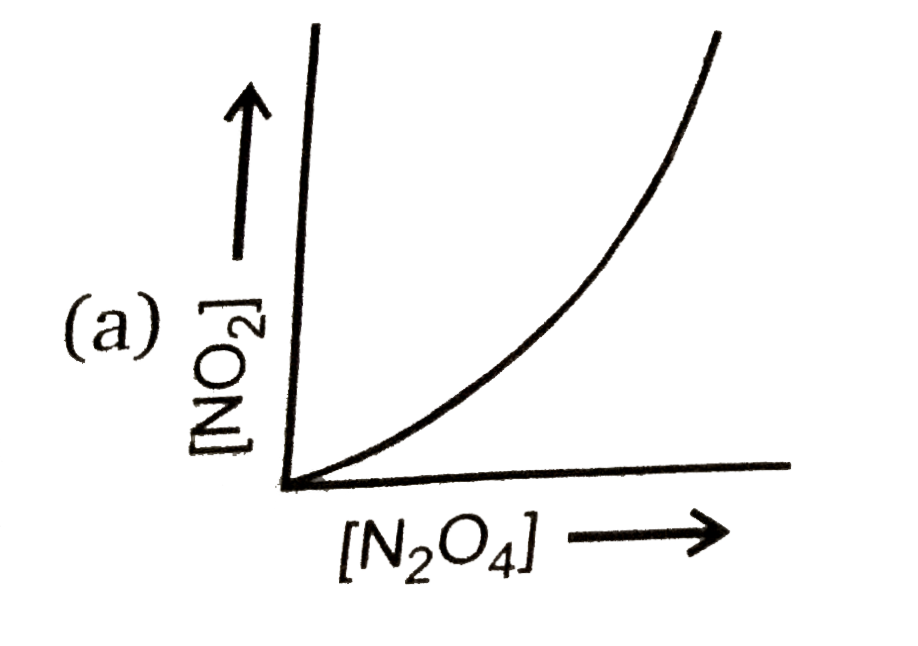
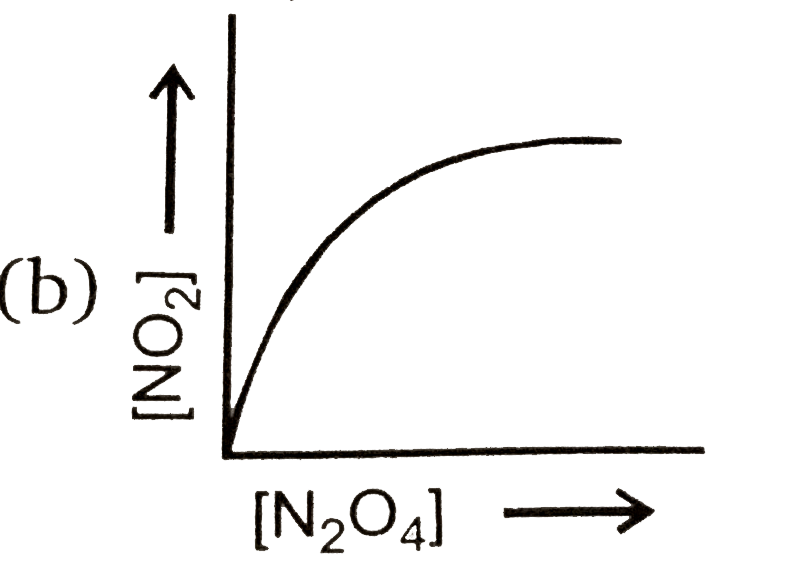
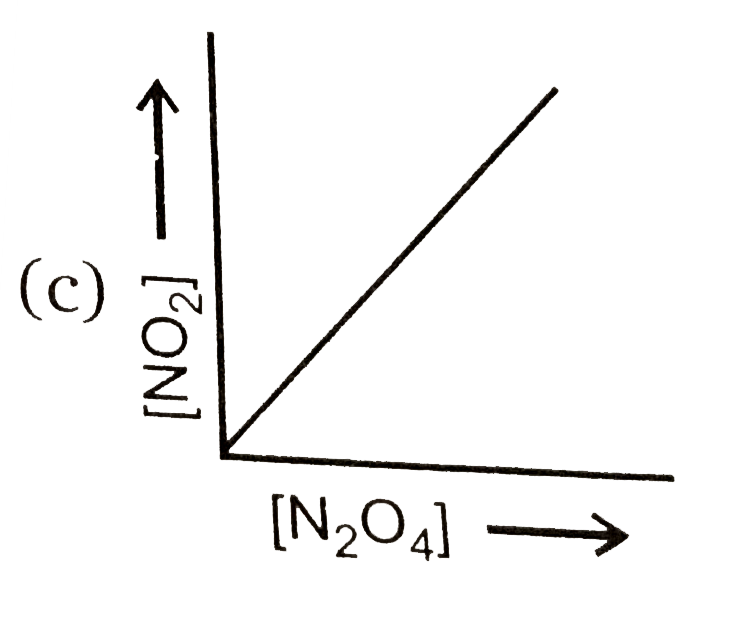
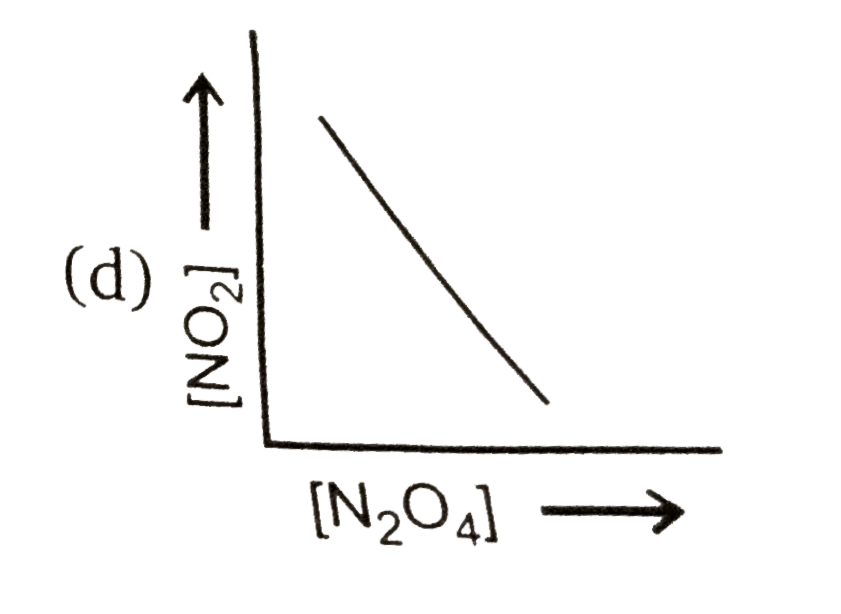
Then the select the correct graph , which shows the variation in concentrations of `N_(2)O_(4)` against concentrations of `NO_(2)`:

A

B

C

D

Text Solution

AI Generated Solution

The correct Answer is:

To solve the problem of determining the correct graph that shows the variation in concentrations of \( N_2O_4 \) against concentrations of \( NO_2 \) for the equilibrium reaction: \[ N_2O_4(g) \rightleftharpoons 2NO_2(g) \] we will follow these steps: ### Step 1: Write the expression for the equilibrium constant \( K_c \) For the given equilibrium reaction, the equilibrium constant \( K_c \) is defined as: \[ K_c = \frac{[NO_2]^2}{[N_2O_4]} \] Where: - \([NO_2]\) is the concentration of \( NO_2 \) - \([N_2O_4]\) is the concentration of \( N_2O_4 \) ### Step 2: Rearrange the equation From the expression for \( K_c \), we can rearrange it to express \([NO_2]^2\) in terms of \([N_2O_4]\): \[ [NO_2]^2 = K_c \cdot [N_2O_4] \] ### Step 3: Define the variables Let: - \( Y = [NO_2] \) - \( X = [N_2O_4] \) Then we can rewrite the equation as: \[ Y^2 = K_c \cdot X \] ### Step 4: Identify the type of graph The equation \( Y^2 = K_c \cdot X \) represents a parabolic relationship between \( Y \) and \( X \). This means that as the concentration of \( N_2O_4 \) (X-axis) increases, the concentration of \( NO_2 \) (Y-axis) will increase in a quadratic manner. ### Step 5: Analyze the graph options Given that we are looking for a parabolic graph, we can eliminate any linear graphs. The correct graph will be one that opens to the right, indicating that \( Y^2 \) increases as \( X \) increases. ### Conclusion The correct graph that shows the variation in concentrations of \( N_2O_4 \) against concentrations of \( NO_2 \) is graph B, which represents a parabolic relationship. ---
Promotional Banner

Similar Questions

Explore conceptually related problems

For the following equilibrium N_(2)O_(4)(g)hArr 2NO_(2)(g) K_(p) is found to be equal to K_(c) . This is attained when :

For the following gases equilibrium, N_(2)O_(4)(g)hArr2NO_(2)(g) K_(p) is found to be equal to K_(c) . This is attained when:

For the following gases equilibrium, N_(2)O_(4) (g)hArr2NO_(2) (g) , K_(p) is found to be equal to K_(c) . This is attained when:

Consider the following reaction N_(2)O_(4)(g)hArr2NO_(2)(g)DeltaH=58.6KJ What will be the effect of the following changes on the concentration of N_(2)O_(4) at equilibrium? (i) Increasing the pressure (ii) Increasing the temperature (iii) Increasing the volume (iv) Adding more NO_(2)(g) to the system without changing temperature and pressure (v) Adding catalyst.

The reaction , N_2O_4(g)rarr2NO_2(g) , is first order reaction , which of the following best describes the variation of concentration of N_2O_4 with time ?

At the equilibrium of the reaction , N_(2)O_(4)(g)rArr2NO_(2)(g) , the observed molar mass of N_(2)O_(4) is 77.70 g . The percentage dissociation of N_(2)O_(4) is :-

Consider the following equilibrium in a closed container: N_(2)O_(4)(g)hArr2NO_(2)(g) At a fixed temperature, the volume of the reaction container is halved. For this change which of the following statements holds true regarding the equilibrium constant (K_(p)) and the degree of dissociation (alpha) ?

Consider the following equilibrium in a closed container, N_(2)O_(4(g))hArr2NO_(2(g)) At a fixed temperature, the volume of the reaction container is halved. For this change which of the following statements holds true regarding the equilibrium constant (K_(p)) and degree of dissociation (alpha) ?

The equilibrium constant K_(p) for the following reaction is 4.5 N_(2)O_(4)(g)hArr2NO_(2)(g) What would be the average molar mass ("in"g//mol) of an equilibrium mixture of N_(2)O_(4) and NO_(2) formed by the dissociation of pure N_(2)O_(4) at a total pressure of 2 atm ?

Which is/are correct statements about following equilibrium? N_(2)O_(4)(g) rightarrow 2NO_(2) (g) Delta _(r) H =+ve
