Home
Class 11
CHEMISTRY
The prepation of SO(3)(g) by reaction SO...

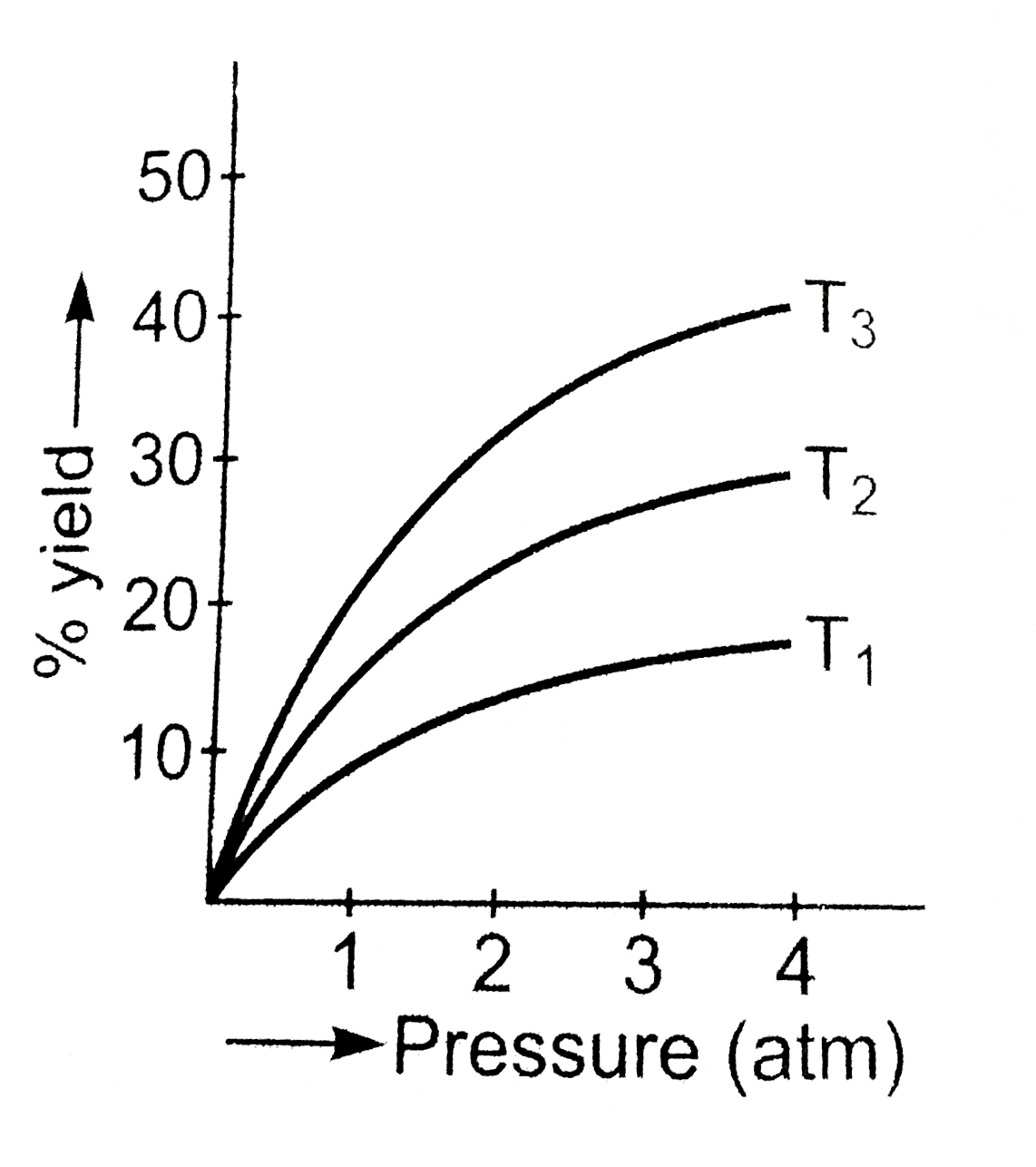
The prepation of `SO_(3)(g)` by reaction `SO_(2)(g)+(1)/(2)O_(2)(g)hArrSO_(3)(g)` is an exothermic reaction .If the preparation follows the following temperature -pressure relationship for % yield , then for temperatures `T_(1),T_(2)andT_(3)` the correct option is:

A

`T_(3)gtT_(2)gtT_(1)`

B

`T_(1)gtT_(2)gtT_(3)`

C

`T_(1)=T_(2)=T_(3)`

D

Nothing could be predicated about temperature though given information

Text Solution

Verified by Experts

The correct Answer is:

b
Promotional Banner

Similar Questions

Explore conceptually related problems

N_(2)(g)+3H_(2)(g) hArr 2NH_(3)(g), DeltaH^(ɵ)=-22.4 kJ The pressure inside the chamber is 100 atm and temperature at 300 K The preparation of ammonia by Haber's process is an exothermic reaction. If the preparation follows the following temperature-pressure relationship for its % yield. Then for temperature T_(1), T_(2) and T_(3) the correct option is:

The reaction SO_(2)(g) +1//2O_(2)(g) rarr SO_(3)(g) should be

Which one is the correct representation for the reaction 2SO_(2)(g)+O_(2)(g) hArr 2SO_(3)(g)

For a reaction SO_(2(g))+1//2O_(2(g))hArrSO_(3(g)) .The valve of (K_(P))/(K_(C)) is equal to

How will the rate of reaction 2SO_(2)(g) + O_(2)(g) rarr 2SO_(3)(g) change if the volume of the reaction vessel is halved?

In the reaction, 2SO_(2)(s)+O_(2)(g) hArr 2SO_(3)(g)+X cal , most favourable conditions of temperature and pressure for greater yield of SO_(3) are

For the reaction CO(g)+(1)/(2)O_(2)(g)rarr CO_(2)(g) Which one of the statement is correct at constant T and P ?

For the reaction, SO_(2)(g) + (1)/(2)O_(2)(g)hArrSO_(3) (g) , If K_(p) = K_(c) (RT)^(x) where the symbols have usual meaning then, the value of x is (assuming ideality).

For the reaction, SO_(2)(g)+1/2O_(2)(g)hArrSO_(3)(g) if K_(p)=K_(C)(RT)^(x) where, the symbols have usual meaning, then the value of x is (assuming ideality)

The reaction, 2SO_(2(g)) + O_(2(g))hArr2SO_(3(g)) is carried out in a 1 dm^(3) and 2 dm^(3) vessel separately. The ratio of the reaction velocity will be
