Home
Class 11
CHEMISTRY
For the chemical equilibrium, CaCO(3)(...

For the chemical equilibrium,
`CaCO_(3)(s) hArr CaO(s)+CO_(2)(g)`
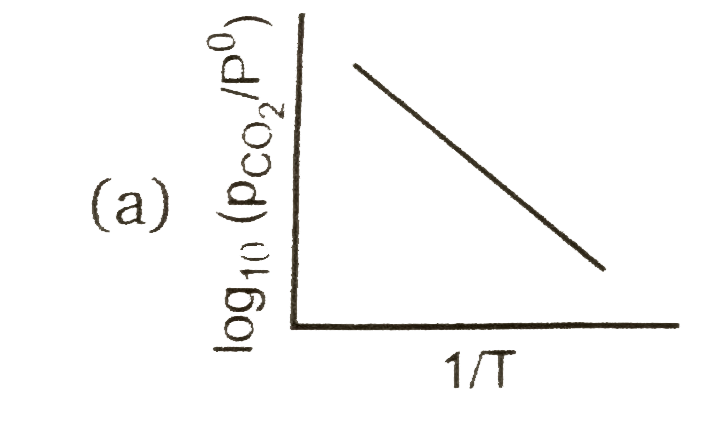
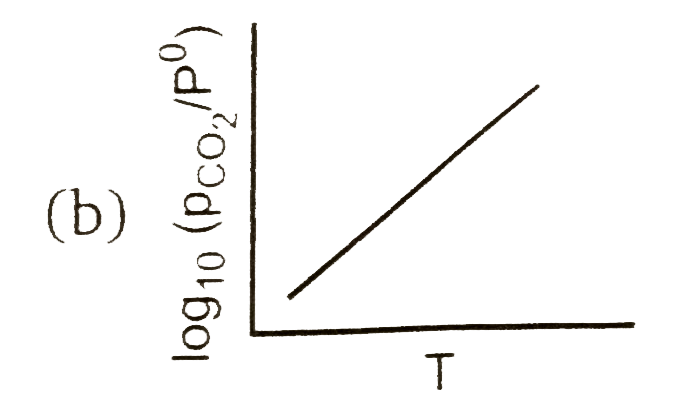
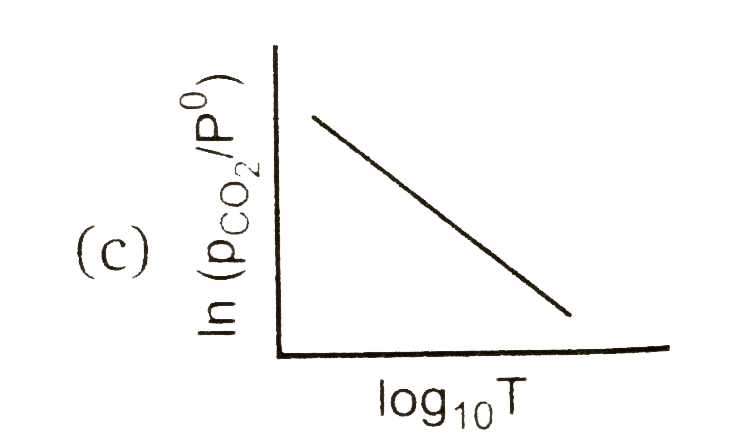
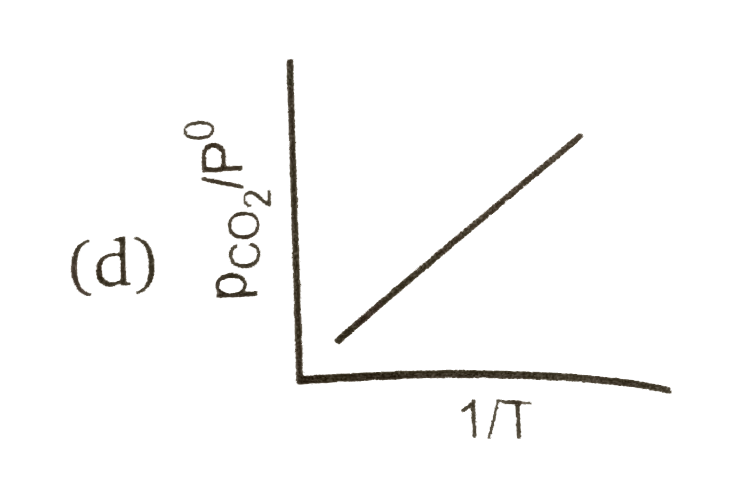
`Delta_(r)H^(ɵ)` can be determined from which one of the following plots?

A

B

C

D

Text Solution

AI Generated Solution

The correct Answer is:

To determine the enthalpy change (ΔrH°) for the equilibrium reaction: \[ \text{CaCO}_3(s) \rightleftharpoons \text{CaO}(s) + \text{CO}_2(g) \] we can analyze the relationship between the equilibrium constant (Kp) and temperature (T). The equilibrium constant Kp can be expressed in terms of the partial pressure of CO2, since the solid components (CaCO3 and CaO) do not contribute to the equilibrium expression. ### Step-by-step Solution: 1. **Write the Reaction and Identify Kp**: The reaction is: \[ \text{CaCO}_3(s) \rightleftharpoons \text{CaO}(s) + \text{CO}_2(g) \] The equilibrium constant Kp for this reaction is given by: \[ K_p = P_{\text{CO}_2} \] where \( P_{\text{CO}_2} \) is the partial pressure of CO2. 2. **Use the Arrhenius Equation**: According to the Arrhenius equation, the relationship between Kp and temperature is: \[ K_p = A e^{-\Delta H^\circ / RT} \] Taking the logarithm of both sides gives: \[ \ln K_p = \ln A - \frac{\Delta H^\circ}{R} \cdot \frac{1}{T} \] 3. **Rearranging the Equation**: We can rearrange this equation to: \[ \ln K_p = \ln A - \frac{\Delta H^\circ}{R} \cdot \frac{1}{T} \] This can be compared to the linear equation \( y = mx + c \), where: - \( y = \ln K_p \) - \( m = -\frac{\Delta H^\circ}{R} \) - \( x = \frac{1}{T} \) - \( c = \ln A \) 4. **Determine the Slope**: From the rearranged equation, we see that the slope (m) is negative, indicating that as \( \frac{1}{T} \) increases, \( \ln K_p \) decreases. 5. **Identify the Correct Plot**: To find ΔrH°, we need to plot \( \ln K_p \) against \( \frac{1}{T} \). The correct plot will show a linear relationship with a negative slope. 6. **Conclusion**: The plot that correctly represents this relationship will have \( \ln K_p \) on the y-axis and \( \frac{1}{T} \) on the x-axis, with a negative slope. ### Final Answer: The correct plot to determine ΔrH° for the reaction is option **A** (the plot showing \( \ln K_p \) vs. \( \frac{1}{T} \) with a negative slope).
Promotional Banner

Similar Questions

Explore conceptually related problems

For the reaction CaCO_(3(s)) hArr CaO_((s))+CO_(2(g))k_p is equal to

For CaCO_(3)(s) hArr CaO(s)+CO_(2)(g), K_(c) is equal to …………..

The equilibrium, BaCO_3(s) hArr Ba0(s) + CO_2(g) will shift in left hand direction by

For the reaction CaCO_(3)(s)hArrCaO(s)+CO_(2)(g) the equilibrium amount of CO_(2) can be increased by :

K_(p) = 1, For the equilibrium CaCO_(3(s)) hArr CaO_((s)) + CO_(2(g)) . The temperature of the reaction can be given as :

The reaction CaCO_(3)(s) hArr CaO(s)+CO_(2)(g) reaches the state of equilibrium when

Calculate the pressure of CO_(2) gas at 700 K in the heterogenous equilibrium reaction CaCO_(3)(s) hArr CaO(s)+CO_(2)(g), if DeltaG^(ɵ) for this reaction is 130.2 kJ mol^(-1) .

For CaCO_(3)(S) hArr CaO(s) + CO_(2) (g), Delta H = + Q at equilibrium. The addition of more CaCO3(s) causes?

For the reaction CaCO_3(s) hArr CaO(s) +CO_2(g) , the pressure of CO_2 depends on

For the reaction, CaCO_(3)(s) rarr CaO(s)+CO_(2)(g) , which is the correct representation?
