Home
Class 11
CHEMISTRY
X(3)Y(2)(i=5) when reacted with A(2)B(3)...

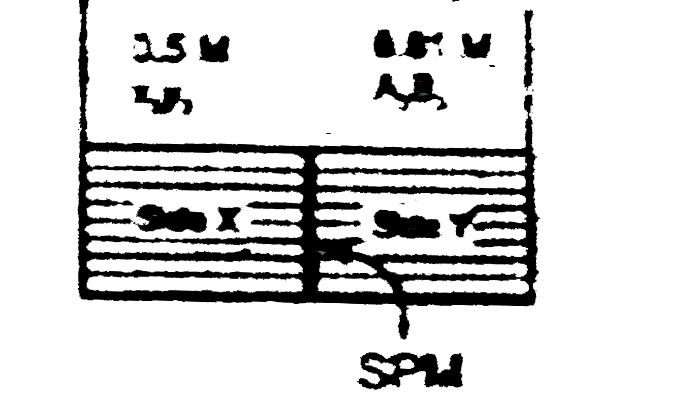
`X_(3)Y_(2)(i=5)` when reacted with `A_(2)B_(3)(i=5` in aqueous solution gives brown colour. These are separated by a semipermeable membrane `AB` as shown. Due to oxmosis there is `:`

a.brown colour formation in side X
b.brown colour formation in side Y
c.formation in both of the sides X and Y
d.no brown colour formation

A

brown colour formation in side X

B

brown colour formation in side Y

C

formation in both of the sides X and Y

D

no brown colour formation

Text Solution

Verified by Experts

The correct Answer is:

d
Promotional Banner

Topper's Solved these Questions

  • DILUTE SOLUTION

    NARENDRA AWASTHI ENGLISH|Exercise leval-02|26 Videos
  • DILUTE SOLUTION

    NARENDRA AWASTHI ENGLISH|Exercise leval-03|23 Videos
  • CHEMICAL EQUILIBRIUM

    NARENDRA AWASTHI ENGLISH|Exercise Match the column|1 Videos
  • ELECTROCHEMISTRY

    NARENDRA AWASTHI ENGLISH|Exercise Subjective problems|14 Videos

Similar Questions

Explore conceptually related problems

FeCI_(3) on reaction with K_(4)[Fe(CN)_(6)] in aqueous solution gives blue colour. These are separated by a semipermeable membrane AB as shown. Due to osmosis there is:

FeCI_(3) on reaction with K_(4)[Fe(CN)_(6)] in aqueous solution gives blue colour. These are separated by a semipermeable membrane AB as shown. Due to osmosis there is:

FeCl_(3) on reaction with K_(4)[Fe(CN)_(6)] in aqueous solution gives blue colour. These are separated by a semipermeable membrane AB as shown. Due to osmosis there is:

FeCl_(3) on reaction with K_(4)[Fe(CN)_(6)] in aqueous solution gives blue colour. These are separated by a semi-permeable membrane AB as shown. Due to osmosis, there is

Reddish brown colouration when neutral FeCl_(3) is added to the CH_(3)CO O^(Θ) aq solution is due to the formation of (a) ____.

An aqueous solution of inorganic compounds (X) gives following reactions. (i) With an aqueous solution of barium chloride a precipitate insoluble in dilute HCl is obtained. (ii) Addition of excess of Kl gives a brown precipitate which turns white on additon of excess of hyposolution. (iii) With an aqueous solution of K_(4)[Fe(CN)_(6)] , a brown coloured precipitate is obtained. Identity (X) and gives equation for the reaction for (i),(ii) and (iii) observations.

Statement-1: 3M solution of alkali metal in liquid ammonia has copper bronze colour. Statement-2: copper bronze colour is due to the formation of metal cluster.

A solution 'X' give orange colour when a drop of it falls on pH paper, while another solution 'Y' gives bluish colour when a drop of it falls on pH paper. What is the nature of both the solutoins? Determine the pH of solution 'X' and 'Y'?

Brown ppt ,of Mn(OH)_2 on boiling with PbO_(2) and cone HNO_(3) yields a pink colouration on dilution due to the formation of

(i)A black coloured compound (B) is formed on passing H_(2)S through the solution of a compound (A) in NH_(4)OH (ii) (B) on treatment with HCl and potassium chlorate or aquaregia gives (A) (iii) (A) on treatment with KCN gives a buff/reddish-brown coloured precipitate which dissolves in excess of this reagent forming a compound ( C) . (iv)The compound ( C) is changed into a compound (D) when its aqueous solution is boiled in air. (v)The solution of (A) was treated with excess of NaHCO_(3) & then with bromine water. On cooling & shaking for some time, a green colour of compound (E) is formed.No change is observed on heating. Identify (A) to (E) and give chemical equations.

NARENDRA AWASTHI ENGLISH-DILUTE SOLUTION-leval-03
  1. X(3)Y(2)(i=5) when reacted with A(2)B(3)(i=5 in aqueous solution gives...

    Text Solution

    |

  2. Lowering in vapour pressure is determined by Ostwald and Walker dynami...

    Text Solution

    |

  3. Lowering in vapour pressure is determined by Ostwald and Walker dynami...

    Text Solution

    |

  4. Lowering in vapour pressure is determined by Ostwald and Walker dynami...

    Text Solution

    |

  5. Lowering in vapour pressure is determined by Ostwald and Walker dynami...

    Text Solution

    |

  6. A dilute solution contains 'x' moles of solute A in 1 kg of solvent wi...

    Text Solution

    |

  7. A dilute solution contains 'x' moles of solute A in 1 kg of solvent wi...

    Text Solution

    |

  8. Which of the following statement(s) is/are correct, if intermolecular ...

    Text Solution

    |

  9. When non-volatile solute is added to a pure solvent, the:

    Text Solution

    |

  10. The total vapour pressure of a binary solution is gives by P = (100X(...

    Text Solution

    |

  11. Which of the following is correct for an ideal solution?

    Text Solution

    |

  12. Which of the following is correct for a non-ideal solution of liquids ...

    Text Solution

    |

  13. A binary solution of liquids A and B will show positive deviation from...

    Text Solution

    |

  14. Which of the following statement is/are correct about acetone and tric...

    Text Solution

    |

  15. The azeotropic solution of two miscible liquids:

    Text Solution

    |

  16. For exact determination of molecular mass through colligative properti...

    Text Solution

    |

  17. In the depression of freezing point experiment, it is found that the:

    Text Solution

    |

  18. The cryoscopic constant value depends upon:

    Text Solution

    |

  19. Consider 0.1 M solutions of two solutes X and Y. The solute X behaves...

    Text Solution

    |

  20. Consider following solutions: (I) I M glucose(aq) (II) 1 M so...

    Text Solution

    |

  21. Which of the following statement is (are) incorrect?

    Text Solution

    |
