Home
Class 11
CHEMISTRY
Which of the following represents correc...

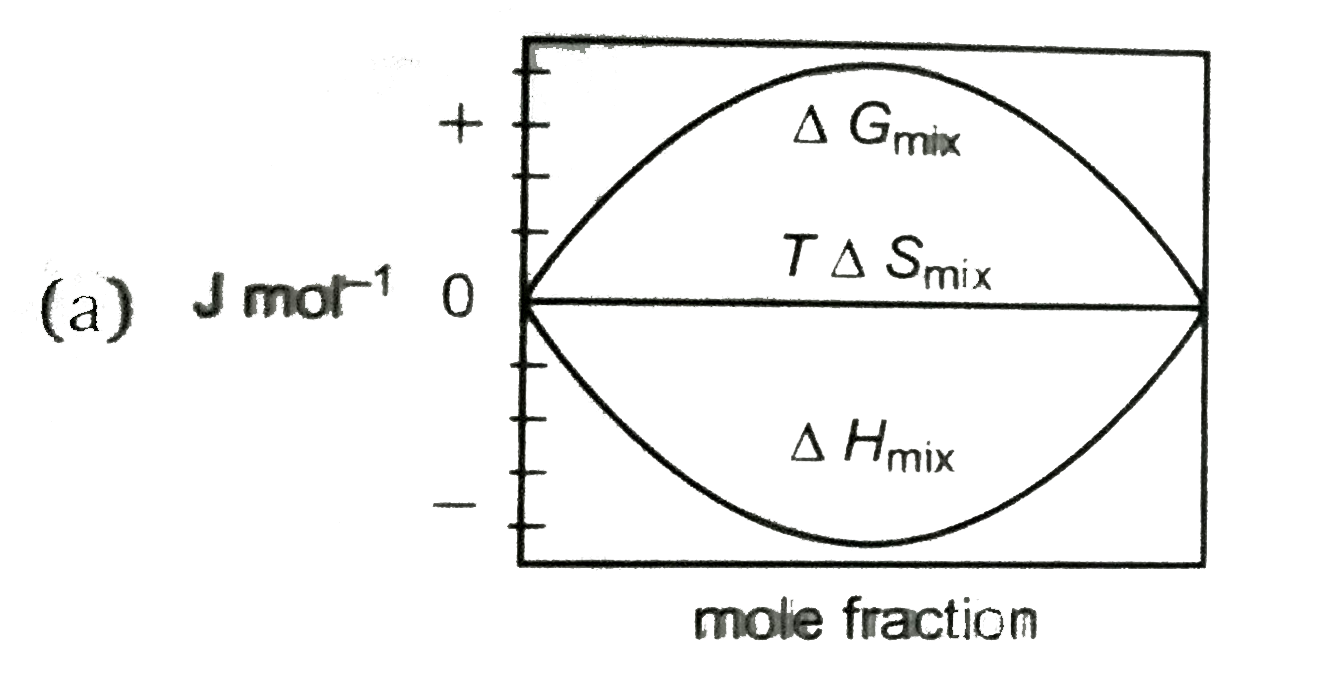
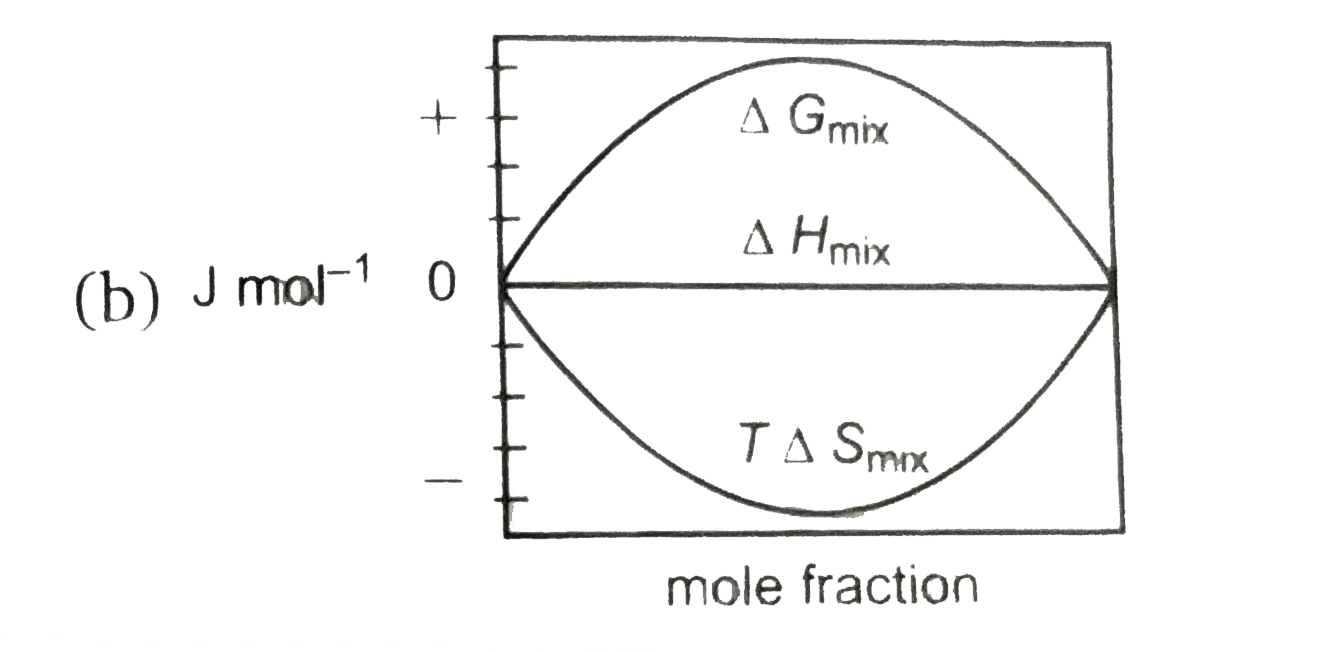
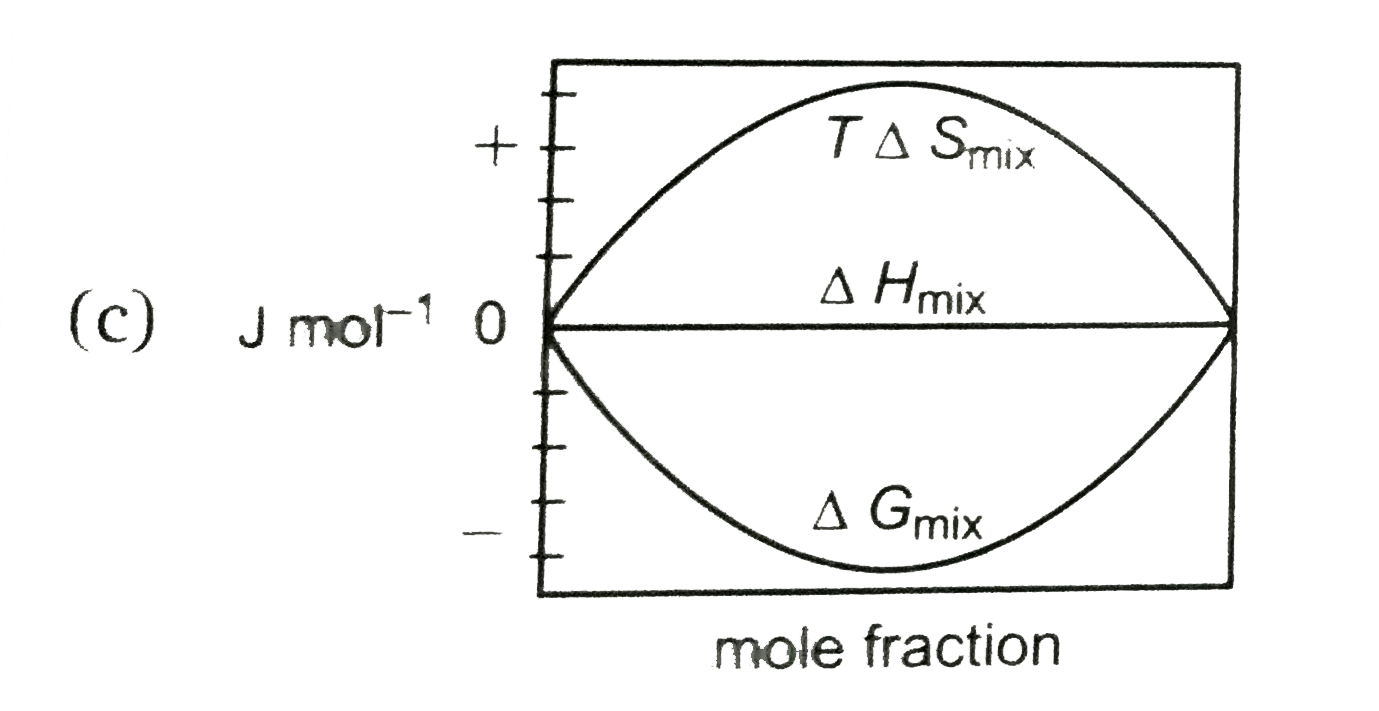
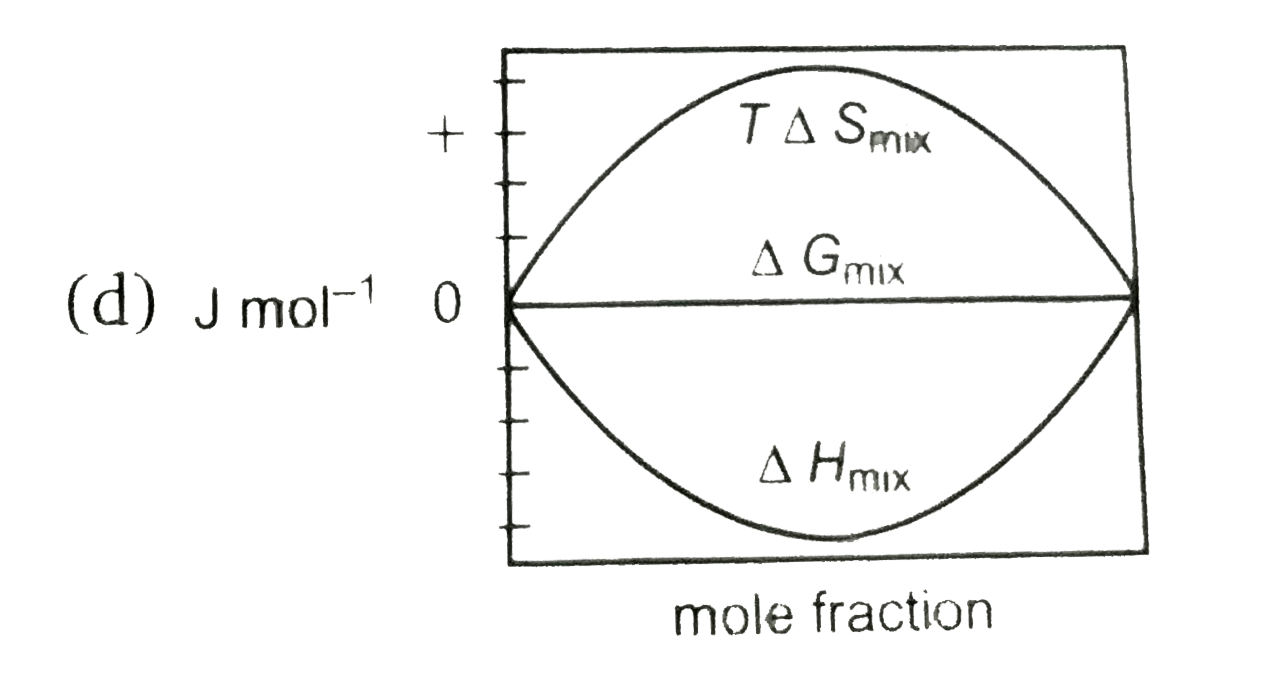
Which of the following represents correcty the changes in thermodynamic properties during the formation of 1 mole of an ideal binary solution :

A

B

C

D

Text Solution

AI Generated Solution

The correct Answer is:

To solve the question regarding the changes in thermodynamic properties during the formation of 1 mole of an ideal binary solution, we will analyze the changes in Gibbs free energy (ΔG), entropy (ΔS), and enthalpy (ΔH). ### Step-by-Step Solution: 1. **Understanding the Formation of an Ideal Solution**: - An ideal binary solution is formed when a solute and a solvent are mixed. In this case, we assume that the interactions between the solute and solvent are similar to the interactions between the solute-solute and solvent-solvent. 2. **Change in Gibbs Free Energy (ΔG)**: - The formation of a solution is generally a spontaneous process. For a spontaneous process, the change in Gibbs free energy (ΔG) is negative. - Therefore, we can conclude that: \[ \Delta G < 0 \] 3. **Change in Entropy (ΔS)**: - Entropy is a measure of randomness or disorder in a system. When a solute is dissolved in a solvent, the number of particles in the solution increases, leading to greater randomness. - Thus, the change in entropy (ΔS) is positive: \[ \Delta S > 0 \] 4. **Change in Enthalpy (ΔH)**: - For an ideal solution, it is assumed that there is no heat absorbed or released during the mixing process. This means that the change in enthalpy (ΔH) is zero: \[ \Delta H = 0 \] 5. **Summary of Thermodynamic Changes**: - Based on the analysis: - ΔG < 0 (negative) - ΔS > 0 (positive) - ΔH = 0 (zero) 6. **Identifying the Correct Option**: - Now, we need to find the option that correctly represents these changes. The correct representation should indicate that ΔG is negative, ΔS is positive, and ΔH is zero. ### Conclusion: The correct representation of the changes in thermodynamic properties during the formation of 1 mole of an ideal binary solution is: - ΔG < 0 - ΔS > 0 - ΔH = 0
Promotional Banner

Topper's Solved these Questions

  • DILUTE SOLUTION

    NARENDRA AWASTHI ENGLISH|Exercise leval-03|23 Videos
  • DILUTE SOLUTION

    NARENDRA AWASTHI ENGLISH|Exercise leval-03|23 Videos
  • CHEMICAL EQUILIBRIUM

    NARENDRA AWASTHI ENGLISH|Exercise Match the column|1 Videos
  • ELECTROCHEMISTRY

    NARENDRA AWASTHI ENGLISH|Exercise Subjective problems|14 Videos

Similar Questions

Explore conceptually related problems

Which of the following represent the correct sequence of indicated property ? .

Which of the following represents the correct order of the properties inidicated?

Which of the following expression represents, the first law of thermodynamics ?

Which of the following represents the incoorect order of the properties indicated?

Which of the following is correct for an ideal solution?

Which of the following does not represent the correct order of the properties indicated?

Which of the following does not represent the correct order of the properties indicated ?

Which of the following represents the incorrect order of properties ?

Which of the following plots represents an ideal binary mixture?

Which of the following does not represent ideal gas equation?

NARENDRA AWASTHI ENGLISH-DILUTE SOLUTION-leval-02
  1. An ideal solution contains two volatile liquids A(P^(@)=100 torr) and ...

    Text Solution

    |

  2. The vapoure pressure of two pure liquids A and B, that from an ideal s...

    Text Solution

    |

  3. Which of the following represents correcty the changes in thermodynami...

    Text Solution

    |

  4. A saturated solution of XCl(3) has a vapour pressure 17.20 mm Hg at 20...

    Text Solution

    |

  5. A certain non-volatile electrolyte contain 40% carbon, 6.7% hydrogen a...

    Text Solution

    |

  6. A 0.10 M solution of a mono protic acid (d=1.01g//cm^(3)) is 5% dissoc...

    Text Solution

    |

  7. An aqueous solution boils at 101^(@)C. What is the freezing point of t...

    Text Solution

    |

  8. An industrial waste water I found to contain 8.2% Na(3)PO(4) and 12% M...

    Text Solution

    |

  9. Ratio of (/\T(b))/(K(b)) of 10 g AB(2) and 14 g A(2)B per 100 g of sol...

    Text Solution

    |

  10. The freezing point of solution containing 0.2 g of acetic acid in 20.0...

    Text Solution

    |

  11. If the boiling point of an aqueous solution containing a non-volatile ...

    Text Solution

    |

  12. 100 g of C(6)H(12)O(6) (aq.) solution has vapour pressure is equal to ...

    Text Solution

    |

  13. 1.0 g of a monobassic acid HA in 100 g water lowers the freezing poin...

    Text Solution

    |

  14. 0.1 M KI and 0.2 M AgNO(3) are mixed in 3 : 1 volume ratio. The depres...

    Text Solution

    |

  15. If 0.1 M H(2)SO(4)(aq.) solution shows freezing point -0.3906^(@)C the...

    Text Solution

    |

  16. A living cell contains a solution which is isotonic with 0.2 M glucose...

    Text Solution

    |

  17. What is the osmotic pressure of 0.2 M HX (aq.) solution at 300 K ? (a...

    Text Solution

    |

  18. A solution contain 8 g of a carbohydrate in 100 g of water has a densi...

    Text Solution

    |

  19. Study the following figure and choose the correct options. Assuming co...

    Text Solution

    |

  20. The total vapour pressure of a 4 mole % solution of NH(3) in water at...

    Text Solution

    |
