Home
Class 11
CHEMISTRY
An ideal gas is taken around the cycle A...

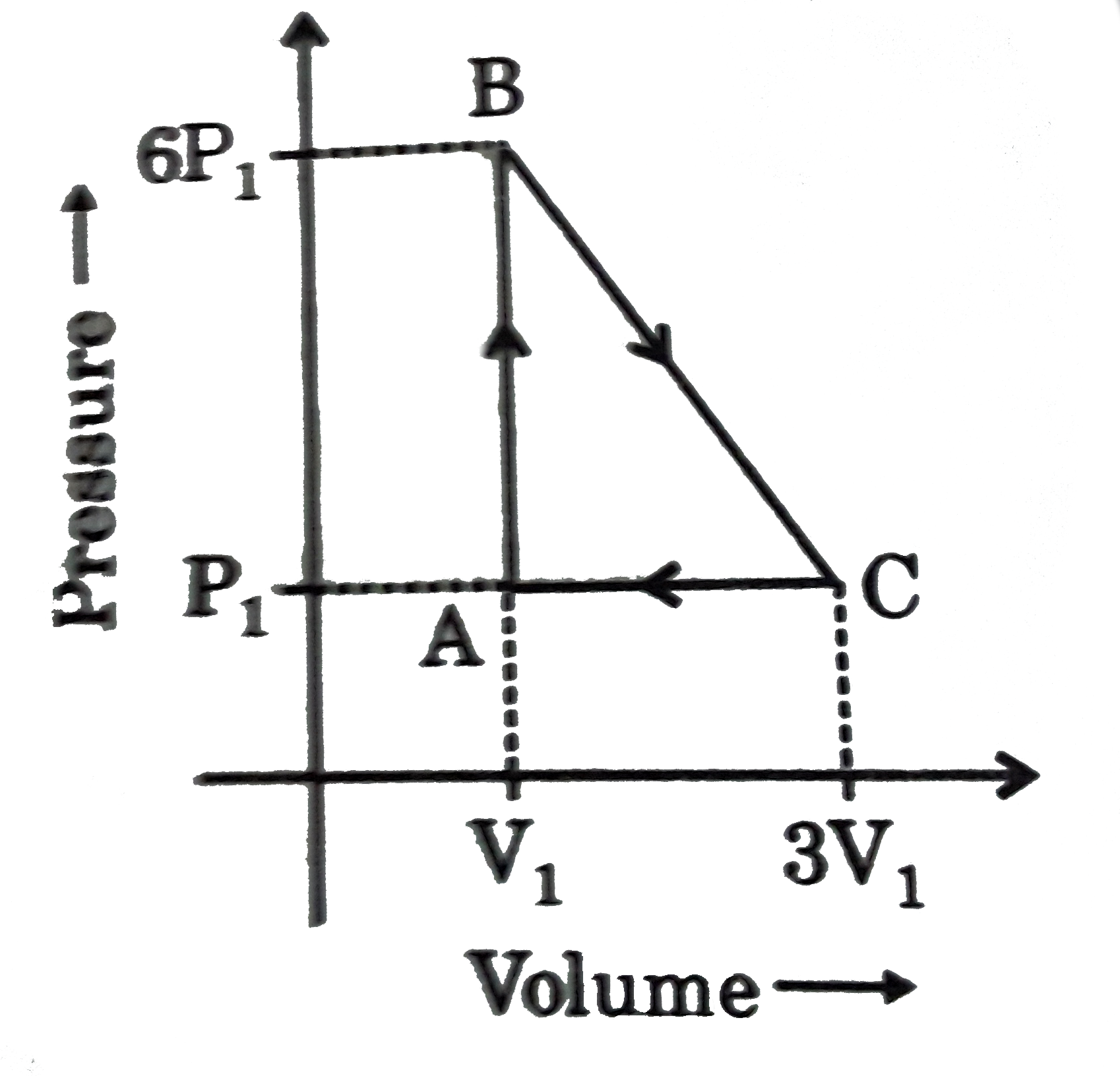
An ideal gas is taken around the cycle ABCA as shown in P-V diagram. The net work done by the gas during the cycle is equal to :

A

`12 P_(1)V_(1)`

B

`6P_(1)V_(1)`

C

`5P_(1)V_(1)`

D

`P_(1)V_(1)`

Text Solution

Verified by Experts

The correct Answer is:

C

Work done in the cyclic process = Area bounded (ABCA) `=5P_(1)V_(1)`
Promotional Banner

Topper's Solved these Questions

  • THERMODYNAMICS

    NARENDRA AWASTHI ENGLISH|Exercise Level 2|40 Videos
  • THERMODYNAMICS

    NARENDRA AWASTHI ENGLISH|Exercise Level 3|89 Videos
  • STOICHIOMETRY

    NARENDRA AWASTHI ENGLISH|Exercise Match the Colum-II|6 Videos

Similar Questions

Explore conceptually related problems

An ideal gas is taken around the cycle ABCA shown in P - V diagram. The net work done by the gas during the cycle is equal to

An ideal gas is taken around the cycle ABCA shown in P - V diagram. The net work done by the gas during the cycle is equal to

An ideal gas is taken around the cycle ABCA as shown in the P-V diagram. The total work done by the gas during the cycle is

An ideal gas is taken around the cycle ABCD shown in the P_V diagram below. The net work done by the gas during the cycle is equal to

An ideal monoatomic gas is taken round the cycle ABCDA as shown in the P-V diagram. The work done during the cycle is

An ideal monoatomic gas is taken round the cycle ABCDA as shown in the P-V diagram. The work done during the cycle is

An ideal monoatomic gas is taken round the cycle ABCDA as shown in the P-V diagram. The work done during the cycle is

One mole of a monatomic ideal gas is taken along the cycle ABCA as shown in the diagram. The net heat absorbed by the gas in the given cycle is

Two moles of helium gas are taken over the cycle ABCDA, as shown in the P-T diagram The net work done on the gas in the cycle ABCDA is :

Two moles of helium gas are taken over the cycle ABCDA, as shown in the P-T diagram The net work done on the gas in the cycle ABCDA is :

NARENDRA AWASTHI ENGLISH-THERMODYNAMICS-Level 3
  1. An ideal gas is taken around the cycle ABCA as shown in P-V diagram. T...

    Text Solution

    |

  2. The first law of thermodynamics for a closed system is dU = dq + dw, w...

    Text Solution

    |

  3. The first law of thermodynamics for a closed system is dU = dq + dw, w...

    Text Solution

    |

  4. If the boundary of system moves by an infinitesimal amount, the work i...

    Text Solution

    |

  5. If the boundary of system moves by an infinitesimal amount, the work i...

    Text Solution

    |

  6. If the boundary of system moves by an infinitesimal amount, the work i...

    Text Solution

    |

  7. If the boundary of system moves by an infinitesimal amount, the work i...

    Text Solution

    |

  8. Standard Gibb's energy of reaction (Delta(r )G^(@)) at a certain temp...

    Text Solution

    |

  9. Standard Gibb's energy of reaction (Delta(r )G^(@)) at a certain temp...

    Text Solution

    |

  10. Standard Gibb's energy of reaction (Delta(r )G^(@)) at a certain temp...

    Text Solution

    |

  11. Standard Gibb's energy of reaction (Delta(r )G^(@)) at a certain temp...

    Text Solution

    |

  12. Consider the following reaction : CO(g)+2H(2)(g)iffCH(3)OH(g) Give...

    Text Solution

    |

  13. Enthalpy of neutralization is defined as the enthalpy change when 1 mo...

    Text Solution

    |

  14. Enthalpy of neutralzation is defined as the enthalpy change when 1 mol...

    Text Solution

    |

  15. Enthalpy of neutralzation is defined as the enthalpy change when 1 mol...

    Text Solution

    |

  16. Gibbs Helmholtz equation relates the enthalpy, entropy and free energy...

    Text Solution

    |

  17. Gibbs Helmholtz equation relates the enthalpy, entropy and free energy...

    Text Solution

    |

  18. Gibbs Helmholtz equation relates the enthalpy, entropy and free energy...

    Text Solution

    |

  19. Identify the intensive quantities from the following : (a)Enthalpy ...

    Text Solution

    |

  20. Identify the extensive quantities from the following :

    Text Solution

    |

  21. Identify the state functions from the following :

    Text Solution

    |
