
Home
Class 11
CHEMISTRY
If liquefied oxygen at 1 atmospheric pre...

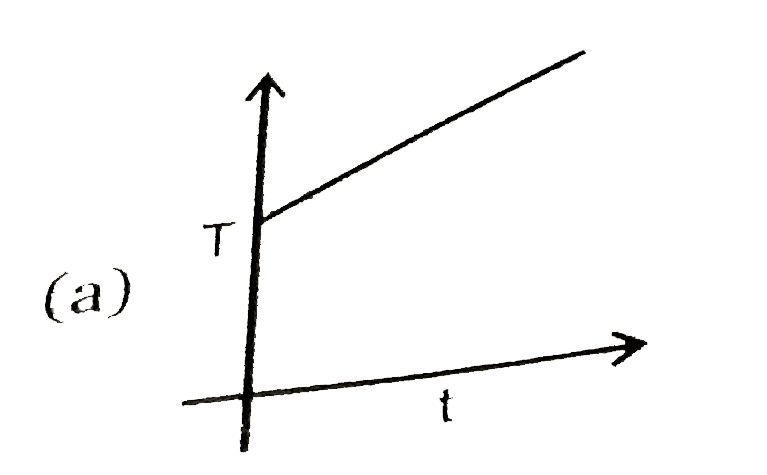
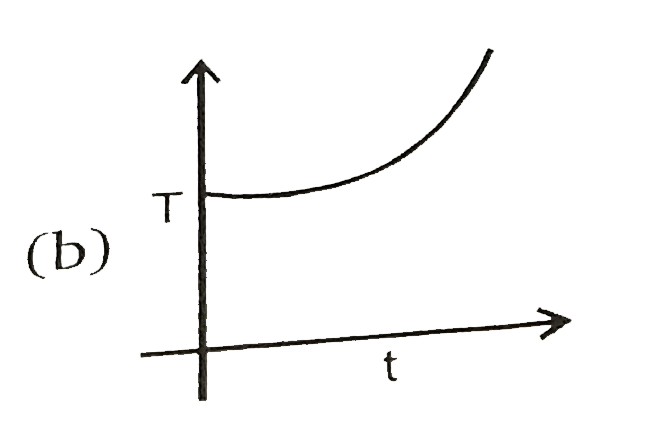
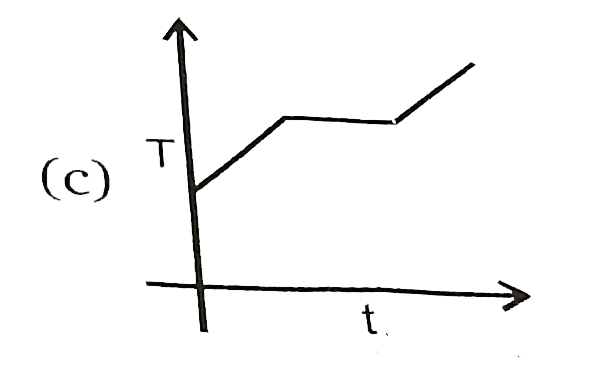
If liquefied oxygen at 1 atmospheric pressure is heated from 50K to 300k by supplying heat at constant rate. The graph of temperature vs time will be

A

B

C

D

Text Solution

AI Generated Solution

The correct Answer is:

To solve the problem of how the temperature of liquefied oxygen changes over time when heated at a constant rate from 50 K to 300 K, we can break it down into several steps: ### Step-by-Step Solution: 1. **Identify the Initial and Final States**: - The initial temperature of liquefied oxygen is 50 K. - The final temperature is 300 K. 2. **Determine the Boiling Point of Oxygen**: - The boiling point of oxygen is approximately 90 K. This is a crucial point where the state of the substance will change from liquid to gas. 3. **Heating the Liquid Oxygen**: - As the oxygen is heated from 50 K to 90 K, the temperature will increase steadily. This portion of the graph will be a straight line as the temperature rises with time. 4. **Phase Change at the Boiling Point**: - At 90 K, the oxygen will start to boil. During the phase change from liquid to gas, the temperature will remain constant at 90 K until all the liquid has converted to gas. This will be represented as a horizontal line on the graph (time will continue to pass, but temperature will not change). 5. **Heating the Gaseous Oxygen**: - After the phase change is complete, the temperature of the gaseous oxygen will begin to increase again. This will continue until it reaches 300 K. This portion of the graph will again be a straight line, indicating a steady increase in temperature with time. 6. **Graphing Temperature vs. Time**: - The graph will consist of three distinct sections: - A rising line from 50 K to 90 K (liquid phase). - A horizontal line at 90 K (phase change). - Another rising line from 90 K to 300 K (gas phase). ### Final Graph Description: - The y-axis represents temperature, and the x-axis represents time. - The graph starts at 50 K, rises to 90 K, remains flat at 90 K during the phase change, and then rises again to 300 K. ### Conclusion: The correct graph for the temperature versus time will have a linear increase from 50 K to 90 K, a flat line at 90 K, and another linear increase from 90 K to 300 K.

To solve the problem of how the temperature of liquefied oxygen changes over time when heated at a constant rate from 50 K to 300 K, we can break it down into several steps: ### Step-by-Step Solution: 1. **Identify the Initial and Final States**: - The initial temperature of liquefied oxygen is 50 K. - The final temperature is 300 K. ...
Promotional Banner

Topper's Solved these Questions

  • THERMODYNAMICS

    NARENDRA AWASTHI ENGLISH|Exercise Level 2|40 Videos
  • THERMODYNAMICS

    NARENDRA AWASTHI ENGLISH|Exercise Level 3|89 Videos
  • STOICHIOMETRY

    NARENDRA AWASTHI ENGLISH|Exercise Match the Colum-II|6 Videos

Similar Questions

Explore conceptually related problems

In the above problem if heat is supplied at a constant rate of q= 10 cal//min , then plot temperature versus time graph.

The temperature of 20 litres of nitrogen was increased from 100 K to 300 K at a constant pressure. Change in volume will be

The rate of a certain reaction increases by 2.3 times when the temperature is raised form 300K to 310 K . If k is the rate constant at 300K, then the rate constant at 310 K will be equal to

An ideal gas is heated by 160J at constant pressure, its temperature rises by 50^@ and if 240J of heat is supplied at constant volume, temperature rises by 100^@C , then its degree of freedom should be

Liquid oxygen at 50 K is heated to 300 K at constant pressure of 1 atm . The rate of heating is constant. Which of the following graphs represents the variation of temperature with time?

One mole of an ideal monoatomic gas requires 207 J heat to raise the temperature by 10 K when heated at constant pressure. If the same gas is heated at constant volume to raise the temperature by the same 10 K, the heat required is [Given the gas constant R = 8.3 J/ mol. K]

If the temperature of a black body is raised from 300K to 600K by what factor the rate of emission shall increase ?

A gas is heated at a constant pressure. The fraction of heat supplied used of external work is

When 1 mole gas is heated at constant volume, temperature is raised from 298 to 308 K. Heat supplied to the gas in 500 J. Then, which statement is correct ?

When a certain amount of heat is supplied to a diatomic gas at constant volume, rise in temperature is T_(0) . When same heat is supplied to the gas at constant pressure, find the rise in temperature

NARENDRA AWASTHI ENGLISH-THERMODYNAMICS-Level 3
  1. If liquefied oxygen at 1 atmospheric pressure is heated from 50K to 30...

    Text Solution

    |

  2. The first law of thermodynamics for a closed system is dU = dq + dw, w...

    Text Solution

    |

  3. The first law of thermodynamics for a closed system is dU = dq + dw, w...

    Text Solution

    |

  4. If the boundary of system moves by an infinitesimal amount, the work i...

    Text Solution

    |

  5. If the boundary of system moves by an infinitesimal amount, the work i...

    Text Solution

    |

  6. If the boundary of system moves by an infinitesimal amount, the work i...

    Text Solution

    |

  7. If the boundary of system moves by an infinitesimal amount, the work i...

    Text Solution

    |

  8. Standard Gibb's energy of reaction (Delta(r )G^(@)) at a certain temp...

    Text Solution

    |

  9. Standard Gibb's energy of reaction (Delta(r )G^(@)) at a certain temp...

    Text Solution

    |

  10. Standard Gibb's energy of reaction (Delta(r )G^(@)) at a certain temp...

    Text Solution

    |

  11. Standard Gibb's energy of reaction (Delta(r )G^(@)) at a certain temp...

    Text Solution

    |

  12. Consider the following reaction : CO(g)+2H(2)(g)iffCH(3)OH(g) Give...

    Text Solution

    |

  13. Enthalpy of neutralization is defined as the enthalpy change when 1 mo...

    Text Solution

    |

  14. Enthalpy of neutralzation is defined as the enthalpy change when 1 mol...

    Text Solution

    |

  15. Enthalpy of neutralzation is defined as the enthalpy change when 1 mol...

    Text Solution

    |

  16. Gibbs Helmholtz equation relates the enthalpy, entropy and free energy...

    Text Solution

    |

  17. Gibbs Helmholtz equation relates the enthalpy, entropy and free energy...

    Text Solution

    |

  18. Gibbs Helmholtz equation relates the enthalpy, entropy and free energy...

    Text Solution

    |

  19. Identify the intensive quantities from the following : (a)Enthalpy ...

    Text Solution

    |

  20. Identify the extensive quantities from the following :

    Text Solution

    |

  21. Identify the state functions from the following :

    Text Solution

    |
