Home
Class 11
CHEMISTRY
For a closed container containing 100 mo...

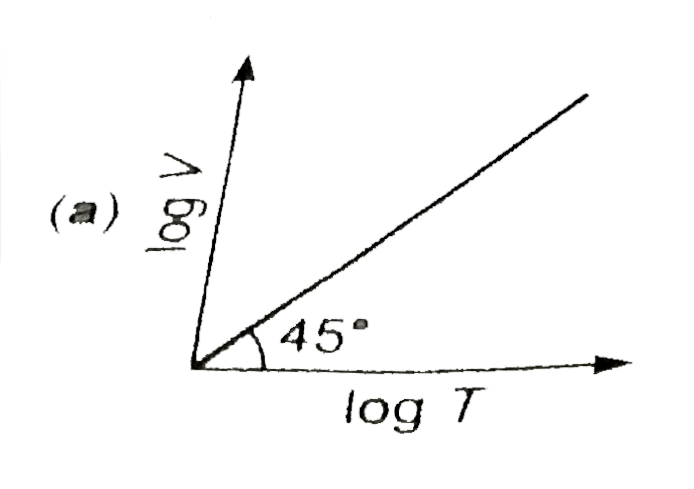
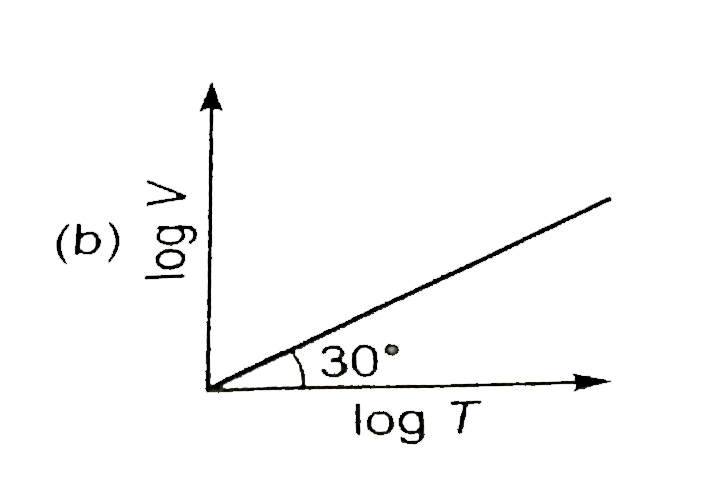
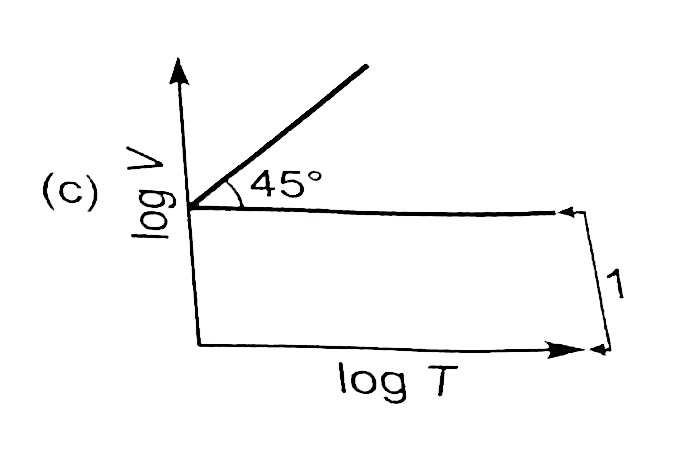
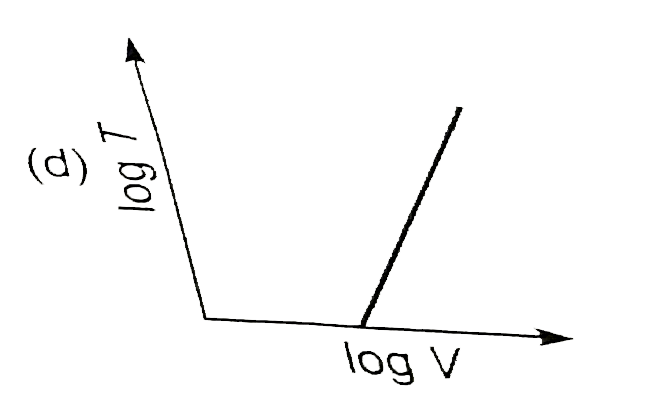
For a closed container containing `100` mol of an ideal gas fitted with movable, frictionless, weightless piston operating such that pressure of gas remain constant at `8.21` atm, which graph repsents correct variation of log `V v//s` log `T` where `V` is in litre and `T` is in Kelvin ? `(R = 0.0821 (atmL)/(molK))`

A

B

C

D

Text Solution

AI Generated Solution

The correct Answer is:

To solve the problem, we need to analyze the relationship between the volume (V) and temperature (T) of an ideal gas under constant pressure conditions. We will use the ideal gas law and logarithmic properties to derive the relationship. ### Step-by-Step Solution: 1. **Identify the Given Values:** - Number of moles (n) = 100 mol - Pressure (P) = 8.21 atm - Gas constant (R) = 0.0821 (atm·L)/(mol·K) 2. **Use the Ideal Gas Law:** The ideal gas law is given by: \[ PV = nRT \] Rearranging this equation for volume (V): \[ V = \frac{nRT}{P} \] 3. **Substituting the Known Values:** Substitute the known values into the equation: \[ V = \frac{100 \, \text{mol} \times 0.0821 \, \frac{\text{atm·L}}{\text{mol·K}} \times T}{8.21 \, \text{atm}} \] Simplifying this gives: \[ V = \frac{100 \times 0.0821 \times T}{8.21} \] 4. **Calculate the Constant:** Calculate the constant factor: \[ V = \frac{8.21}{8.21} \times 100 \times 0.0821 \times T = 100 \times 0.010 \times T = 0.821 \times T \] 5. **Taking Logarithm:** Now, take the logarithm of both sides: \[ \log V = \log(0.821 \times T) \] Using the logarithmic property \(\log(ab) = \log a + \log b\): \[ \log V = \log 0.821 + \log T \] 6. **Rearranging the Equation:** Rearranging gives: \[ \log V = \log T + \log 0.821 \] This indicates a linear relationship between \(\log V\) and \(\log T\). 7. **Graph Interpretation:** The graph of \(\log V\) vs. \(\log T\) will be a straight line with a slope of 1, indicating that as temperature increases, volume also increases at a constant pressure. ### Conclusion: The correct graph representing the variation of \(\log V\) vs. \(\log T\) is a straight line with a positive slope.

To solve the problem, we need to analyze the relationship between the volume (V) and temperature (T) of an ideal gas under constant pressure conditions. We will use the ideal gas law and logarithmic properties to derive the relationship. ### Step-by-Step Solution: 1. **Identify the Given Values:** - Number of moles (n) = 100 mol - Pressure (P) = 8.21 atm - Gas constant (R) = 0.0821 (atm·L)/(mol·K) ...
Promotional Banner

Topper's Solved these Questions

  • THERMODYNAMICS

    NARENDRA AWASTHI ENGLISH|Exercise Level 2|40 Videos
  • THERMODYNAMICS

    NARENDRA AWASTHI ENGLISH|Exercise Level 3|89 Videos
  • STOICHIOMETRY

    NARENDRA AWASTHI ENGLISH|Exercise Match the Colum-II|6 Videos

Similar Questions

Explore conceptually related problems

Ten moles of an ideal gas are filled in a closed vessel. The vessel has cylinder and piston type arrangement and pressure of the gas remains constant at 0.821 atm. Which of the following graph represents correct variation of log V vs log T? (V = Volume in litre and T = temperature in Kelvin)

For a closed container containing 10 moles of an ideal gas, at constant pressure of 0.82 atm, which graph correctly represent, variation of log V us log T where volume is in litre and temp. in kelvin :

3 moles of an ideal gas are contained within a cylinder by a frictionless piston and are initially at temperature T . The pressure of the gas remains constant while it is heated and its volume doubles . If R is molar gas constant , the work done by the gas in increasing its volume is

In a closed rigid container an ideal gas is filled. If the gas is heated, the graph of pressure (P) v/s root mean square speed (rms) will be :

V vs T curves at constant pressure P_(1) and P_(2) for an ideal gas are shown below Which is correct ?

Two moles of an ideal gas is contained in a cylinder fitted with a frictionless movable piston, exposed to the atmosphere, at an initial temperature T_(0) . The gas is slowly heated so that its volume becomes four times the initial value. The work done by gas is

V vs T curves at constant pressure P_1 and P_2 for an ideal gas are shown in the figure. Which of the following is correct?

A vertical thermally insulated cylinder of volume V contain n moles of an ideal monoatomic gas under a weightless piston. A load of weight W is placed on the piston as a result of which the piston is displaced. If the initial temp of the gas is 300K , area of piston is A and atmospheric pressure P_(0) . (take W=P_(0)A ). Determine the value of final temperature of the gas

The slope of 'P' v/s "T" plot at constant volume for a fixed amount of an ideal gas aus 0.01 atm//K . Then what will be the value of pressure of gas ("In atm") at 300 K temperature ?

One mole of an ideal gas undergoes a process in which T = T_(0) + aV^(3) , where T_(0) and a are positive constants and V is molar volume. The volume for which pressure with be minimum is

NARENDRA AWASTHI ENGLISH-THERMODYNAMICS-Level 3
  1. For a closed container containing 100 mol of an ideal gas fitted with ...

    Text Solution

    |

  2. The first law of thermodynamics for a closed system is dU = dq + dw, w...

    Text Solution

    |

  3. The first law of thermodynamics for a closed system is dU = dq + dw, w...

    Text Solution

    |

  4. If the boundary of system moves by an infinitesimal amount, the work i...

    Text Solution

    |

  5. If the boundary of system moves by an infinitesimal amount, the work i...

    Text Solution

    |

  6. If the boundary of system moves by an infinitesimal amount, the work i...

    Text Solution

    |

  7. If the boundary of system moves by an infinitesimal amount, the work i...

    Text Solution

    |

  8. Standard Gibb's energy of reaction (Delta(r )G^(@)) at a certain temp...

    Text Solution

    |

  9. Standard Gibb's energy of reaction (Delta(r )G^(@)) at a certain temp...

    Text Solution

    |

  10. Standard Gibb's energy of reaction (Delta(r )G^(@)) at a certain temp...

    Text Solution

    |

  11. Standard Gibb's energy of reaction (Delta(r )G^(@)) at a certain temp...

    Text Solution

    |

  12. Consider the following reaction : CO(g)+2H(2)(g)iffCH(3)OH(g) Give...

    Text Solution

    |

  13. Enthalpy of neutralization is defined as the enthalpy change when 1 mo...

    Text Solution

    |

  14. Enthalpy of neutralzation is defined as the enthalpy change when 1 mol...

    Text Solution

    |

  15. Enthalpy of neutralzation is defined as the enthalpy change when 1 mol...

    Text Solution

    |

  16. Gibbs Helmholtz equation relates the enthalpy, entropy and free energy...

    Text Solution

    |

  17. Gibbs Helmholtz equation relates the enthalpy, entropy and free energy...

    Text Solution

    |

  18. Gibbs Helmholtz equation relates the enthalpy, entropy and free energy...

    Text Solution

    |

  19. Identify the intensive quantities from the following : (a)Enthalpy ...

    Text Solution

    |

  20. Identify the extensive quantities from the following :

    Text Solution

    |

  21. Identify the state functions from the following :

    Text Solution

    |
