Home
Class 11
CHEMISTRY
P-V plot for two gases (assuming ideal) ...

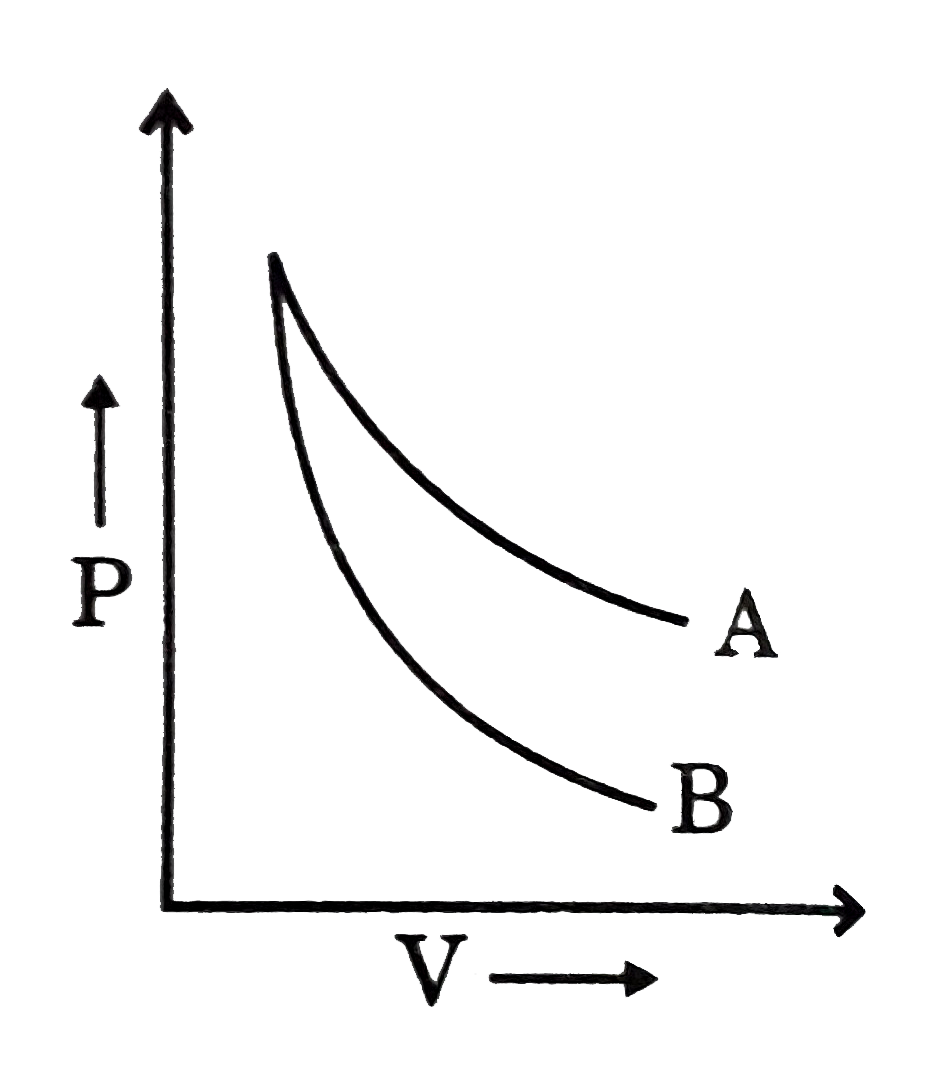
P-V plot for two gases (assuming ideal) during adiabatic processes are given in the figure. Plot A and plot B should correspond respectively to :

A

He and `H_(2)`

B

`H_(2)` and He

C

He and Ne

D

`H_(2)` and `Cl_(2)`

Text Solution

Verified by Experts

The correct Answer is:

B

PV = constant for isothermal process `PV^(gamma)` = constant for adiabatic process so more is the value of `gamma`, more is decrease in pressure.
Promotional Banner

Topper's Solved these Questions

  • THERMODYNAMICS

    NARENDRA AWASTHI ENGLISH|Exercise Level 2|40 Videos
  • THERMODYNAMICS

    NARENDRA AWASTHI ENGLISH|Exercise Level 3|89 Videos
  • STOICHIOMETRY

    NARENDRA AWASTHI ENGLISH|Exercise Match the Colum-II|6 Videos

Similar Questions

Explore conceptually related problems

P-V plots for two gases during an adiabatic process are given in the figure: Plot A and plot B should correspond to :

P.V plots for two gases during adiabatic processes are shown in the figure Plots 1 and 2 should correspond respectively to

p-V plots for two gases during adiabatic processes are shown in the figure. Plots 1 and 2 should correspond respectively to

P-V plots for two gases during adiabatic processes are shown in the figure. Plots 1 and 2 should corresponds respectively to

The pressure-volume of varies thermodynamic process is shown in graphs: Work is the mole of transference of energy. It has been observed that reversible work done by the system is the maximum obtainable work. w_(rev) gt w_(irr) The works of isothermal and adiabatic processes are different from each other. w_("isothermal reversible") = 2.303 nRT log_(10) ((V_(2))/(V_(1))) = 2.303 nRT log_(10)((P_(2))/(P_(1))) w_("adiabatic reversible") = C_(V) (T_(1)-T_(2)) P-V plots for two gases during adiabatic processes are given in the given figure: Plot D and Plot C should correspond to

P-V plots for two gases during adiabatic processes are shown in Fig. 15.9.6. Plot 1 and 2 should correspond respectively to

P-V plots for two gases during adiabatic expansion are shown in figure. Plot I and II should correspond respectively to :

P-V plots for three gases (assuming ideal behaviour and similar condition) for reversible adiabatic compression are given in the figure below : Plots X,Y and Z should correspond to respectively :

P-V plts for the gases ( assuming ideal behaviour and similar condition ) for reversible adiabatic compression are given in the figure below : Plots X,Y and Z should correspond to respectively :

The work done by 1 mole of ideal gas during an adiabatic process is (are ) given by :

NARENDRA AWASTHI ENGLISH-THERMODYNAMICS-Level 3
  1. P-V plot for two gases (assuming ideal) during adiabatic processes are...

    Text Solution

    |

  2. The first law of thermodynamics for a closed system is dU = dq + dw, w...

    Text Solution

    |

  3. The first law of thermodynamics for a closed system is dU = dq + dw, w...

    Text Solution

    |

  4. If the boundary of system moves by an infinitesimal amount, the work i...

    Text Solution

    |

  5. If the boundary of system moves by an infinitesimal amount, the work i...

    Text Solution

    |

  6. If the boundary of system moves by an infinitesimal amount, the work i...

    Text Solution

    |

  7. If the boundary of system moves by an infinitesimal amount, the work i...

    Text Solution

    |

  8. Standard Gibb's energy of reaction (Delta(r )G^(@)) at a certain temp...

    Text Solution

    |

  9. Standard Gibb's energy of reaction (Delta(r )G^(@)) at a certain temp...

    Text Solution

    |

  10. Standard Gibb's energy of reaction (Delta(r )G^(@)) at a certain temp...

    Text Solution

    |

  11. Standard Gibb's energy of reaction (Delta(r )G^(@)) at a certain temp...

    Text Solution

    |

  12. Consider the following reaction : CO(g)+2H(2)(g)iffCH(3)OH(g) Give...

    Text Solution

    |

  13. Enthalpy of neutralization is defined as the enthalpy change when 1 mo...

    Text Solution

    |

  14. Enthalpy of neutralzation is defined as the enthalpy change when 1 mol...

    Text Solution

    |

  15. Enthalpy of neutralzation is defined as the enthalpy change when 1 mol...

    Text Solution

    |

  16. Gibbs Helmholtz equation relates the enthalpy, entropy and free energy...

    Text Solution

    |

  17. Gibbs Helmholtz equation relates the enthalpy, entropy and free energy...

    Text Solution

    |

  18. Gibbs Helmholtz equation relates the enthalpy, entropy and free energy...

    Text Solution

    |

  19. Identify the intensive quantities from the following : (a)Enthalpy ...

    Text Solution

    |

  20. Identify the extensive quantities from the following :

    Text Solution

    |

  21. Identify the state functions from the following :

    Text Solution

    |
