Home
Class 11
CHEMISTRY
The efficiency of an ideal gas with adia...

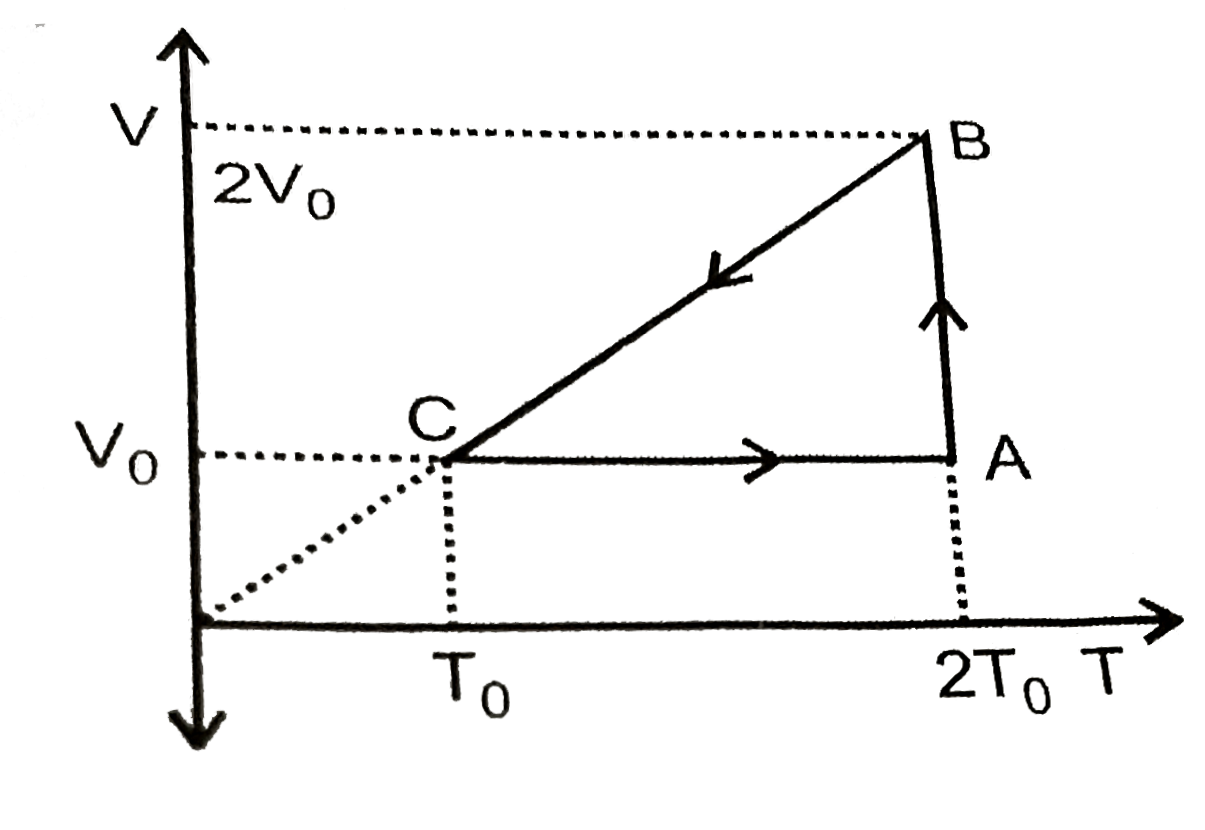
The efficiency of an ideal gas with adiabatic exponent `'gamma'` for the shown cyclic process would be

A

`((gamma-1)("2 ln 2"-1))/(1+(gamma-1)"2 ln 2")`

B

`((gamma-1)(1-"2 ln 2"))/((gamma-1)"2 ln 2"-1)`

C

`(("2 ln 2"+1)(gamma-1))/((gamma-1)"2 ln 2"+1)`

D

`(("2 ln 2"-1))/(gamma//(gamma-1))`

Text Solution

Verified by Experts

The correct Answer is:
A


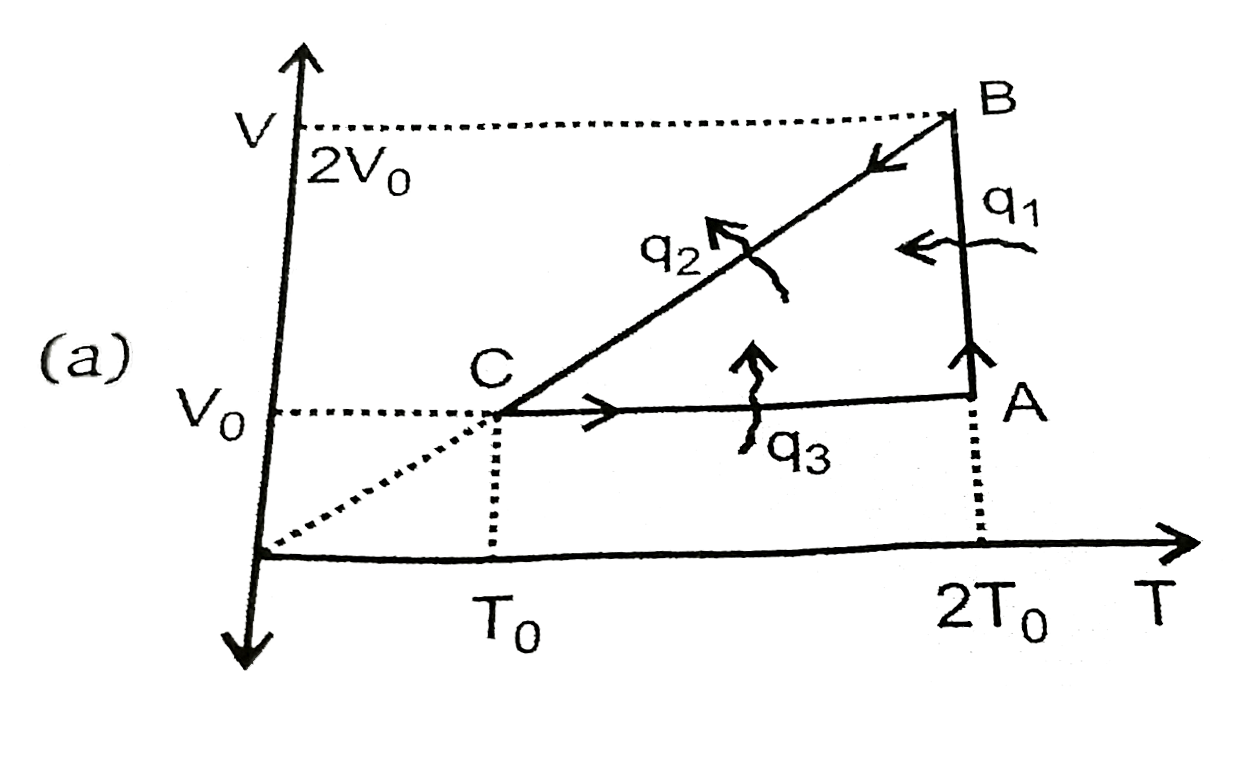
AB process
`0=q_(1)+w_(1)`
`=q_(1)-nR(2T_(0))ln2`
BC process `DeltaU_(2)=q_(2)+w_(2)`
`(nR)/((gamma-1))(T_(0)-2T_(0))=q_(2)-((nRT_(0))/(V_(0))).(V_(0)-2V_(0))`
CA process
`DeltaU_(3)=q_(3)+w_(3)`
`(nR)/((gamma-1))(2T_(0)-T_(0))=q_(3)+0`
`" Efficiency "= ("Total work done")/("Total heat absorbed")=(w_(1)+w_(2))/(q_(1)+q_(3))`
`=((-2RT_(0)ln2)+(nRT_(0)))/((2RT_(0)ln2)+((nRT_(0))/(gamma-1)))`
Promotional Banner

Topper's Solved these Questions

  • THERMODYNAMICS

    NARENDRA AWASTHI ENGLISH|Exercise Level 3|89 Videos
  • THERMODYNAMICS

    NARENDRA AWASTHI ENGLISH|Exercise Level 3|89 Videos
  • STOICHIOMETRY

    NARENDRA AWASTHI ENGLISH|Exercise Match the Colum-II|6 Videos

Similar Questions

Explore conceptually related problems

Find the molar heat capacity of an ideal gas with adiabatic exponent gamma for the polytorpic process PV^(n)= Constant.

The volume of one mode of an ideal gas with adiabatic exponent gamma is varied according to the law V = a//T , where a is constant . Find the amount of heat obtained by the gas in this process, if the temperature is increased by Delta T .

The volume of one mode of an ideal gas with adiabatic exponent gamma is varied according to the law V = a//T , where a is constant . Find the amount of heat obtained by the gas in this process, if the temperature is increased by Delta T .

Adiabatic exponent of a gas is equal to

One mole of an ideal gas whose adiabatic exponent is gamma = 4/3 undergoes a process P = 200 + 1/V . Then change in internal energy of gas when volume changes from 2 m^2 to 4 m^3 is:

An ideal gas with adiabatic exponent gamma is heated isochorically. If it absorbs Q amount heat then, fraction of heat absorbed in increasing the internal energy is

An ideal gas is expended adiabatically then

An ideal gas with adiabatic exponent ( gamma=1.5 ) undergoes a process in which work done by the gas is same as increase in internal energy of the gas. Here R is gas constant. The molar heat capacity C of gas for the process is:

An ideal gas with adiabatic exponent gamma is heated at constant pressure. It absorbs Q amount of heat. Fraction of heat absorbed in increasing the temperature is

An ideal gas with adiabatic exponent gamma = 4/3 undergoes a process in which internal energy is related to volume as U = V^2 . Then molar heat capacity of the gas for the process is :

NARENDRA AWASTHI ENGLISH-THERMODYNAMICS-Level 2
  1. Calculate Delta(r)G^(@) for (NH(4)Cl,s) at 310K. Given :Delta(r)H^(@...

    Text Solution

    |

  2. Using listed informations, calculate Delta(r)G^(@) (in kJ/mol) at 27^(...

    Text Solution

    |

  3. Fixed mass of an ideal gas collected in a 24.64 litre sealed rigid ves...

    Text Solution

    |

  4. The molar heat capacities at constant pressure (assumed constant with ...

    Text Solution

    |

  5. Determine Delta U^(@) at 300K for the following reaction using the li...

    Text Solution

    |

  6. Calculate Delta(f)H^(@) (in kJ/mol) for Cr(2)O(3) from the Delta(r)G^(...

    Text Solution

    |

  7. Calculate the heat produced (in kJ) when 224 gm of CaO is completely c...

    Text Solution

    |

  8. When 1.0 g of oxalic acid (H(2)C(2)O(4)) is burnt in a bomb calorimete...

    Text Solution

    |

  9. Enthalpy of neutralization of H(3)PO(3) "with " NaOH " is" -106.68 "kJ...

    Text Solution

    |

  10. The enthalpy of neutralization of a Weak monoprotic acid (HA) in 1 M s...

    Text Solution

    |

  11. Determine C-C and C-H bond enthalpy (in kJ//mol) Given : Delta(f)H^(...

    Text Solution

    |

  12. Consider the following data : Delta(f)H^(@)(N(2)H(4),l)=50kJ//mol,Delt...

    Text Solution

    |

  13. What is the bond enthalpy of Xe-F bond ? XeF(4)(g)rarrXe^(+)(g)+F^(-...

    Text Solution

    |

  14. If enthaopy of hydrogenation of C(6)H(6)(l) into C(6)H(12)(l) is -205k...

    Text Solution

    |

  15. The enthalpy of combustion of propance (C(3)H(8)) gas in temes of give...

    Text Solution

    |

  16. The efficiency of an ideal gas with adiabatic exponent 'gamma' for the...

    Text Solution

    |

  17. Initially one mole of ideal gas (C(v)=(5)/(2)R) at 0.1 atm and 300 K i...

    Text Solution

    |

  18. What is the enthalpy of neutralization of HF against a strong base? ...

    Text Solution

    |

  19. The molar heat capacities of Iodine vapour and solid are 7.8 and 14 ca...

    Text Solution

    |

  20. For the reaction taking place at certain temperature NH(2)COONH(4)(s)h...

    Text Solution

    |

