Home
Class 11
CHEMISTRY
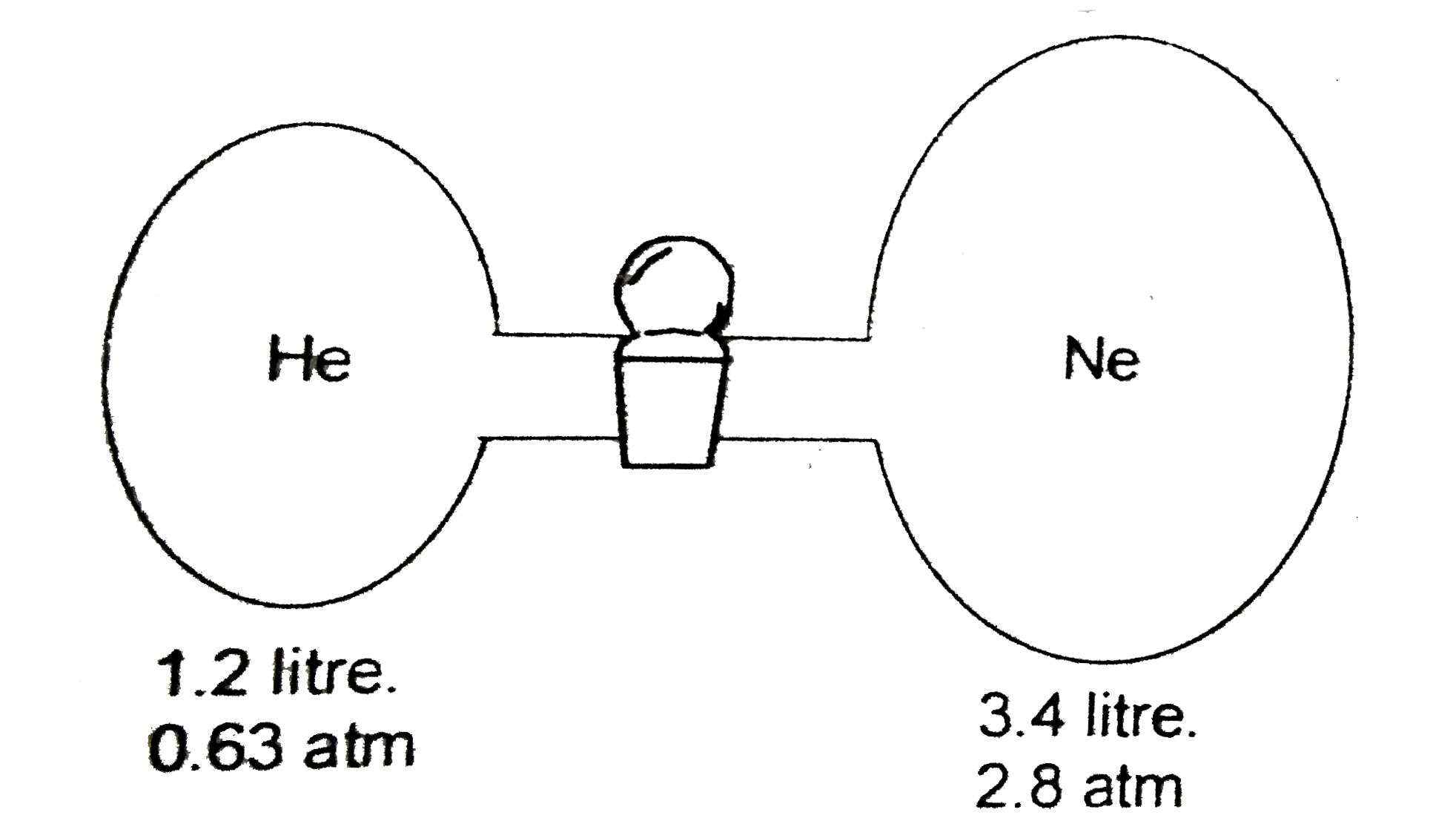
Consider the following apparatus. Calcul...


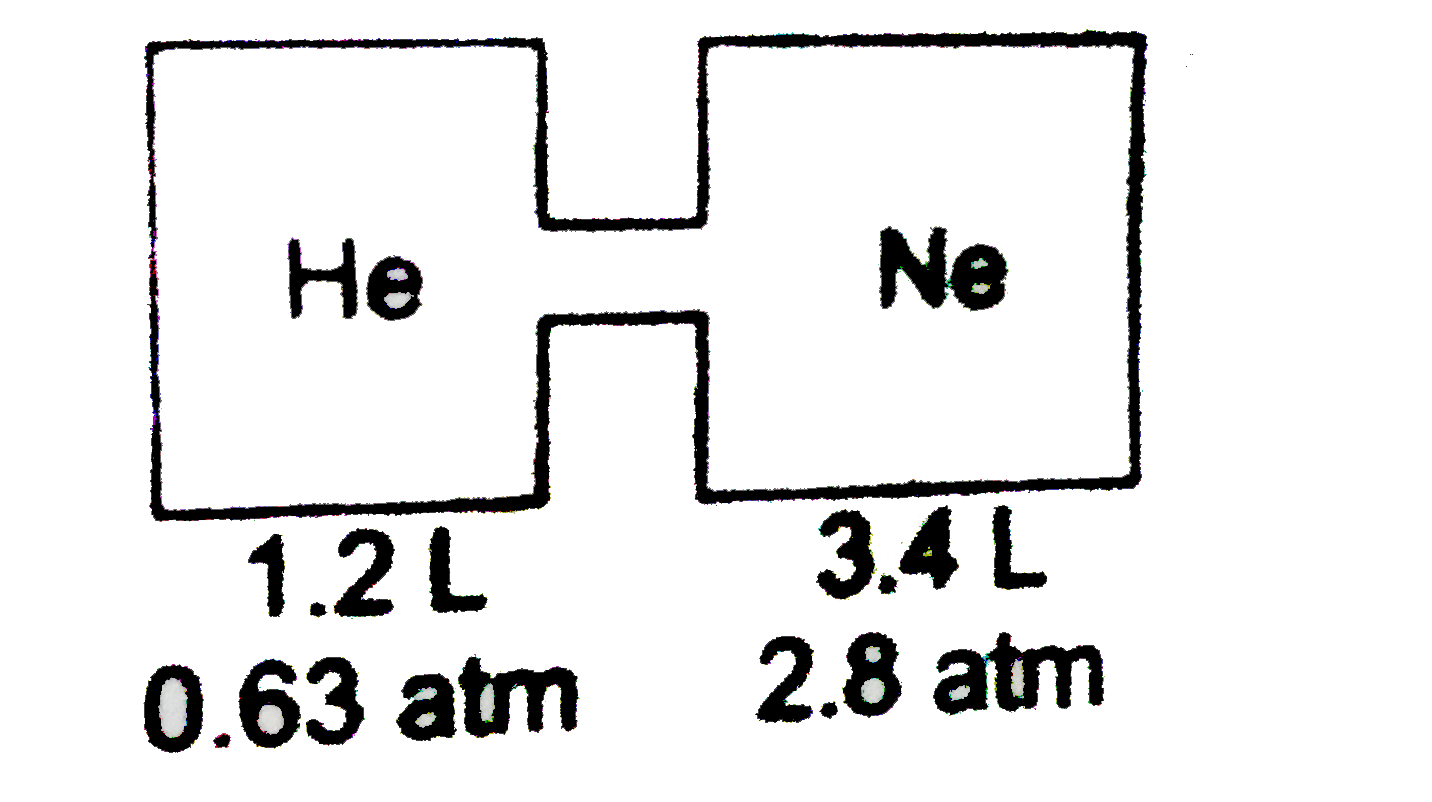
Consider the following apparatus. Calculate the partical pressure of He after opening the valve. The temperature is remain constant at `16^(@)C`
(a)0.164atm
(b)1.64atm
(c)0.328atm
(d)1atm

A

0.164 atm

B

1.64 atm

C

0.328 atm

D

1 atm

Text Solution

Verified by Experts

The correct Answer is:
a

(a)
`n_(He)=(1.2xx0.63)/(0.082xx289)," " n_(He)=(3.4xx2.8)/(0.0821xx289)`
`=0.032 " " =0.4`
`P_(f)=(0.431xx0.0821xx289)/(4.6)=2.223`
`P_(He)=(0.032)/(0.432)xx2.223=0.164atm`
Promotional Banner

Topper's Solved these Questions

  • GASEOUS STATE

    NARENDRA AWASTHI ENGLISH|Exercise Level 2|30 Videos
  • GASEOUS STATE

    NARENDRA AWASTHI ENGLISH|Exercise Level 3 Passage 1|4 Videos
  • ELECTROCHEMISTRY

    NARENDRA AWASTHI ENGLISH|Exercise Subjective problems|14 Videos
  • IONIC EEQUILIBRIUM

    NARENDRA AWASTHI ENGLISH|Exercise Subjective problems|1 Videos

Similar Questions

Explore conceptually related problems

A container is filled with hydrogen gas at a pressure of 15 atm at 15^@C . At what temperature will the pressure inside the container be 30 atm ?

A 10.0 L container is filled with a gas to a pressure of 2.00 atm at 0^(@)C . At what temperature will the pressure inside the container be 2.50 atm ?

Calculate the work done by 1.0 mol of an ideal gas when it expands at external pressure 2atm from 10atm to 2atm at 27^(@)C

The density of a gas at 27^(@)C and 1 atm is d. At what temperature would its density be 0.75d, if the pressure is kept constant?

At 25^(@)C and 1 atm pressure, the partial pressure in equilibrium mixture of N_(2)O_(4) and NO_(2) , are 0.7 and 0.3 atm , respectively. Calculate the partial pressures of these gases when they are in equilibrium at 25^(@)C and a total pressure of 10 atm .

Calculate the density of SO_2 " at " 27^@C and 1.5 atm pressure.

A gas expands by 0.5L against a constant pressure of 1 atm . Calculate the work done in joule and calorie.

A small bubble rises from the bottom of a lake, where the temperature and pressure are 8^(@)C and 6.0 atm , to the water's surface, where the temperature is 25^(@)C and pressure is 1.0 atm . Calculate the final volume of the bubble if its initial volume was 2mL .

If the collision frequency of a gas at 1 atm pressure is Z, then its collision frequency at 0.5 atm is

A living cell contains a solution which is isotonic with 0.2 M glucose solution. What osmotic pressure develops when the cell is placed in 0.05 M BaCl_(2) solution at 300 K ? (a)1.23 atm (b)3.69 atm (c)6.15 atm (d)None of these

NARENDRA AWASTHI ENGLISH-GASEOUS STATE-Subjective problems
  1. Consider the following apparatus. Calculate the partical pressure of H...

    Text Solution

    |

  2. A bubble of gas released at the bottom of a lake increases to four t...

    Text Solution

    |

  3. A gaseous mixture containing equal mole sof H(2),O(2) and He is subjec...

    Text Solution

    |

  4. One mole of a gas changed from its initial state (15L,2 atm) to final ...

    Text Solution

    |

  5. Two moles of an ideal gas undergoes the following process. Given that ...

    Text Solution

    |

  6. 1 mole of a diatomic gas present in 10 L vessel at certain temperature...

    Text Solution

    |

  7. The graph of compressibility factor (Z) vs. P for one mole of a real g...

    Text Solution

    |

  8. Under the identical conditions of temperature, the density of a gas X...

    Text Solution

    |

  9. The time for a certain volume of a gas A to diffuse through a small ho...

    Text Solution

    |

  10. Excess F(2)(g) reacts at 150^(@)C and 1.0 atm pressure with Br(2)(g) t...

    Text Solution

    |

  11. Initially bulb "a" contained oxygen gas at 27^(@)C and 950 mm of Hg an...

    Text Solution

    |

  12. Air is trapped in a horizontal glass tube by 36 cm mercury column as s...

    Text Solution

    |

  13. A flask containing air at 107^(@)C and 722 mm of Hg is cooled to 100 K...

    Text Solution

    |

  14. If an ideal gas at 100 K is heated to 109 K in a rigid container, the ...

    Text Solution

    |

  15. The van der Waals' constantes for a gas are a=3.6 atmL^(2)mol^(-2),b=0...

    Text Solution

    |

  16. A flask has 10 molecules out of which four molecules are moving at 7 m...

    Text Solution

    |

