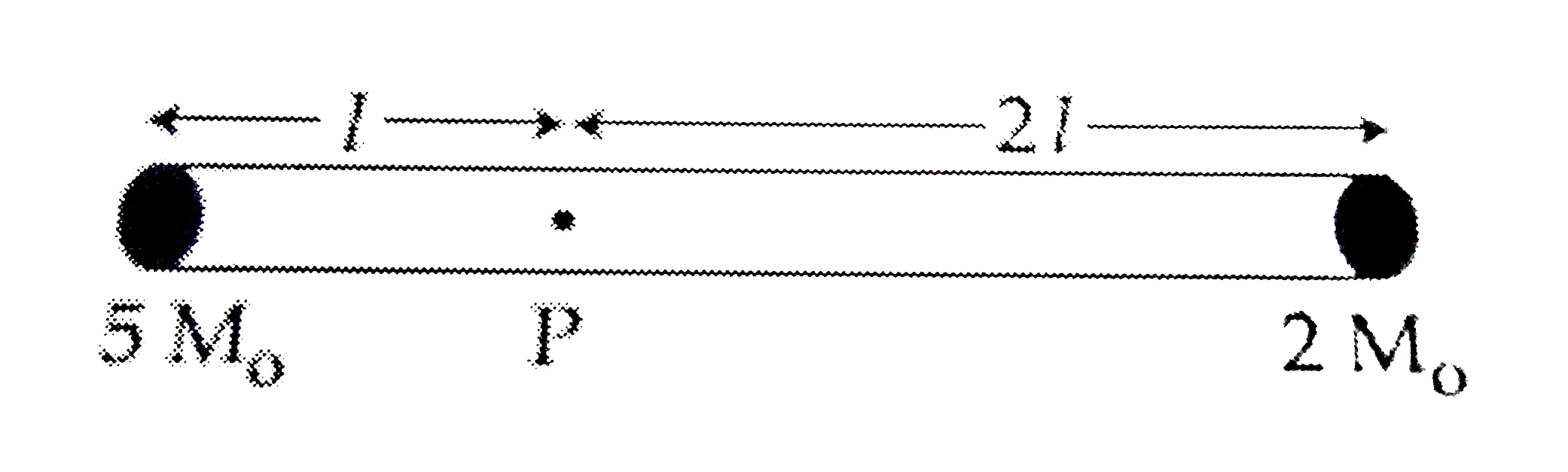
A rigid massless rod of length `3l` has two masses attached at each end as shown in the figure. The rod is pivoted at point P on the horizontal axis (see figuare). When released from initial horizontal position, its instantaneous angular acceleration will be
A
`(g)/(13l)`
B
`(g)/(3l)`
C
`(g)/(2l)`
D
`(7g)/(3l)`
Text Solution
Verified by Experts
Topper's Solved these Questions
JEE MAINS
JEE MAINS PREVIOUS YEAR ENGLISH|Exercise Chemistry|1 Videos
JEE MAIN
JEE MAINS PREVIOUS YEAR ENGLISH|Exercise All Questions|452 Videos
JEE MAINS 2020
JEE MAINS PREVIOUS YEAR ENGLISH|Exercise PHYSICS|250 Videos
Similar Questions
Explore conceptually related problems
A uniform rod of mass m and length l is fixed from Point A , which is at a distance l//4 from one end as shown in the figure. The rod is free to rotate in a vertical plane. The rod is released from the horizontal position. What is the reaction at the hinge, when kinetic energy of the rod is maximum?
A light rigid rod of length 4 m is connected rigidly with two identical particles each of mass m = 2 kg . the free end of the rod is smoothly pivoted at O . The rod is released from rest from its horizontal position at t = 0 . Find the angular acceleration of the rod at t = 0 (in rad s^(-2)).
The ends of a rod of length l and mass m are attached to two identical springs as shown in the figure. The rod is free to rotate about its centre O . The rod is depressed slightly at end A and released . The time period of the oscillation is
A uniform rod of mass m and length L is free to rotate in the vertical plane about a horizontal axis passing through its end. The rod initially in horizontal position is released. The initial angular acceleration of the rod is:
A massless rod S having length 2l has equal point masses attached to its two ends as shown in figure. The rod is rotating about an axis passing through its centre and making angle alpha with the axis. The magnitude of change of momentum of rod i.e., |(dL)/(dt)| equals
A uniform rod of length l and mass m is free to rotate in a vertical plane about A as shown in Fig. The rod initially in horizontal position is released. The initial angular acceleration of the rod is
A light rigid rod of length 4 m is connected rigidly with two identical particles each of mass m = 2 kg . the free end of the rod is smoothly pivoted at O . The rod is released from rest from its horizontal position at t = 0 . Find the reaction offered by the pivot at t = 0 (in N ).
A uniform rod of mass m and length L is suspended with two massless strings as shown in the figure. If the rod is at rest in a horizontal position the ratio of tension in the two strings T_1/T_2 is:
A thin homogeneous rod of mass m and length l is free to rotate in vertical plane about a horizontal axle pivoted at one end of the rod. A small ballof mass m and charge q is attached to the opposite end of this rod. The whole system is positioned in a horizontal electric field of magnitude E=(mg)/(2q) . The rod is released from, shown position from rest. What is the angular acceleration of the rod at the instant of releasing the rod?
A uniform rod of mass m and length l can rotate in a vertical plane about a smooth horizontal axis point H . a. Find angular acceleration alpha of the rod. just after it is released from initial horizontal position from rest'? b. Calculate the acceleration (tangential and radial) , point A at this moment.
JEE MAINS PREVIOUS YEAR ENGLISH-JEE MAINS-Chemistry