Home
Class 12
PHYSICS
In the value circuit, C=(sqrt(3))/(2)muF...


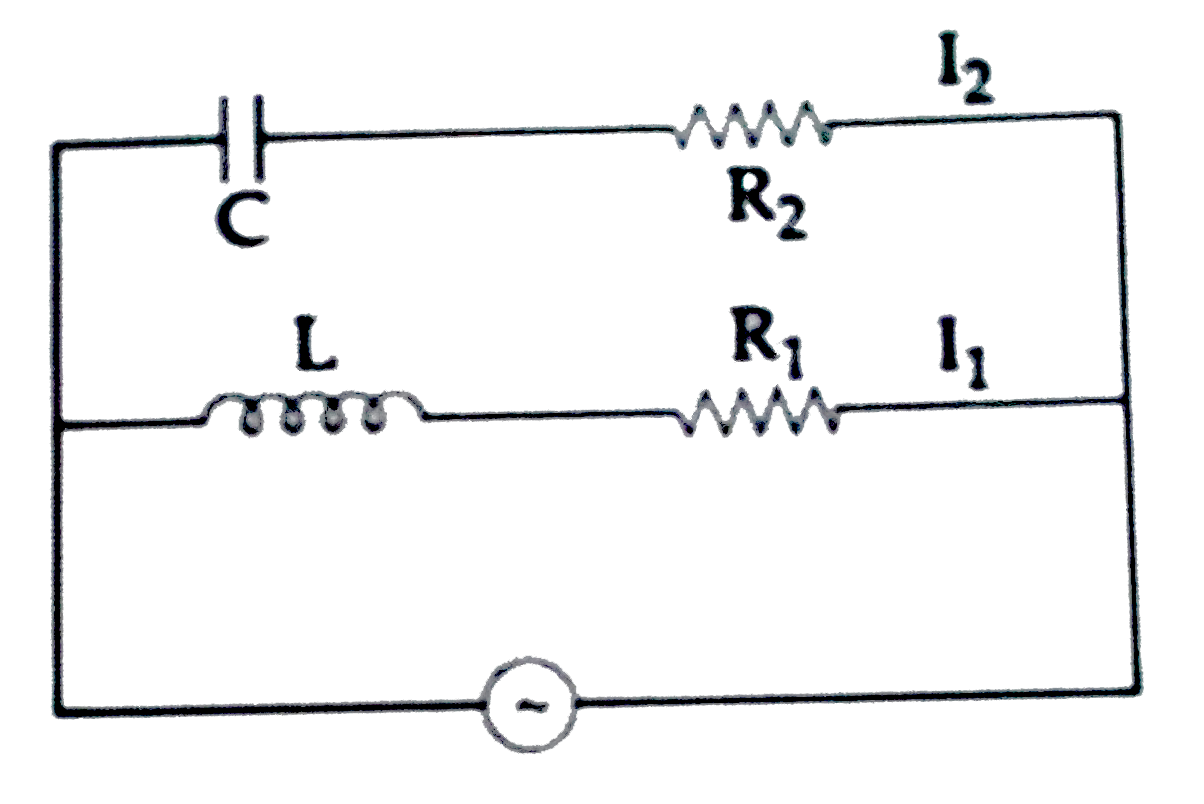
In the value circuit, `C=(sqrt(3))/(2)muF,R_2=20Omega, L=sqrt(3)/(10)H`, and `R_1=10Omega` .Current in `L-R_1` path is `I_1` and in `C-R_2` path it is `I_2`. The voltage of A.C source is given by, `V=200sqrt(2)sin(100t)` volts. The phase difference between `I_2` and `I_1` is :

A

`60^@`

B

`150^@`

C

`90^@`

D

`0^@`

Text Solution

Verified by Experts

The correct Answer is:

A

NA
Promotional Banner

Similar Questions

Explore conceptually related problems

In the circuit shown in figure : R = 10 Omega , L = (sqrt(3))/(10) H, R_(2) = 20 Omega and C = (sqrt(3))/(2) mF . Current in L - R_(1) circuit is I_(1) in C - R_(1) circuit is I_(2) and the main current is I Phase difference between I_(1) and I_(2) is

In the circuit shown in figure : R = 10 Omega , L = (sqrt(3))/(10) H, R_(2) = 20 Omega and C = (sqrt(3))/(2) mF . Current in L - R_(1) circuit is I_(1) in C - R_(1) circuit is I_(2) and the main current is I Phase difference between I_(1) and I_(2) is

A 200 Omega resistor and 1H inductor are joined in series with an ac source of emf 10 sqrt(2) sin (200t)V . Calculate the phases difference between emf and current.

In the circuit shown in figure : R = 10 Omega , L = (sqrt(3))/(10) H, R_(2) = 20 Omega and C = (sqrt(3))/(2) mF . Current in L - R_(1) circuit is I_(1) in C - R_(1) circuit is I_(2) and the main current is I At some instant current in L - R_(1) circuit is 10 A . At the same instant current in C - R_(2) branch will be

An inductor (L = (1)/(100 pi) H) , a capacitor (C = (1)/(500 pi) F) and a resistance (3 Omega) is connected in series with an AC voltage source as shown in the figure. The voltage of the AC source is given as V = 10 cos(100 pi t) volt. What will be the potential difference between A and B ?

In the following circuit , E_1 = 4V, R_1 = 2 Omega, E_2 = 6 V, R_2 = 2Omega, and R_3 = 4Omega. Find the currents i_1 and i_2

For a series RLC circuit R=X_(L)=2X_(C) . The impedence of the current and phase different (between) V and i will be

In the circuit shown below E_(1) = 4.0 V, R_(1) = 2 Omega, E_(2) = 6.0 V, R_(2) = 4 Omega and R_(3) = 2 Omega . The current I_(1) is

In the given circuit, R_(1) = 10Omega R_(2) = 6Omega and E = 10V, then correct statement is

In the circuit shown, R_1=2 Omega,R_2=R_3=10Omega, R_4=20Omega and E=6V . Work out the equivalent resistance of the circuit and the current in each resistor.
