Home
Class 12
PHYSICS
In the figure, given that V(BB) supply c...


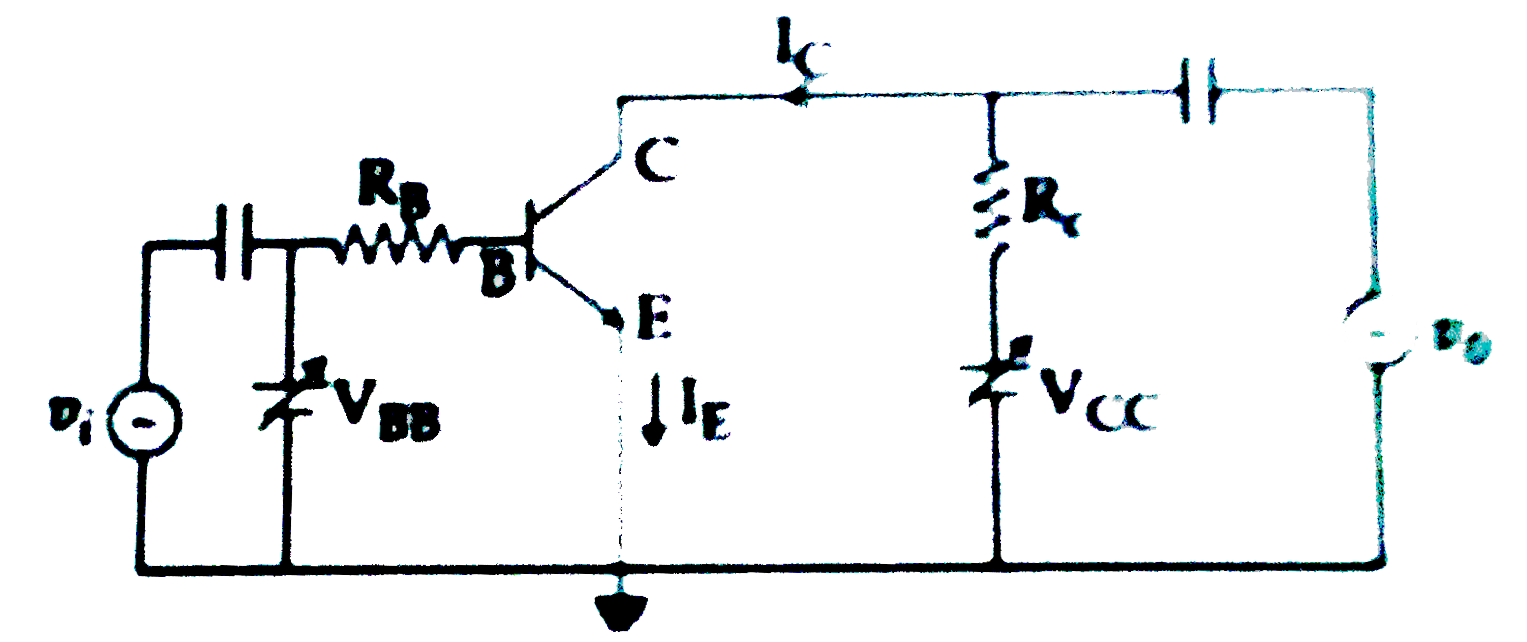
In the figure, given that `V_(BB)` supply can vary from 0 to `5.0V,V_(CC)=5V,beta_(dc)=200,R_(B)=100KOmega,R_(C)=1KOmega` and `V_(BE)=1.0V`, The minimum base current and the input voltage at which the transistor will go to saturation, will be, respectively:

A

`25muA and 3.5V`

B

`20muA and 3.5V`

C

`25muA and 2.8V`

D

`20muA and 2.8V`

Text Solution

Verified by Experts

The correct Answer is:

A

NA
Promotional Banner

Similar Questions

Explore conceptually related problems

In common emitter transistor as shown in Fig., the V_(BB) supply can be varied from 0 V to 5.0V. The Si. Transistor has beta_(ac)=250 and R_(B)=100kOmega, R_(c)=1k Omega,V_(C C)=5.0V . Assume that when the transistor is saturated, V_(CE)=0V and V_(BE)=0.8V . Calculate the minimum base current, for which the transistor will reach saturation. Hence, determine V_(i) when the transistor is 'switched on' find ranges of V_(i) for which the transistor is switched off and switched on.

V_("BB") can vary between 0 and 5 V. Find the minimum value of base current and V_("BB") , so that transistor works in saturation mode. ["Given "beta =200 and V_("BE")=1V]

In the figure shown R_B = 500K Omega, R_C = 8K Omega, V_BB= 10.6 V and V_(C C) = 20V . The current amplification factor of the transistor is 100 and V_BE = 0.6 volt then which of the following is false?

A common emitted amplifier circuit, built using an npn transistor, is shown in the figure. Its dc current gain is 250,R_(C)=1Komega and V_(C C)=10V . What is the minimum base current for V_(CE) to reach saturation?

A common emitted amplifier circuit, built using an npn transistor, is shown in the figure. Its dc current gain is 250,R_(C)=1Komega and V_(C C)=10V . What is the minimum base current for V_(CE) to reach saturation?

In the following common emitter circuit , if beta = 100 , V_(CE)=7 V , R(C)=2 kOmega and V_(BE) negligible , then I_B is

For a common emitter transistor working in active state, following data is given R_(L)=1KOmega V_("in")=10mV triangleI_(B)=15muA,triangleI_(C)=3mA . The input resistance r_(i) & voltage gain A_(V) for the transitor is

For the given input voltage wavelength V_("in")(t) , the output voltage waveform (V_0)(t) , across the capacitor is correctly depicted by :

In the circuit of CE amplifier, a silicon transistor is used. The value of V_("CC")=+20V, R_(L)=3kOmega , collector voltage =5v, beta=100 . Then the base resistance R_(B) should be ……xx10^(5)Omega (Take input voltage drop across Si transistor = 0.7 V)

In the figure shown , R_B=500kOmega, R_C = 8 kOmega, V_("BB")=10.6V and V_("CC") = 20V . The current amplification factor beta=100 and V_("BE")=0.6 V . Mark the incorrect statement .
