Home
Class 12
PHYSICS
A soap bubble is blown with the help of ...

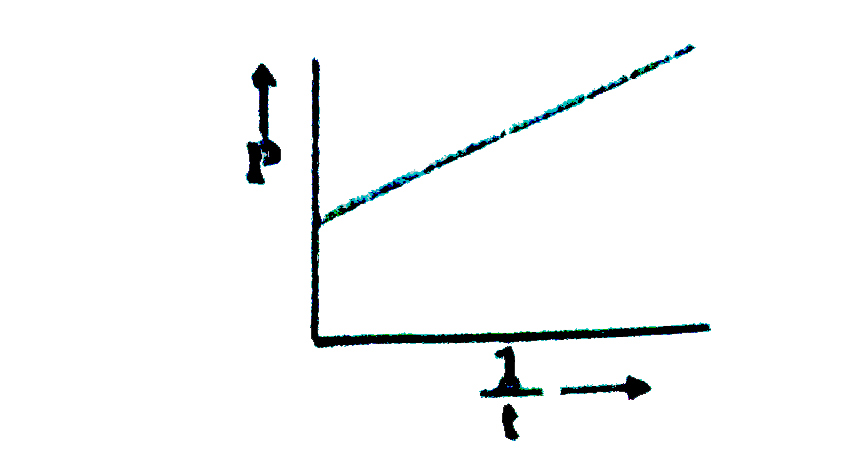
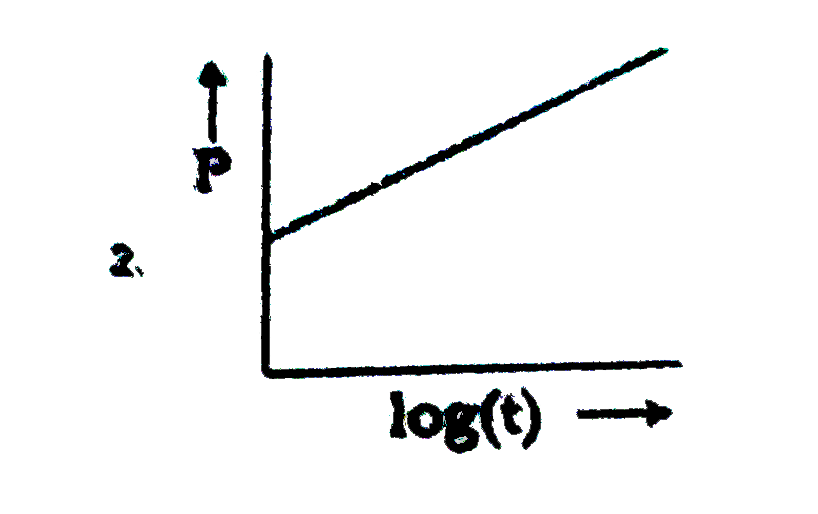
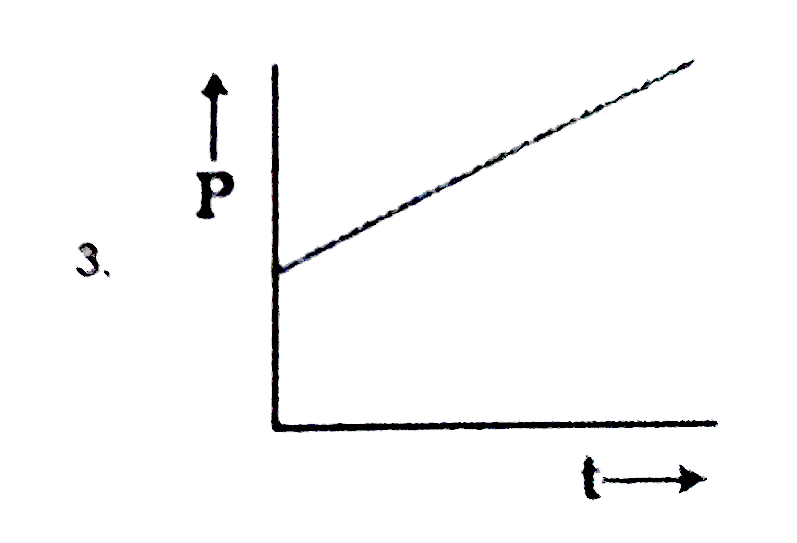
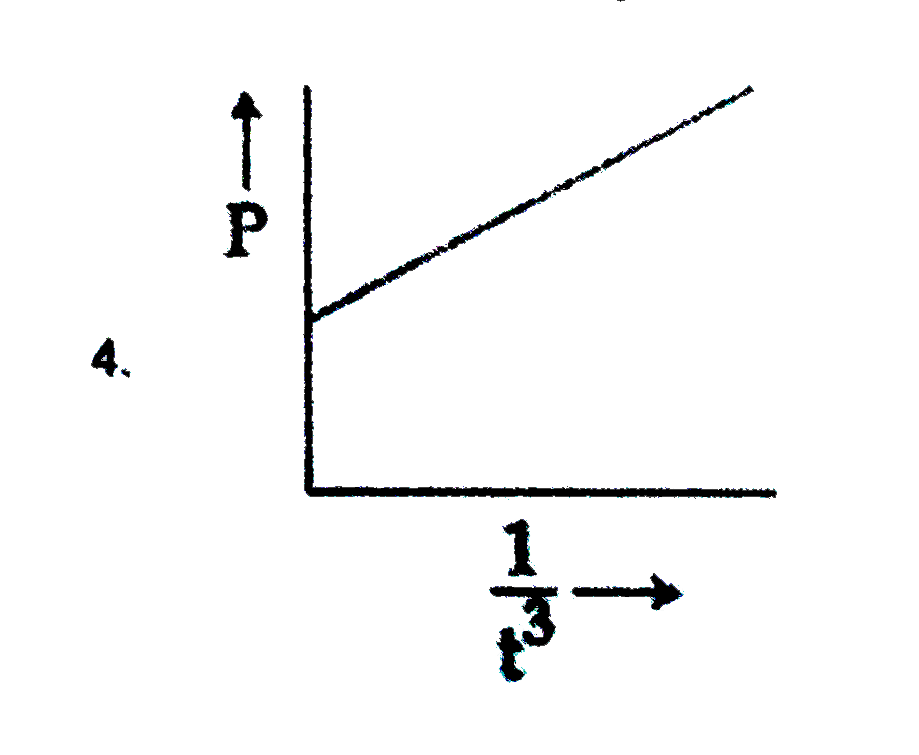
A soap bubble is blown with the help of mechanical pump at the mouth of a tube. The pump produces a cartain increase per minute in the volume of the bubble, irrespective of its internal pressure. The graph between the pressure inside the soap bubble and time `t` will be

A

B

C

D

Text Solution

AI Generated Solution

The correct Answer is:

To solve the problem, we need to analyze the relationship between the pressure inside a soap bubble and time as the bubble is inflated by a mechanical pump. Here’s a step-by-step solution: ### Step 1: Understand the Pressure Inside the Soap Bubble The pressure inside a soap bubble can be expressed using the formula: \[ P = P_0 + \frac{4T}{R} \] where: - \( P \) is the pressure inside the bubble, - \( P_0 \) is the atmospheric pressure, - \( T \) is the surface tension of the soap solution, - \( R \) is the radius of the bubble. ### Step 2: Relate Volume and Time The volume \( V \) of a soap bubble is given by the formula: \[ V = \frac{4}{3} \pi R^3 \] According to the problem, the volume of the bubble increases at a constant rate per minute, which means: \[ V \propto t \] Thus, we can write: \[ V = k \cdot t \] for some constant \( k \). ### Step 3: Express Radius in Terms of Time From the volume equation, we can express the radius \( R \) in terms of time \( t \): \[ \frac{4}{3} \pi R^3 = k \cdot t \] This implies: \[ R^3 = \frac{3k}{4\pi} t \] Taking the cube root: \[ R = \left( \frac{3k}{4\pi} \right)^{1/3} t^{1/3} \] Let’s denote the constant \( \left( \frac{3k}{4\pi} \right)^{1/3} \) as \( C \): \[ R = C \cdot t^{1/3} \] ### Step 4: Substitute Radius Back into the Pressure Equation Now, we substitute \( R \) back into the pressure equation: \[ P = P_0 + \frac{4T}{C \cdot t^{1/3}} \] This can be rewritten as: \[ P = P_0 + \frac{4T}{C} t^{-1/3} \] ### Step 5: Analyze the Relationship From the equation \( P = P_0 + \frac{4T}{C} t^{-1/3} \), we can see that as time \( t \) increases, the term \( t^{-1/3} \) decreases. Therefore, the pressure \( P \) will approach \( P_0 \) as \( t \) increases. ### Step 6: Graphical Representation The graph of \( P \) versus \( t \) will start from \( P_0 \) and will decrease as \( t \) increases. The relationship is inversely proportional to \( t^{1/3} \), which means the graph will have a decreasing curve. ### Conclusion The correct graph between the pressure inside the soap bubble and time \( t \) will show a decreasing trend starting from \( P_0 \) and approaching \( P_0 \) as time increases.

To solve the problem, we need to analyze the relationship between the pressure inside a soap bubble and time as the bubble is inflated by a mechanical pump. Here’s a step-by-step solution: ### Step 1: Understand the Pressure Inside the Soap Bubble The pressure inside a soap bubble can be expressed using the formula: \[ P = P_0 + \frac{4T}{R} \] where: - \( P \) is the pressure inside the bubble, - \( P_0 \) is the atmospheric pressure, ...
Promotional Banner

Similar Questions

Explore conceptually related problems

The excess pressure inside a soap bubble is

What happens to the pressure inside a soap bubble when air is blown into it?

Describe an experiment to demonstrate the excess pressure inside a soap bubble.

The soap bubble formed at the end of the tube is blown very slowly. Draw the graph between excess of pressure inside the bubble with time.

The excess pressure inside a soap bubble of radius R is (S is the surface tension)

A soap bubble has radius R and thickness d(ltltR) as shown. It colapses into a spherical drop. The ratio of excess pressure in the drop to the excess pressure inside the bubble is

The surface of soap solution is 25xx10^-3Nm^-1 . The excess pressure inside a soap bubble of diameter 1 cm is

A soap bubble of raidus R is surrounded by another soap bubble of radius 2R , as shown. Take surface tension =S . Then the pressure inside the smaller soap bubble, in excess of the atmosphere presure will be

If R is the radius of a soap bubble and S its surface tension, then the excess pressure inside is

Deduce expressions for the excess pressure inside a : (i) liquid drop, (ii) soap bubble.
