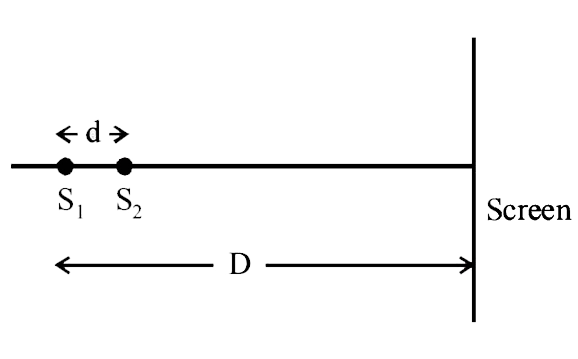
Two coherent point sources `S_1` and `S_2` are separated by a small distance `d` as shown. The fringes obtained on the screen will be
A
straight lines
B
semi-circles
C
concentric circles
D
points
Text Solution
Verified by Experts
The correct Answer is:
C
Topper's Solved these Questions
JEE MAINS
JEE MAINS PREVIOUS YEAR ENGLISH|Exercise Chemistry|1 Videos
JEE MAIN
JEE MAINS PREVIOUS YEAR ENGLISH|Exercise All Questions|452 Videos
JEE MAINS 2020
JEE MAINS PREVIOUS YEAR ENGLISH|Exercise PHYSICS|250 Videos
Similar Questions
Explore conceptually related problems
Two coherent sources S_(1)" and "S_(2) are separated by a small distance d. The fringes obtained on the screen will be:
Two monochromatic coherent point sources S_(1) and S_(2) are separated by a distance L. Each sources emits light of wavelength lambda , where L gt gt lambda . The line S_(1) S_(2) when extended meets a screen perpendicular to it at point A. Then
Two coherent sources S_1 and S_2 area separated by a distance four times the wavelength lambda of the source. The sources lie along y axis whereas a detector moves along +x axis. Leaving the origin and far off points the number of points where maxima are observed is
Statement I: Two coherent point sources of light having no-zero phase difference are separated by a small distance. Then, on the perpendicular bisector of line segment joining both the point sources, constructive interference cannot be obtained. Statement II: For two waves from coherent point sources to interfere constructively at a point, the magnitude of their phase difference at that point must be 2 m pi (where m is non-negative integer).
Assertion: Two coherent sources S_1 and S_2 are placed in front of a screen as shown in figure. At point P, 10th order maxima is obtained. Then , 11th order maxima will be obtained above P. Reason: For 11th order maxima path difference should be more.
Consider two coherent, monochromatic (wavelength lambda ) sources S_(1) and S_(2) , separated by a distance d. The ratio of intensities of S_(1) and that of S_(2) (which is responsible for interference at point P, where detector is located) is 4. The distance of point P from S_(1) is (if the resultant intensity at point P is equal to (9)/(4) times of intensity of S_(1) ) ("Given : "angleS_(2)S_(1)P=90^(@), d gt0 and n" is a positive integer")
Two coherent point sources S_1 " and "S_2 vibrating in phase light of wavelength lambda . The separation between the sources is 2lambda . The smallest distance from S_(2) on a line passing through S_2 and perpendicular to s_(1)s_(2) where a minimum of intensity occurs is
Two coherent monochromatic point sources S_1 and S_2 are placed in front of an infinite screen as shown in figure. Wavelength of the light emitted by both the sources is zero. Initial phase difference between the sources is zero. Initially S_(1)S_(2)=2.5 lambda and the number of bright circular rings on the screen in n_(1) . if the distance S_(1)S_(2) is increased and made 5.7 lambda , the number of bright circular rings becomes n_(2) . the difference n_(2)-n_(1) is
Two coherent point sources S_(1) and S_(2) vibrating in phase emit light of wavelength lambda . The separation between the sources is 2lambda . Consider a line passing through S_(2) and perpendicular to line S_(1) S_(2) . Find the position of farthest and nearest minima. .
Two coherent source of light can be obtained by
JEE MAINS PREVIOUS YEAR ENGLISH-JEE MAINS-Chemistry