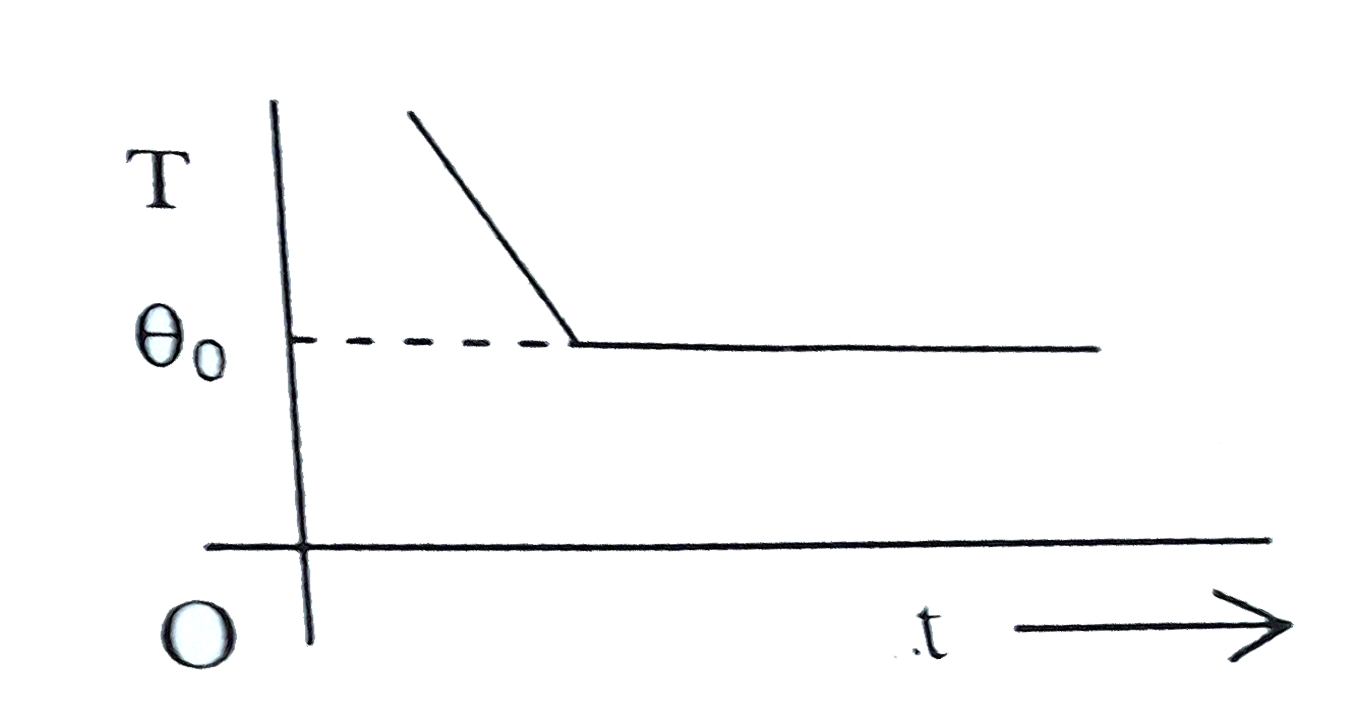
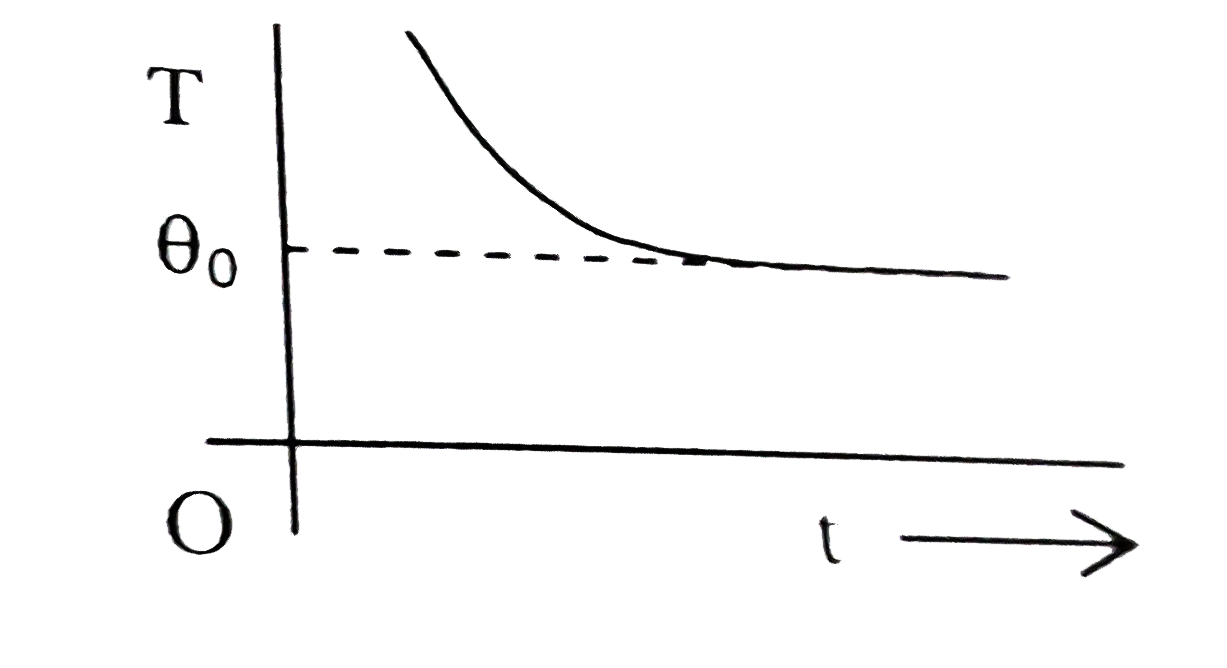
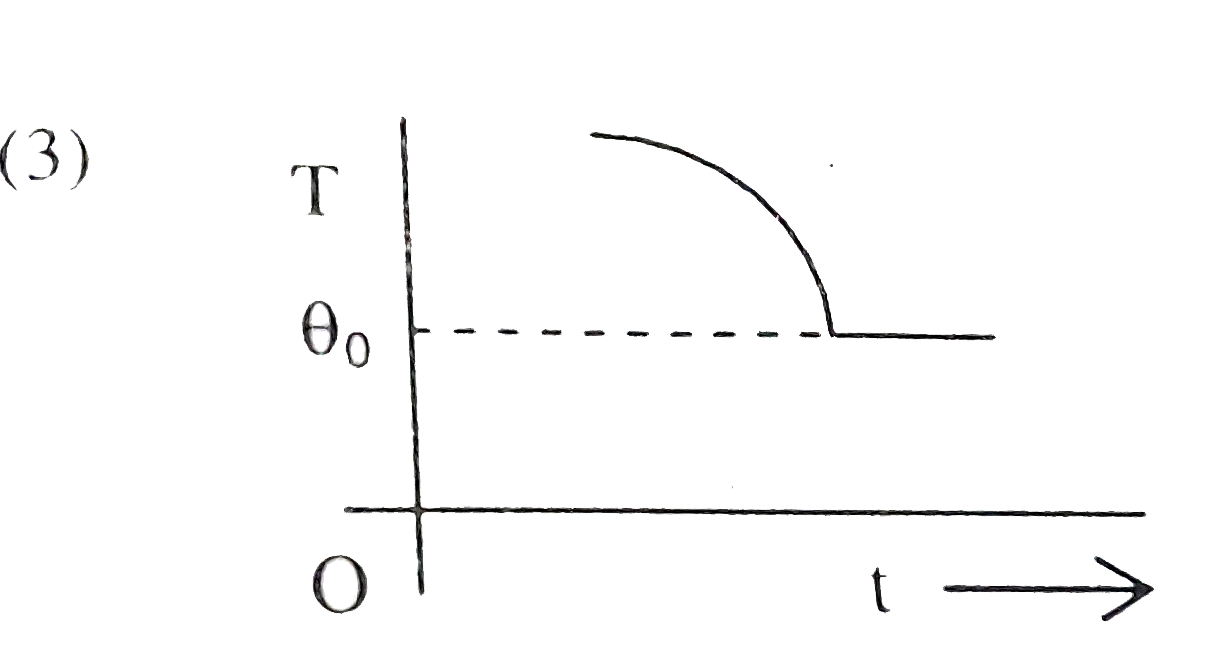
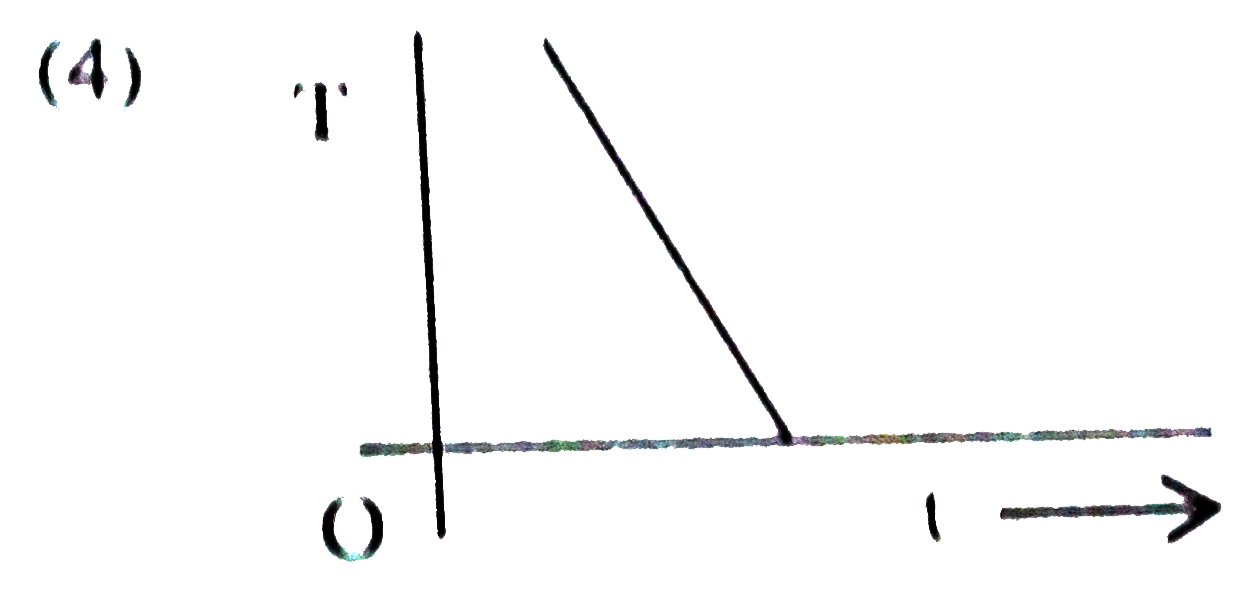
If a piece of metal is heated to temperature `theta` and the allowed to cool in a room which is at temperature `theta_0`, the graph between the temperature T of the metal and time t will be closet to
A
B
C
D
Text Solution
AI Generated Solution
The correct Answer is:
To solve the problem of how the temperature \( T \) of a piece of metal changes over time \( t \) as it cools in a room at temperature \( \theta_0 \), we can apply Newton's Law of Cooling. Here is a step-by-step solution:
### Step 1: Understand Newton's Law of Cooling
According to Newton's Law of Cooling, the rate of change of temperature of an object is proportional to the difference between its temperature and the ambient temperature. Mathematically, this can be expressed as:
\[
\frac{dT}{dt} = -k(T - \theta_0)
\]
where:
- \( T \) is the temperature of the metal,
- \( \theta_0 \) is the ambient temperature,
- \( k \) is a positive constant.
### Step 2: Rearranging the Equation
We can rearrange the equation to isolate the variables:
\[
\frac{dT}{T - \theta_0} = -k \, dt
\]
### Step 3: Integrate Both Sides
Next, we integrate both sides. The left side will be integrated with respect to \( T \) and the right side with respect to \( t \):
\[
\int \frac{dT}{T - \theta_0} = -k \int dt
\]
This gives us:
\[
\ln |T - \theta_0| = -kt + C
\]
where \( C \) is the constant of integration.
### Step 4: Solve for \( T \)
To solve for \( T \), we exponentiate both sides:
\[
|T - \theta_0| = e^{-kt + C} = e^C e^{-kt}
\]
Let \( A = e^C \), then we can write:
\[
T - \theta_0 = A e^{-kt}
\]
Thus, we have:
\[
T = \theta_0 + A e^{-kt}
\]
### Step 5: Determine the Constant \( A \)
At \( t = 0 \), the initial temperature \( T(0) = \theta \):
\[
\theta = \theta_0 + A
\]
This implies:
\[
A = \theta - \theta_0
\]
Substituting \( A \) back into the equation gives:
\[
T = \theta_0 + (\theta - \theta_0)e^{-kt}
\]
### Step 6: Analyze the Behavior of the Function
As \( t \) approaches infinity, the term \( e^{-kt} \) approaches 0, leading to:
\[
T \to \theta_0
\]
At \( t = 0 \), \( T = \theta \). The graph of \( T \) versus \( t \) will show an exponential decay towards \( \theta_0 \).
### Conclusion
The graph of the temperature \( T \) of the metal versus time \( t \) will be an exponential decay curve approaching the ambient temperature \( \theta_0 \).
Topper's Solved these Questions
JEE MAINS
JEE MAINS PREVIOUS YEAR ENGLISH|Exercise Chemistry|1 Videos
JEE MAIN
JEE MAINS PREVIOUS YEAR ENGLISH|Exercise All Questions|452 Videos
JEE MAINS 2020
JEE MAINS PREVIOUS YEAR ENGLISH|Exercise PHYSICS|250 Videos
Similar Questions
Explore conceptually related problems
This metal is a liquid at room temperature :
This metal is a liquid at room temperature :
This metal is a liquid at room temperature.
The graph between the (velocity^(2)) and temperature T of a gas is
This non-metal is liquid at room temperature :
Name the following: A metal which is liquid at room temperature,
A piece of glass is heated to a high temperature and then allowed to cool. If it cracks, a probable reason for this is the following property of glass
Name a metal which is liquid at room temperature.
A very thin metallic shell of radius r is heated to temperature T and then allowed to cool. The rate of cooling of shell is proportional to
A body with an initial temperature theta_(1) is allowed to cool in a surrounding which is at a constant temperature of theta_(0) (theta lt theta_(1)) Assume that Newton's law of cooling is obeyed Let k = constant The temperature of the body after time t is best experssed by .
JEE MAINS PREVIOUS YEAR ENGLISH-JEE MAINS-Chemistry