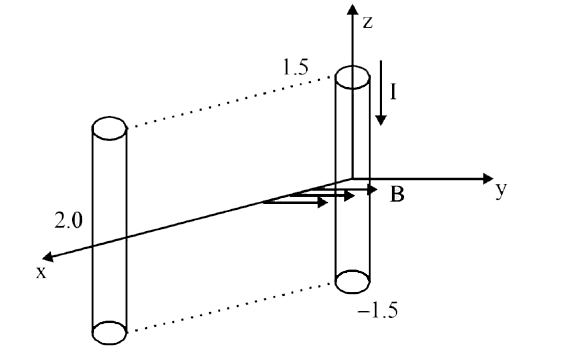
A conductor lies along the ` z`-axis at ` -1.5 le z lt 1.5 m` and carries a fixed current of `10.0 A` in `- hat(a)_(z)` direction ( see figure). For a field `vec(B) = 3.0 xx 10^(-4) e^(-0.2x) hat(a)_(y) T`, find the power required to move the conductor at constant speed to `x = 2.0 m , y = 0 m ` in `5xx 10^(-3)s` . Assume parallel motion along the ` x-axis`.
A
`14.85 W`
B
`29.7 W`
C
`1.57 W`
D
`2.97 W`
Text Solution
Verified by Experts
Topper's Solved these Questions
JEE MAINS
JEE MAINS PREVIOUS YEAR ENGLISH|Exercise Chemistry|1 Videos
JEE MAIN
JEE MAINS PREVIOUS YEAR ENGLISH|Exercise All Questions|452 Videos
JEE MAINS 2020
JEE MAINS PREVIOUS YEAR ENGLISH|Exercise PHYSICS|250 Videos
Similar Questions
Explore conceptually related problems
A magnet of magnetic moment 50 hat(i) A-m^(2) is placed along the x-axis in a magnetic field vec(B)=(0.5hat(i)+3.0hat(j))T . The torque acting on the magnet is
A straight conductor carries a current of 5A . An electron travelling with a speed of 5xx10^(6)ms^(-1) parallel to the wire at a distance of 0.1m from the conductor, experiences a force of
If x= 10^(1.4), y = 10^(0.7) , and x^(z) = y^(3) , then what is the value of z?
A current of 10A is established in a long wire along the positive z-axis. Find the magnetic field (vec B) at the point (1m , 0 , 0).
An EMW is travelling along z-axis vecB=5 xx 10^(-8) hatj T , C=3 xx 10^8 m/s & Frequency of wave is 25 Hz, then electric field in volt/m.
A uniform magnetic field existsin region given by vec(B) = 3 hat(i) + 4 hat(j)+5hat(k) . A rod of length 5 m is placed along y -axis is moved along x - axis with constant speed 1 m//sec . Then the magnitude of induced e.m.f in the rod is :
A uniform magnetic field existsin region given by vec(B) = 3 hat(i) + 4 hat(j)+5hat(k) . A rod of length 5 m is placed along y -axis is moved along x - axis with constant speed 1 m//sec . Then the magnitude of induced e.m.f in the rod is :
A proton is moving with a velocity of 5 xx 10^(5) m//s along the Y-direction. It is acted upon by an electric field of intensity 10^(5) V/m along the X-direction and a magnetic field of 1 Wb//m^(2) along the Z-direction. Then the Lorentz force on the particle is :
As a charged particle 'q' moving with a velocity vec(v) enters a uniform magnetic field vec(B) , it experience a force vec(F) = q(vec(v) xx vec(B)). For theta = 0^(@) or 180^(@), theta being the angle between vec(v) and vec(B) , force experienced is zero and the particle passes undeflected. For theta = 90^(@) , the particle moves along a circular arc and the magnetic force (qvB) provides the necessary centripetal force (mv^(2)//r) . For other values of theta (theta !=0^(@), 180^(@), 90^(@)) , the charged particle moves along a helical path which is the resultant motion of simultaneous circular and translational motions. Suppose a particle that carries a charge of magnitude q and has a mass 4 xx 10^(-15) kg is moving in a region containing a uniform magnetic field vec(B) = -0.4 hat(k) T . At some instant, velocity of the particle is vec(v) = (8 hat(i) - 6 hat(j) 4 hat(k)) xx 10^(6) m s^(-1) and force acting on it has a magnitude 1.6 N If the coordinates of the particle at t = 0 are (2 m, 1 m, 0), coordinates at a time t = 3 T, where T is the time period of circular component of motion. will be (take pi = 3.14 )
An electron is constrained to move along the y- axis with a speed of 0.1 c (c is the speed of light) in the presence of electromagnetic wave, whose electric field is vec E = 30hat j sin (1.5 xx 10^7t - 5 xx 10^2x) V//m . The maximum magnetic force experienced by the electron will be : (given c = 3 xx 10^8 ms^(-1) and electron charge = 1.6 xx 10^(-19)C )
JEE MAINS PREVIOUS YEAR ENGLISH-JEE MAINS-Chemistry