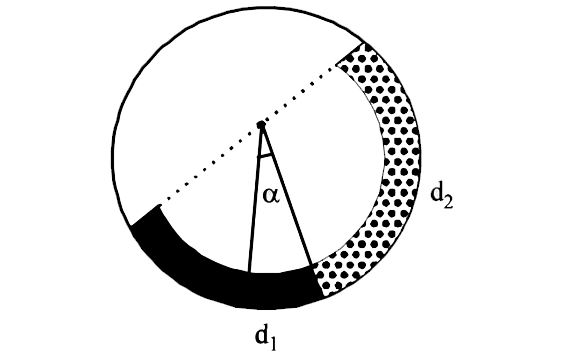
There is a circular tube in a vertical plane. Two liquids which do not mix and of densities `d_1 and d_2` are filled in the tube. Each liquid subtends `90^@` angle at centre. Radius joining their interface make an angle `alpha` with vertical. Ratio `(d_1)/(d_2)` is :
A
`(1+tanalpha)/(1-tanalpha)`
B
`(1+sinalpha)/(1-cosalpha)`
C
`(1+sinalpha)/(1-sinalpha)`
D
`(1+cosalpha)/(1-cosalpha)`
Text Solution
Verified by Experts
Topper's Solved these Questions
JEE MAINS
JEE MAINS PREVIOUS YEAR ENGLISH|Exercise Chemistry|1 Videos
JEE MAIN
JEE MAINS PREVIOUS YEAR ENGLISH|Exercise All Questions|452 Videos
JEE MAINS 2020
JEE MAINS PREVIOUS YEAR ENGLISH|Exercise PHYSICS|250 Videos
Similar Questions
Explore conceptually related problems
A thin uniform circular tube is kept in a vertical plane. Equal volume of two immiscible liquids whose densites are rho_(1) and rho_(2) fill half of the tube as shown. In equilibrium the radius passing through the interface makes an angle of 30^(@) with vertical. The ratio of densities (rho_(1)//rho_(2)) is equal to
A uniform long tube is bent into a circle of radius R and it lies in vertical plane. Two liquids of same volume but densities rho " and " delta fill half the tube. The angle theta is
If equal masses of two liquids of densities d_(1) and d_(2) are mixed together, the density of the mixture is
A small uniform tube is bent into a circle of radius r whose plane is vertical. Equal volumes of two fluids whose densities are rho and sigma(rhogtsigma) fill half the circle. Find the angle that the radius passing through the interface makes with the vertical.
A circular tube of uniform cross section is filled with two liquids densities rho_(1) and rho_(2) such that half of each liquid occupies a quarter to volume of the tube. If the line joining the free surfaces of the liquid makes an angle theta with horizontal find the value of theta.
Two non - viscous, incompressible and immiscible liquids of densities (rho) and (1.5 rho) are poured into the two limbs of a circular tube of radius ( R) and small cross section kept fixed in a vertical plane as shown in fig. Each liquid occupies one fourth the cirumference of the tube. Find the angle (theta) that the radius to the interface makes with the verticles in equilibrium position.
A tube in vertical plane is shown in figure. It is filled with a liquid of density rho and its end B is closed. Then the force exerted by the fluid on the tube at end B will be: [Assume the radius of the tube to be negligible in comparison to l]
A circular beam of light (diameter d) falls on a plane surface of a liquid. The angle of incidence is 45^(@) and refractive index of the liquid is mu . The diameter of the refracted beam is
Two discs have same mass and thickness. Their materials are of densities d_(1) and d_(2) . The ratio of their moments of inertia about an axis passing through the centre and perpendicular to the plane is
An object weights m_(1) in a liquid of density d_(1) and that in liquid of density d_(2) is m_(2) . The density of the object is
JEE MAINS PREVIOUS YEAR ENGLISH-JEE MAINS-Chemistry