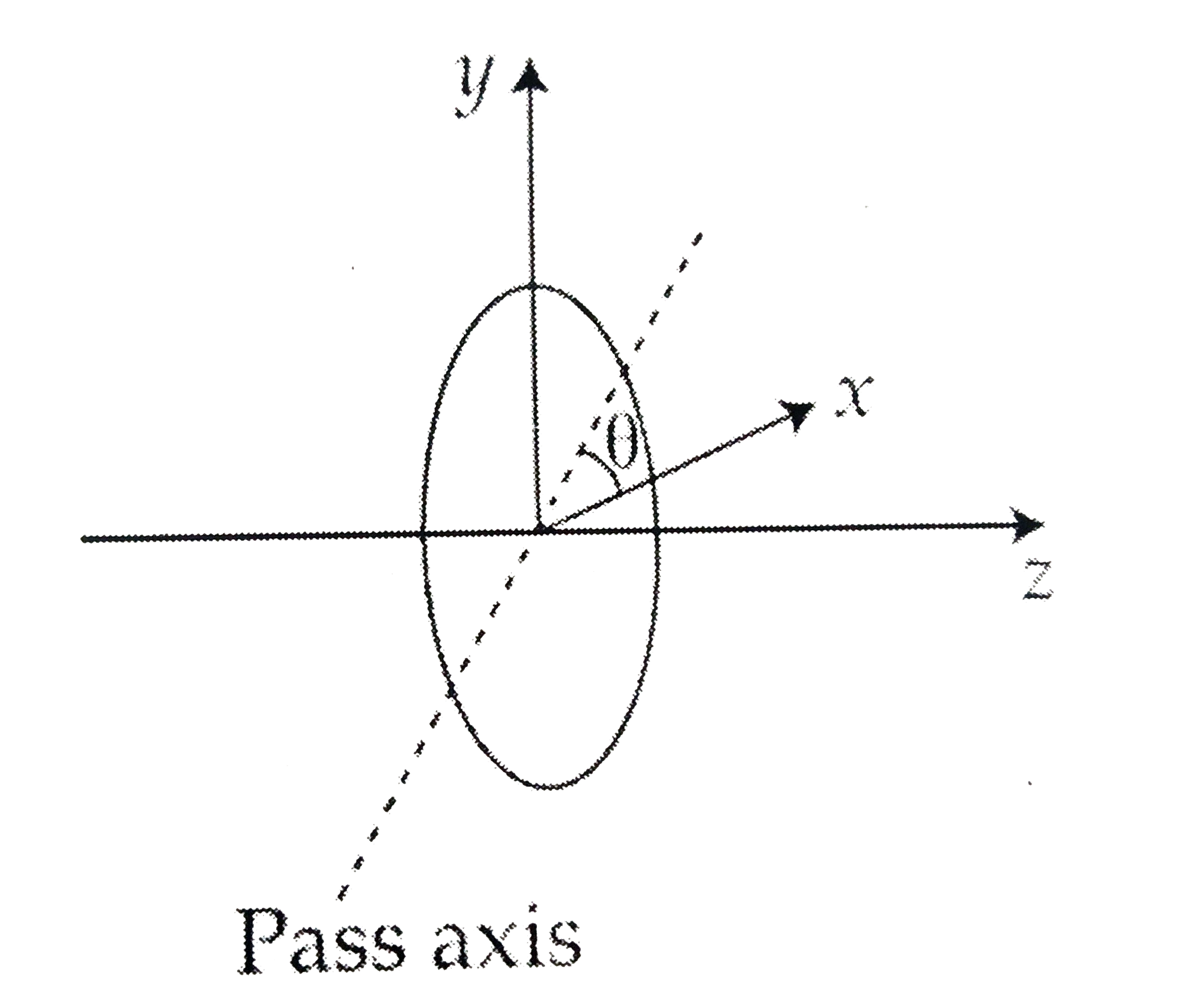
A plane polarized light is incident on a polariser with its pass axis making anlge `theta` with x axis as shown in the figure At four different values of `theta , theta =8^(@),38^(@),188^(@) and 218^(@)` the observed intensities are same what is the angle between the direction of polariztion and x axis ?
A
`98^(@)`
B
`128^(@)`
C
`203^(@)`
D
`45^(@)`
Text Solution
Verified by Experts
Topper's Solved these Questions
JEE MAINS
JEE MAINS PREVIOUS YEAR ENGLISH|Exercise Chemistry|1 Videos
JEE MAIN
JEE MAINS PREVIOUS YEAR ENGLISH|Exercise All Questions|452 Videos
JEE MAINS 2020
JEE MAINS PREVIOUS YEAR ENGLISH|Exercise PHYSICS|250 Videos
Similar Questions
Explore conceptually related problems
A plane polarized light is incident normally on a tourmaline plate. Its E vector make an angle of 60^(@) with the optic axis of the plate. Find the percentage difference between initial and final intensities
A line makes an angle theta both with x-axis and y-axis. A possible range of theta is
A plane polarized light with intensity I_(0) is incident on a polaroid with Electric Field vector making an angle of 60^(@) with transmission axis of polaroid. The intensity of the resulting light will be
Two tangents to the parabola y^2 = 4ax make angles theta_1,theta_2 with the x-axis. Then the locus of their point of intersection if cot theta_1 + cot theta_2=c is
A polarised light intensity I_(0) is passed through another polariser whose pass axis makes an angle of 60^(@) with the pass axis of the former, What is the intensity of emergent polarised light from second polarised?
A polarized light of intensity I_(0) is passed through another polarizer whose pass axis makes an angle of 60^(@) with the pass axis of the former, What is the intensity of emergent polarized light from second polarizer?
A uniform rod AB of mass m and length L rotates about a fixed vertical axis making a constant angle theta with it as shown in figure. The rod is rotated about this axis, so that point B the free end of the rod moves with a uniform speed V in the horizontal plane then the angular momentum of the rod about the axis is:
A uniform rod AB of mass m and length L rotates about a fixed vertical axis making a constant angle theta with it as shown in figure. The rod is rotated about this axis, so that point B the free end of the rod moves with a uniform speed V in the horizontal plane then the angular momentum of the rod about the axis is:
An unpolarized light of intensity I_(0) passes through three polarizers, sach that the transmission axis of last polarizer is perpendicular to that of first. If the intensity of emergent light is (3I_(0))/(32) and the angle between the transmission axis of first two polarizers is theta , then
Two Polaroids, P_(1)andP_(2) are set-up so that their pass-axis are crossed with respect to each other. A third Polaroids, P_(3) is now introduced between these two so that its pass-axis makes and angle theta with the pass-axis of P_(1) . A beam of unpolarised light, of intensity I, is incident on P_(1) . If the intensity of light, that gets transmitted through this combination of three Polaroids is I' find the ratio ((I')/(I)) when theta equals. (i) 30^(@)" "(ii)45^(@)
JEE MAINS PREVIOUS YEAR ENGLISH-JEE MAINS-Chemistry