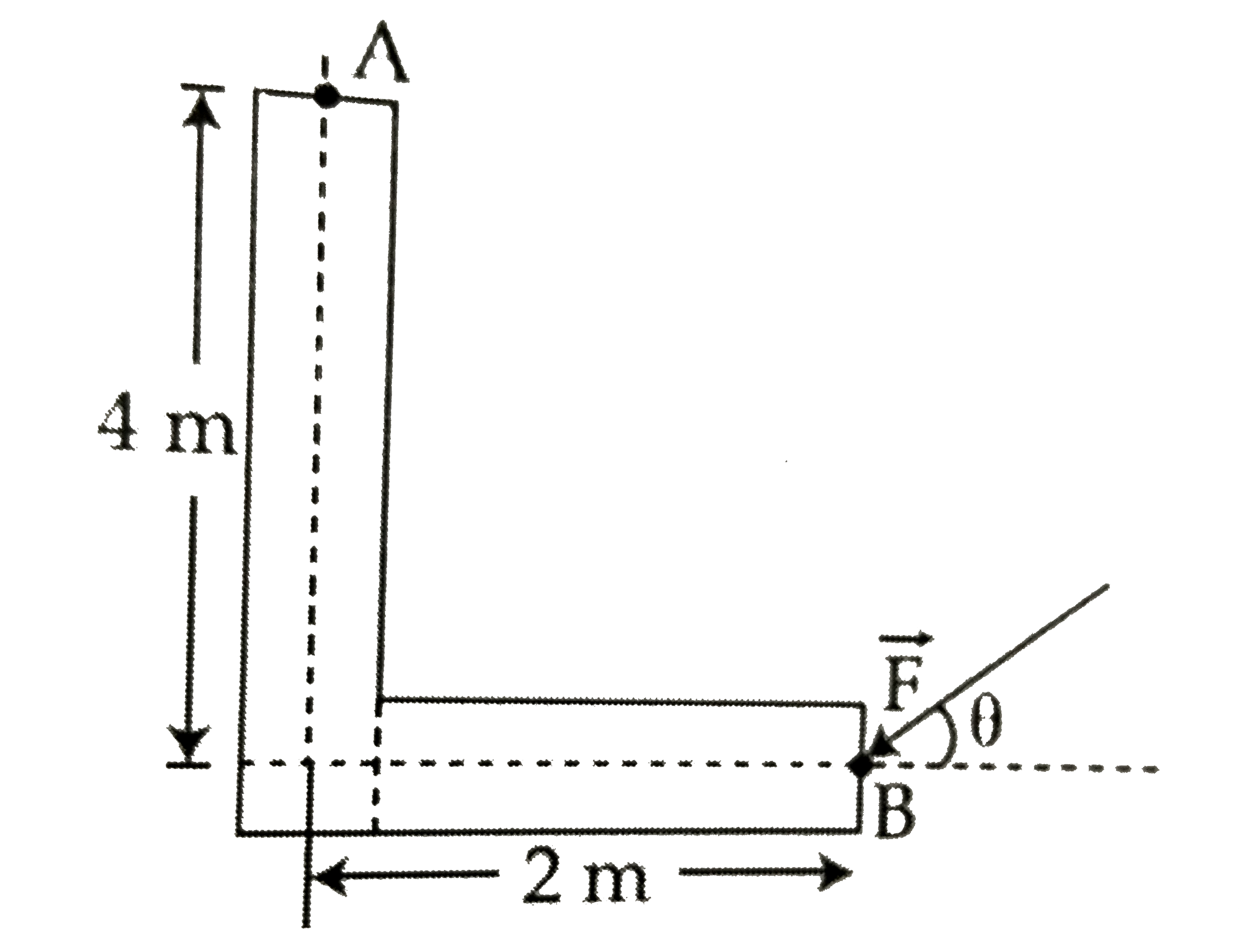
A force of 40 N acts on a point B at the end of the L-shaped object, as shown in the figure. The angle `theta` that will produce maximum moment of the force about point A is given by :
A
`tan theta= 2`
B
`tan theta = 4`
C
`tan theta = 1/2`
D
`tan theta = 1/4`
Text Solution
Verified by Experts
The correct Answer is:
C
Topper's Solved these Questions
JEE MAINS
JEE MAINS PREVIOUS YEAR ENGLISH|Exercise Chemistry|1 Videos
JEE MAIN
JEE MAINS PREVIOUS YEAR ENGLISH|Exercise All Questions|452 Videos
JEE MAINS 2020
JEE MAINS PREVIOUS YEAR ENGLISH|Exercise PHYSICS|250 Videos
Similar Questions
Explore conceptually related problems
Electric lines of force are as shown in the figure. Then potential at point P
A uniform L shaped rod each of side a is held ,as shown in the figure. The angle theta such that rod remains stable. Will be.
The moment of the force F acting at a point P, about the point C is
A force F acting on an object varies with distance x as shown in the figure. The work done by the force in moving the object from x=0 to x = 20 m is
A constant force produces maximum velocity V on the block connected to the spring of force constant K as shown in the figure. When the force constant of spring becomes 4K, the maximum velocity of the block is
Fig.1.31 shows two forces each of magnitude 10N acting at points A and B at a separation of 50cm, in opposite directions. Calculate the resultant moment of the two forces about the point (i) A (ii) B and (iii) O situtated exactly at the middle of the two forces.
Calculate the total torque acting on the body shown in figure about the point O.
Point C is the centre of mass of the rigid body shown in figure. Find the total torque acting on the body about point C.
Power of a force acting on a block varies with time t as shown in figure. Then, angle between force acting on the block and its velocity is
Two forces each of 5 N act vertically upwards and downwards respectively on the two ends of a uniform meter rule which is placed at its mid-point as shown in the diagram. Determine the magnitude of the resultant moment of these forces about the midpoint.
JEE MAINS PREVIOUS YEAR ENGLISH-JEE MAINS-Chemistry