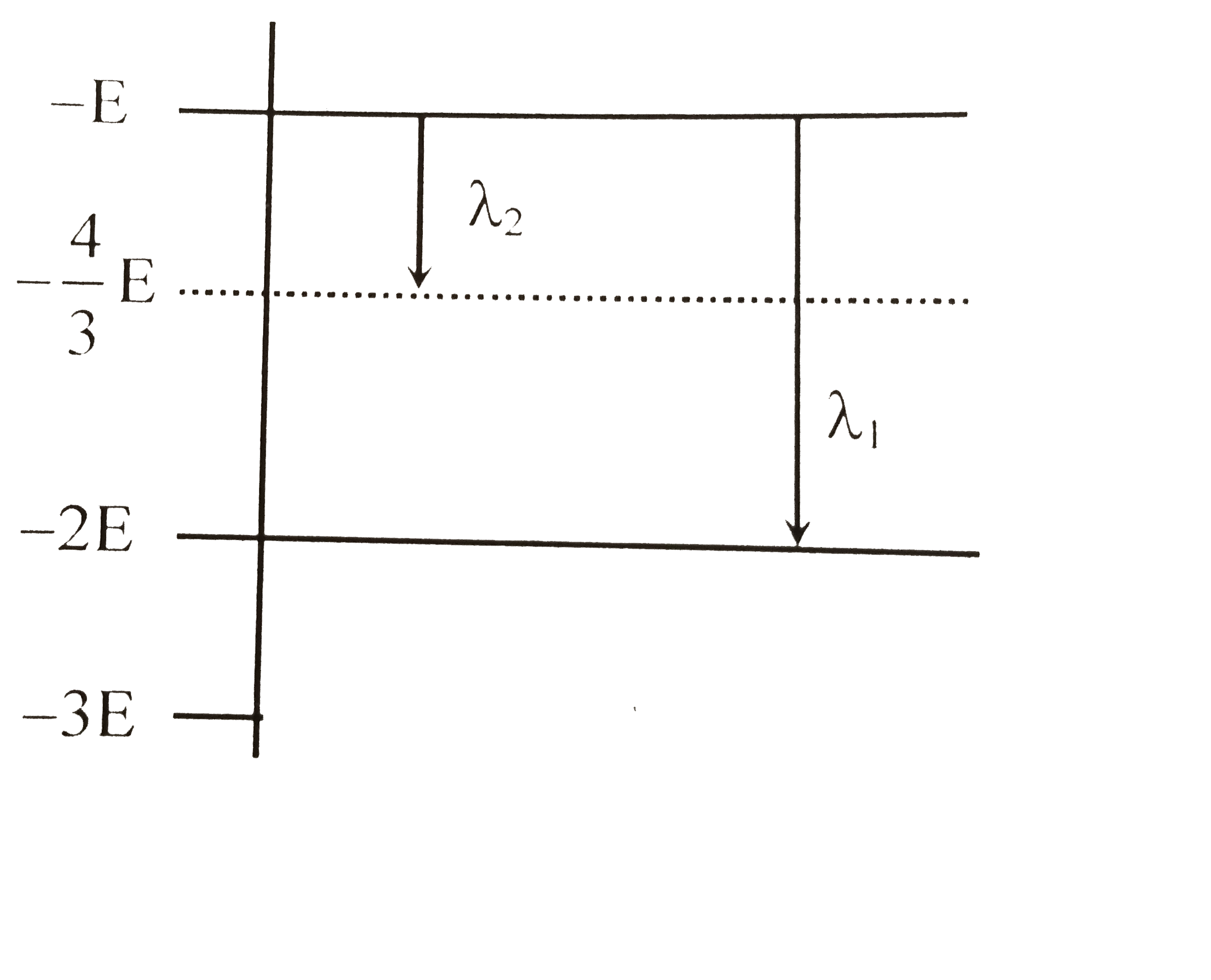
Some energy levels of a molecule are shown in the figure. The ratio of the wavelength `r=lamda_(1)lamda_(2)`,is given by:
A
`n^(-3)`
B
`n^(-2)`
C
`n^(-4)`
D
`n^(-5)`
Text Solution
Verified by Experts
The correct Answer is:
B
Topper's Solved these Questions
JEE MAINS
JEE MAINS PREVIOUS YEAR ENGLISH|Exercise Chemistry|1 Videos
JEE MAIN
JEE MAINS PREVIOUS YEAR ENGLISH|Exercise All Questions|452 Videos
JEE MAINS 2020
JEE MAINS PREVIOUS YEAR ENGLISH|Exercise PHYSICS|250 Videos
Similar Questions
Explore conceptually related problems
If lambda_(1), lamda_(2)and lamda_(3) are the wavelengths of the wave giving resonance with the fundamental, first and second overtones respectively of a closed organ pipe Then the ratio of wavelength lambda_(1), lamda_(2)and lamda_(3) is
The energy levels of a hypotherical one electron atom are shown in figure Find the short wavelength limit of the series terminating at n = 2 .
The photoelectric threshold wavelength for silver is lamda_(0) . The energy of the electron ejected from the surface of silver by an incident wavelength lamda(lamdaltlamda_(0)) will be
A praticle of mass M at rest decays into two particle of masses m_1 and m_2 , having non-zero velocities. The ratio of the de Broglie wavelength of the particles (lamda_1)/(lamda_2) is
The energy levels of an atom are as shown in figure . Which one of those transition will result in the emission of a photon of wavelength 275 nm ?
If lamda_1 and lamda_2 denote the wavelength of de Broglie waves for electrons in the first and second Bohr orbits in a hydrogen atom, the (lamda_1)/(lamda_2) is equal to
V_(1) and V_(2) are the stopping potentials for the incident radiations of wave lengths lamda_(1) and lamda_(2) respectively are incident on a metallic surface. If lamda_(1)=3lamda_(2) then
A particle of mass 3m at rest decays into two particles of masses m and 2m having non-zero velocities. The ratio of the de Broglie wavelengths of the particles ((lamda_1)/(lamda_2)) is
Which graph shows how the energy E of a photon of light is related to its wavelengths (lamda) ?
Electron are accelerated through a potential difference V and protons are accelerated through a potential difference of 4 V. The de-Broglie wavelength are lamda_e and lamda_p for electrons and protons, respectively The ratio of lamda_e/lamda_p is given by ( given , m_e is mass of electron and m_p is mass of proton )
JEE MAINS PREVIOUS YEAR ENGLISH-JEE MAINS-Chemistry