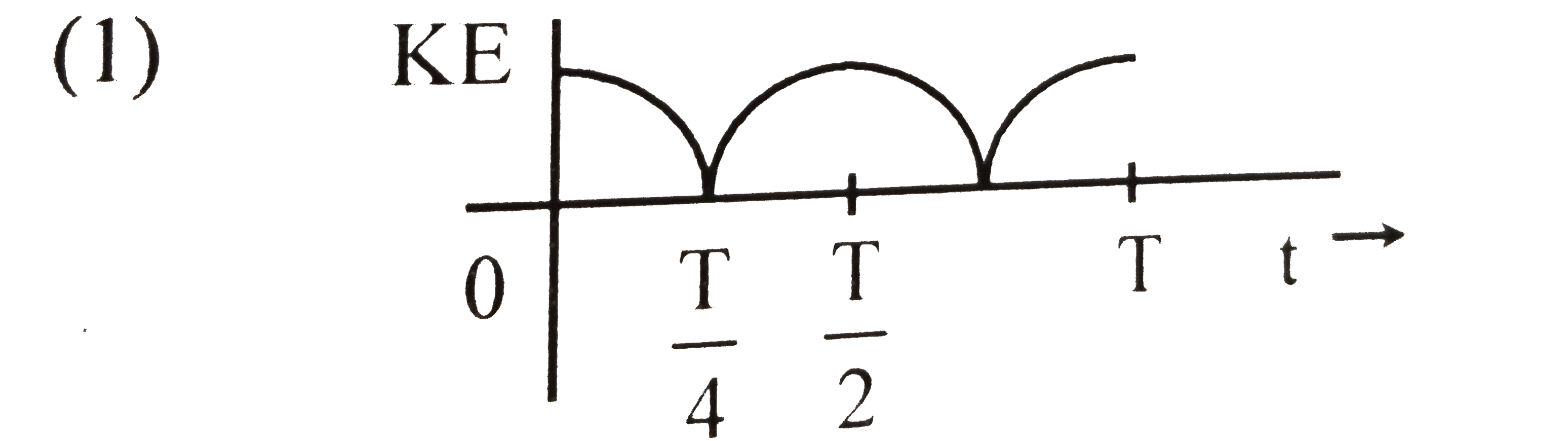
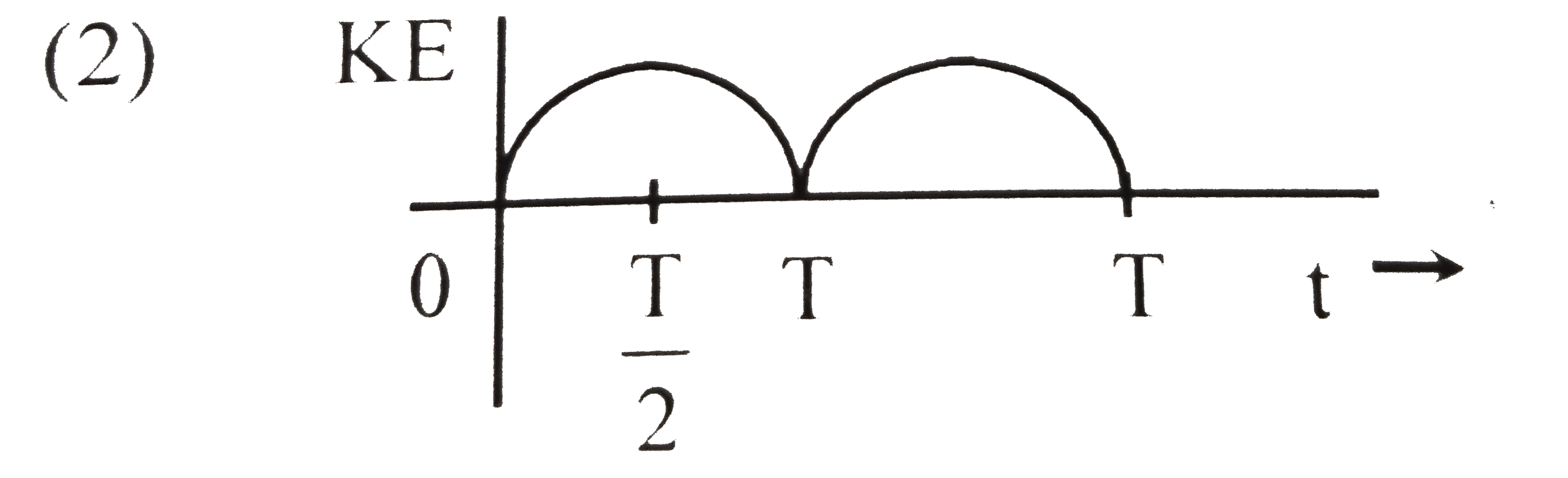
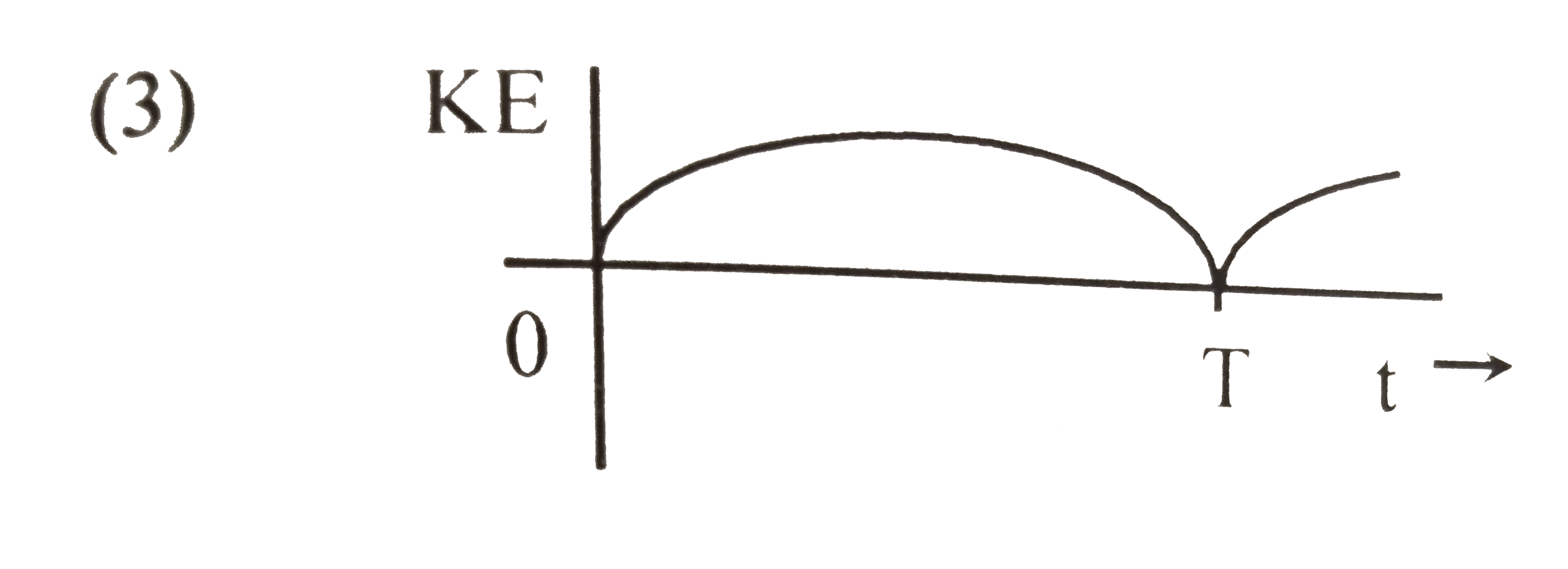
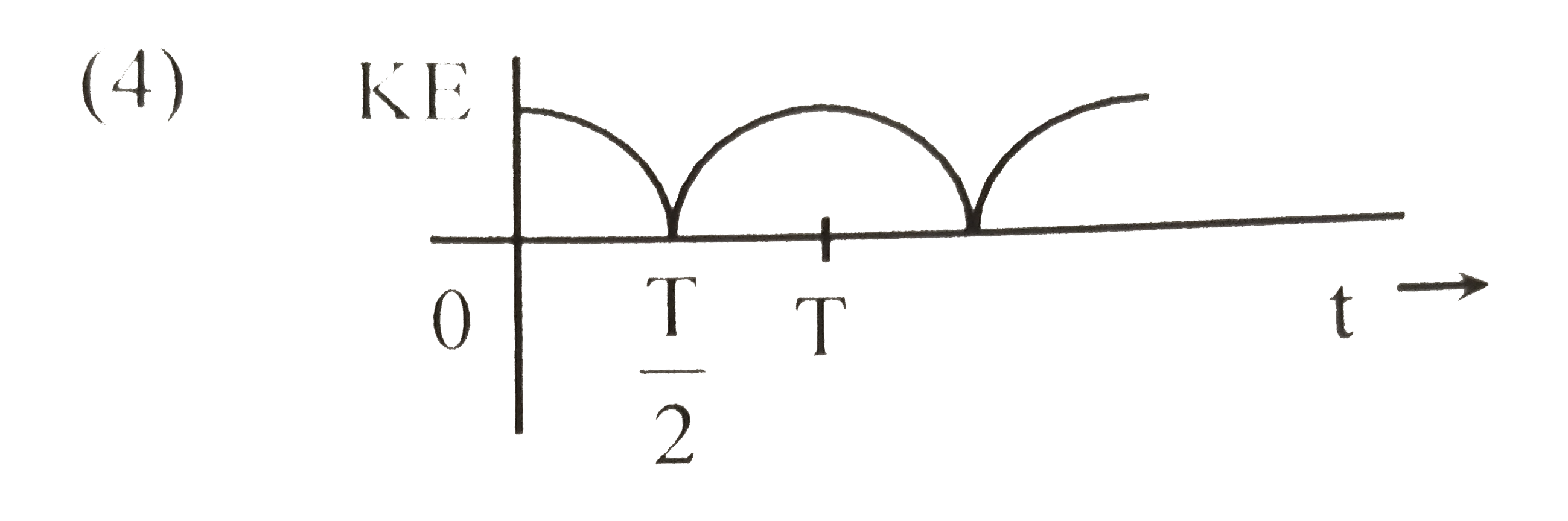
A particle is executing simple harmonic motion with a time period `T`. At time `t=0,` it is at its position of equilibium. The kinetice energy -time graph of the particle will look like
A
B
C
D
Text Solution
AI Generated Solution
The correct Answer is:
To solve the problem of the kinetic energy-time graph of a particle executing simple harmonic motion (SHM), we will follow these steps:
### Step 1: Understand the Motion
A particle in simple harmonic motion can be described by the equation:
\[ x(t) = A \sin(\omega t) \]
where:
- \( A \) is the amplitude,
- \( \omega = \frac{2\pi}{T} \) is the angular frequency,
- \( T \) is the time period.
### Step 2: Find the Velocity
The velocity \( v(t) \) of the particle is the derivative of the displacement:
\[ v(t) = \frac{dx}{dt} = A \omega \cos(\omega t) \]
### Step 3: Calculate the Kinetic Energy
The kinetic energy \( KE \) of the particle is given by:
\[ KE = \frac{1}{2} m v^2 \]
Substituting the expression for velocity:
\[ KE = \frac{1}{2} m (A \omega \cos(\omega t))^2 \]
\[ KE = \frac{1}{2} m A^2 \omega^2 \cos^2(\omega t) \]
### Step 4: Analyze the Kinetic Energy Function
The expression for kinetic energy can be rewritten as:
\[ KE = \frac{1}{2} m A^2 \omega^2 \cos^2(\omega t) \]
This shows that the kinetic energy varies with time according to the function \( \cos^2(\omega t) \).
### Step 5: Determine the Graph Shape
- At \( t = 0 \), \( \cos^2(0) = 1 \), so \( KE \) is at its maximum value.
- As \( t \) increases to \( \frac{T}{4} \), \( \cos^2(\omega t) \) decreases to 0, making \( KE \) minimum.
- At \( t = \frac{T}{2} \), \( \cos^2(\omega t) \) returns to 1, making \( KE \) maximum again.
The kinetic energy will oscillate between a maximum and a minimum value, repeating this pattern every half period.
### Conclusion
The kinetic energy-time graph will be a waveform that starts at its maximum value, decreases to zero, returns to maximum, and repeats this cycle. This corresponds to the graph of \( \cos^2(\omega t) \).
### Final Answer
The kinetic energy-time graph of the particle executing simple harmonic motion will look like a cosine squared wave, starting from maximum kinetic energy at \( t = 0 \).
---
Topper's Solved these Questions
JEE MAINS
JEE MAINS PREVIOUS YEAR ENGLISH|Exercise Chemistry|1 Videos
JEE MAIN
JEE MAINS PREVIOUS YEAR ENGLISH|Exercise All Questions|452 Videos
JEE MAINS 2020
JEE MAINS PREVIOUS YEAR ENGLISH|Exercise PHYSICS|250 Videos
Similar Questions
Explore conceptually related problems
For a particle executing simple harmonic motion, the acceleration is -
A particle executing simple harmonic motion with time period T. the time period with which its kinetic energy oscillates is
A particle is executing simple harmonic motion. Its total energy is proportional to its
If particle is excuting simple harmonic motion with time period T, then the time period of its total mechanical energy is :-
For a particle executing simple harmonic motion, the acceleration is proportional to
While a particle executes linear simple harmonic motion
The displacement of a particle in simple harmonic motion in one time period is
A particle is executing simple harmonic motion with an amplitude A and time period T. The displacement of the particles after 2T period from its initial position is
A particle executing simple harmonic motion with an amplitude A. The distance travelled by the particle in one time period is
A particle executing simple harmonic motion has amplitude of 1 m and time period 2 s . At t = 0 , net force on the particle is zero. Find the equation of displacement of the particle.
JEE MAINS PREVIOUS YEAR ENGLISH-JEE MAINS-Chemistry