

Home
Class 12
PHYSICS
A charge particle of mass m and charge q...

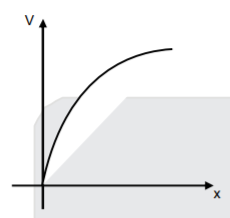
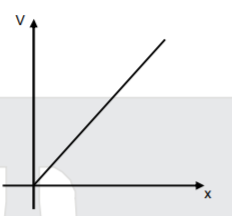
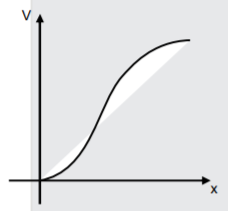
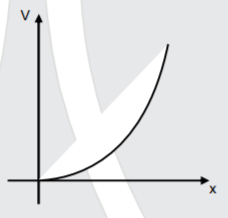
A charge particle of mass m and charge q is released from rest in uniform electric field. Its graph between velocity (v) and distance travelled (x) will be :

A

B

C

D

Text Solution

AI Generated Solution

The correct Answer is:
To solve the problem of a charged particle of mass \( m \) and charge \( q \) released from rest in a uniform electric field, we need to derive the relationship between the velocity \( v \) of the particle and the distance \( x \) it travels. ### Step-by-Step Solution: 1. **Identify the Force on the Charged Particle**: The force \( F \) acting on the charged particle in an electric field \( E \) is given by: \[ F = qE \] 2. **Apply Newton's Second Law**: According to Newton's second law, the force is also equal to the mass times acceleration: \[ F = ma \] Therefore, we can equate the two expressions for force: \[ ma = qE \] From this, we can express the acceleration \( a \) as: \[ a = \frac{qE}{m} \] 3. **Relate Acceleration to Velocity and Distance**: We know that acceleration can also be expressed as the derivative of velocity with respect to time: \[ a = \frac{dv}{dt} \] We can also express \( a \) in terms of velocity and distance: \[ a = v \frac{dv}{dx} \] Setting these equal gives us: \[ v \frac{dv}{dx} = \frac{qE}{m} \] 4. **Separate Variables and Integrate**: Rearranging the equation, we have: \[ v \, dv = \frac{qE}{m} \, dx \] Now, we can integrate both sides. The left side integrates from \( 0 \) to \( v \) and the right side from \( 0 \) to \( x \): \[ \int_0^v v \, dv = \int_0^x \frac{qE}{m} \, dx \] The integral of \( v \) gives: \[ \frac{v^2}{2} \bigg|_0^v = \frac{qE}{m} x \bigg|_0^x \] This results in: \[ \frac{v^2}{2} = \frac{qE}{m} x \] 5. **Rearranging the Equation**: Multiplying both sides by 2 gives: \[ v^2 = \frac{2qE}{m} x \] 6. **Identifying the Graph**: The equation \( v^2 = \frac{2qE}{m} x \) is in the form of \( y = kx \), where \( y = v^2 \) and \( k = \frac{2qE}{m} \). This indicates that the graph of \( v^2 \) against \( x \) is a straight line, and since \( v \) is the square root of \( v^2 \), the graph of \( v \) against \( x \) will be a parabola opening to the right. ### Conclusion: The graph between velocity \( v \) and distance \( x \) will be a parabola symmetric about the x-axis. ---

To solve the problem of a charged particle of mass \( m \) and charge \( q \) released from rest in a uniform electric field, we need to derive the relationship between the velocity \( v \) of the particle and the distance \( x \) it travels. ### Step-by-Step Solution: 1. **Identify the Force on the Charged Particle**: The force \( F \) acting on the charged particle in an electric field \( E \) is given by: \[ F = qE ...
Promotional Banner

Topper's Solved these Questions

  • JEE MAINS

    JEE MAINS PREVIOUS YEAR ENGLISH|Exercise Chemistry|1 Videos

Similar Questions

Explore conceptually related problems

A particle of mass m and charge -q is released from rest in a uniform electric field. If there is no other force on the particle, the dependence of its potential energy on the distance x travelled by it is correctly given by (assume initial potential energy to be zero ,graphs are schematic and not drawn to scale)

A particle of mass m and charge -q is released from rest in a uniform electric field. If there is no other force on the particle, the dependence of its potential energy on the distance x travelled by it is correctly given by (assume initial potential energy to be zero ,graphs are schematic and not drawn to scale)

A charge of mass .m. charge .2e. is released from rest in a uniform electric field of strength .E.. The time taken by it to travel a distance .d. in the field is

A particle of mass and charge is released from rest in a uniform electric field. If there is no other force on the particle, the dependence of its kinetic energy on the distance travelled by it is correctly given by (graphs are schematic and not drawn to scale)

A particle of mass and charge is released from rest in a uniform electric field. If there is no other force on the particle, the dependence of its kinetic energy on the distance travelled by it is correctly given by (graphs are schematic and not drawn to scale)

A charged particle of mass m and charge q is released from rest in an electric field of constant magnitude E . The kinetic energy of the particle after time t is

A particle of mass m and charge q is released from rest in uniform electric field of intensity E. Calculate the kinetic energy it attains after moving a distance y between the plates.

A charged particle of mass m and charge q is released from rest the position (x_0,0) in a uniform electric field E_0hatj . The angular momentum of the particle about origin.

A particle of mass ma and charge q is released from rest in a uniform filed of magnitude E. the uniform field is created between two parallel plates of charge densities +sigma and -sigma , respectively. The particle accelerates toward the other plate a distance d apart. Determine the speed at which it stirkes the opposite plate.

A particle of mass m and charge q is placed at rest in a uniform electric field E and then released, the kinetic energy attained by the particle after moving a distance y will be

JEE MAINS PREVIOUS YEAR ENGLISH-JEE MAIN-All Questions
  1. In the given circuit switch is closed at t = 0. The charge flown in ti...

    Text Solution

    |

  2. A particle is dropped from height h = 100 m, from surface of a planet....

    Text Solution

    |

  3. A charge particle of mass m and charge q is released from rest in unif...

    Text Solution

    |

  4. An object is gradually moving away from the focal point of a concave m...

    Text Solution

    |

  5. In full scale deflection current in galvanometer of 100 ohm resistance...

    Text Solution

    |

  6. There are two identical particles A and B. One is projected vertically...

    Text Solution

    |

  7. The length of a pendulum is measured as 20.0 cm. The time interval for...

    Text Solution

    |

  8. An electron is moving initially with velocity vo hati+vohatj in unifor...

    Text Solution

    |

  9. An asteroid of mass m (m lt lt mE) is approaching with a velocity 12 k...

    Text Solution

    |

  10. In H–spectrum wavelength of 1^(st) line of Balmer series is lambda= 65...

    Text Solution

    |

  11. Two batteries (connected in series) of same emf 10 V of internal resis...

    Text Solution

    |

  12. An EMW is travelling along z-axis vecB=5 xx 10^(-8) hatj T, C=3 xx 10^...

    Text Solution

    |

  13. Kinetic energy of the particle is E and it's De-Broglie wavelength is ...

    Text Solution

    |

  14. The dimensional formula of sqrt((hc^5)/G) is

    Text Solution

    |

  15. Two immiscible liquids of refractive index sqrt 2 and 2sqrt2 are fille...

    Text Solution

    |

  16. The identical solid sphere each having mass m and diameter d are touch...

    Text Solution

    |

  17. A solid sphere having radius R and uniform charge density rho has a ca...

    Text Solution

    |

  18. Consider an infinitely long current carrying cylindrical straight wire...

    Text Solution

    |

  19. Find current in the wire BC.

    Text Solution

    |

  20. Electric field and magnetic field in a region of space are given by(Ē=...

    Text Solution

    |