Home
Class 12
CHEMISTRY
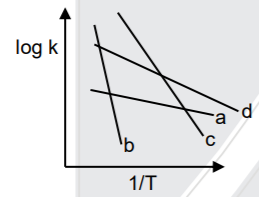
Compare Ea (activation energy) for a, b,...

Compare `E_a` (activation energy) for a, b, c and d.

A

`E_b gt E_c gt E_d gt E_a`

B

`E_a gt E_d gt E_c gt E_b`

C

`E_c gt E_b gt E_a gt E_d`

D

`E_d gt E_a gt E_b gt E_c`

Text Solution

Verified by Experts

The correct Answer is:

A

NA
Promotional Banner

Similar Questions

Explore conceptually related problems

A : For exothermic reaction, DeltaH=E_a (forward) -E_a (backward) R : The value of activation energy for forward direction is less than activation energy for backward reaction.

Given the following diagram for the reaction A+B rarr C+D The enthalpy change and activation energy for the reverse reaction, C+ D rarrA+ B are respectively.

A colliison between reactant molecules must occur with a certain minimum energy before it is effective in yielding Product molecules. This minimum energy is called activation energy E_(a) Large the value of activation energy, smaller the value of rate constant k . Larger is the value of activation energy, greater is the effect of temperature rise on rate constant k . E_(f) = Activation energy of forward reaction E_(b) = Activation energy of backward reaction Delta H = E_(f) - E_(b) E_(f) = threshold energy The activation eneries for forward and backward reactions in a chemical reaction are 30.5 and 45.4 kJ mol^(-1) respectively. The reaction is

A colliison between reactant molecules must occur with a certain minimum energy before it is effective in yielding Product molecules. This minimum energy is called activation energy E_(a) Large the value of activation energy, smaller the value of rate constant k . Larger is the value of activation energy, greater is the effect of temperature rise on rate constant k . E_(f) = Activation energy of forward reaction E_(b) = Activation energy of backward reaction Delta H = E_(f) - E_(b) E_(f) = threshold energy If a reaction A + B rarr C is exothermic to the extent 30 kJ mol^(-1) and the forward reaction has an activation energy of 249 kJ mol^(-1) the activation energy for reverse reaction in kJ mol^(-1) is

A colliison between reactant molecules must occur with a certain minimum energy before it is effective in yielding Product molecules. This minimum energy is called activation energy E_(a) Large the value of activation energy, smaller the value of rate constant k . Larger is the value of activation energy, greater is the effect of temperature rise on rate constant k . E_(f) = Activation energy of forward reaction E_(b) = Activation energy of backward reaction Delta H = E_(f) - E_(b) E_(f) = threshold energy The rate constant of a certain reaction is given by k = Ae^(-E_(a)//RT) (where A = Arrhenius constant). Which factor should be lowered so that the rate of reaction may increase?

What is the effect of adding a catalyst on (a) Activation energy (Ea), and (b) Gibbs energy ( DeltaG ) of a reaction?

A colliison between reactant molecules must occur with a certain minimum energy before it is effective in yielding Product molecules. This minimum energy is called activation energy E_(a) Large the value of activation energy, smaller the value of rate constant k . Larger is the value of activation energy, greater is the effect of temperature rise on rate constant k . E_(f) = Activation energy of forward reaction E_(b) = Activation energy of backward reaction Delta H = E_(f) - E_(b) E_(f) = threshold energy In a hypothetical reaction A rarr B , the activation energies for the forward and backward reactions are 15 and 9 kJ mol^(-1) , respectively. The potential energy of A is 10 kJ mol^(-1) . Which of the following is wrong?

The activation energy of the reaction, A+BtoC+D+38 kcal is 20 kcal. What would be the activation energy pof the following reaction. C+DtoA+B
