

Home
Class 12
PHYSICS
An object is moving away from concave mi...

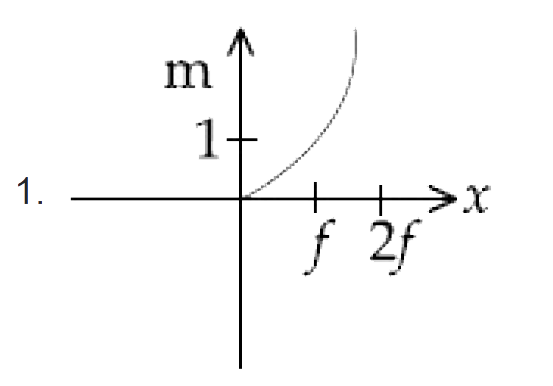
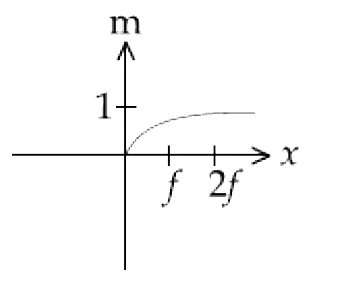
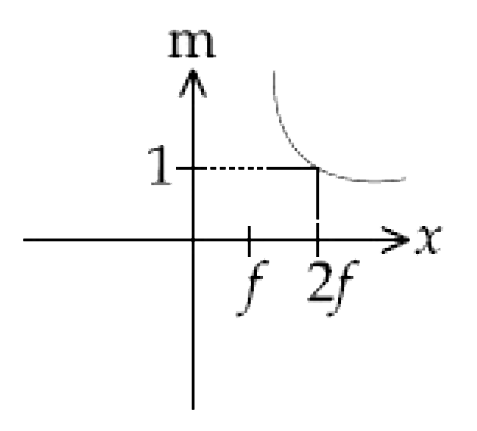
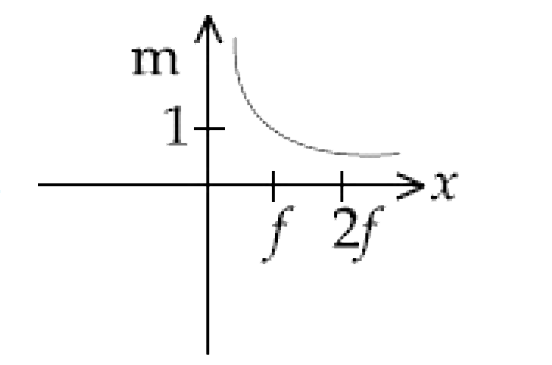
An object is moving away from concave mirror of focal length f starting from focus. The distance of an object from pole of mirror is x. The correct graph of magnitude of magnification(m) verses distance x is:

A

B

C

D

Text Solution

AI Generated Solution

The correct Answer is:
To solve the problem of finding the correct graph of the magnitude of magnification (m) versus the distance (x) for an object moving away from a concave mirror, we can follow these steps: ### Step 1: Understand the Mirror Formula The mirror formula for a concave mirror is given by: \[ \frac{1}{v} + \frac{1}{u} = \frac{1}{f} \] where: - \( v \) = image distance - \( u \) = object distance (negative for concave mirrors) - \( f \) = focal length (negative for concave mirrors) ### Step 2: Set the Initial Conditions The object starts at the focus of the mirror, so: - At the focus, \( u = -f \) (since object distances are taken as negative in mirror convention). - Therefore, at this point, we can calculate the image distance \( v \). ### Step 3: Calculate Magnification at the Focus The magnification \( m \) is defined as: \[ m = -\frac{v}{u} \] At \( u = -f \): - From the mirror formula, substituting \( u = -f \): \[ \frac{1}{v} + \frac{1}{-f} = \frac{1}{f} \] This simplifies to: \[ \frac{1}{v} = \frac{2}{f} \implies v = \frac{f}{2} \] Now substituting \( v \) into the magnification formula: \[ m = -\frac{\frac{f}{2}}{-f} = \frac{1}{2} \] However, as the object is at the focus, the image distance approaches infinity, leading to infinite magnification. ### Step 4: Calculate Magnification at \( x = 2f \) Now, let’s consider when \( x = 2f \): - Here, \( u = -2f \). - Using the mirror formula: \[ \frac{1}{v} + \frac{1}{-2f} = \frac{1}{f} \] This simplifies to: \[ \frac{1}{v} = \frac{1}{f} + \frac{1}{2f} = \frac{3}{2f} \implies v = \frac{2f}{3} \] Now substituting \( v \) into the magnification formula: \[ m = -\frac{\frac{2f}{3}}{-2f} = \frac{1}{3} \] ### Step 5: Analyze the Behavior of Magnification as \( x \) Increases As the object moves further away from the mirror (increasing \( x \)): - The image distance \( v \) will decrease in magnitude. - Consequently, the magnification \( m \) will approach zero but remain negative, indicating that the image is inverted and diminishing in size. ### Step 6: Determine the Graph Characteristics - At \( x = f \), \( m \) is infinite. - At \( x = 2f \), \( m = -1 \). - As \( x \) increases beyond \( 2f \), \( m \) approaches zero. ### Conclusion The correct graph of the magnitude of magnification \( |m| \) versus distance \( x \) will show: - A vertical asymptote at \( x = f \) (where \( m \) is infinite). - A value of \( |m| = 1 \) at \( x = 2f \). - A decreasing curve approaching zero as \( x \) increases.
Promotional Banner

Topper's Solved these Questions

  • JEE MAINS

    JEE MAINS PREVIOUS YEAR ENGLISH|Exercise Chemistry|1 Videos

Similar Questions

Explore conceptually related problems

An object is placed at 20 cm from a convex mirror of focal length 20 cm. The distance of the image from the pole of the mirror is

A convex mirror offocal length fforms an image which is 1/n times the object. The distance of the object from the mirror is:

An object is placed at a distance f in the front of a convex mirror. If focal length of the mirror is f, then distance of image from pole of the mirror is

For a concave mirror of focal length f, image is 2 times larger. Then the object distance from the mirror can be

The image formed by a convex mirror of focal length 30 cm . is a quarter of the object. What is the distance of the object from the mirror ?

An object is moving towards a concave mirror of focal length 24 cm. When it is at a distance of 60 cm from the mirror, its speed is 9 cm//s . The speed of its image at that instant , is

A convex mirror of focal length f produced an image (1//n)^(th) of the size of the object. The distance of the object from the mirror is

An object is kept on the principal axis of a concave mirror of focal length 10cm, at a distance of 15 cm from its pole. The image formed by the mirror is:

An object is gradually moving away from the focal point of a converging lens along the axis of the lens. The graphical representation of the magnitude of linear magnification (m) versus distance of the object from the lens (x) is correctly given by : (Graphs are drawn schematically and are not to scale)

A concave mirror of focal length f produces a real image n times the size of the object. What is the distance of the object from the mirror?

JEE MAINS PREVIOUS YEAR ENGLISH-JEE MAIN-All Questions
  1. A plane electromagnetic wave of frequency 25 GHz is propagating in vac...

    Text Solution

    |

  2. A simple pendulum is being used to determine the value of gravitationa...

    Text Solution

    |

  3. An object is moving away from concave mirror of focal length f startin...

    Text Solution

    |

  4. Two square plates of side 'a' are arranged as shown in the figure. The...

    Text Solution

    |

  5. Velocity of a wave in a wire is v when tension in it is 2.06 × 10^4 N....

    Text Solution

    |

  6. A particle moves so that its position vector is given by vec r = cos o...

    Text Solution

    |

  7. A galvanometer having a coil resistance 100 Omega given full scale ...

    Text Solution

    |

  8. As shown in the figur a battery of emf in is conneced to an inductor...

    Text Solution

    |

  9. Output at terminal Y of given logic circuit.

    Text Solution

    |

  10. A Carnot engine, having an efficiency of eta= 1/10 as heat engine, is ...

    Text Solution

    |

  11. If the wavelength of the first line of the Balmer series of hydrogen i...

    Text Solution

    |

  12. A particle is dropped from height h = 100 m, from surface of a planet....

    Text Solution

    |

  13. The series combination of two batteries both of the same emf 10 V, bu...

    Text Solution

    |

  14. When two non reactive samples at different temperatures are mixed in a...

    Text Solution

    |

  15. Two electromagnetic waves are moving in free space whose electric fiel...

    Text Solution

    |

  16. Consider an infinitely long current carrying cylindrical straight wire...

    Text Solution

    |

  17. Consider, two ideal diatomic gases A and B at some temperature T. Mole...

    Text Solution

    |

  18. Three waves of same intensity (I0) having initial phases 0, pi/4 , - ...

    Text Solution

    |

  19. In the given circuit diagram, a wire is joining points B and D. The cu...

    Text Solution

    |

  20. A particle of mass m is revolving around a planet in a circular orbit ...

    Text Solution

    |