Home
Class 12
PHYSICS
Angular velocity of smooth parabolic wir...

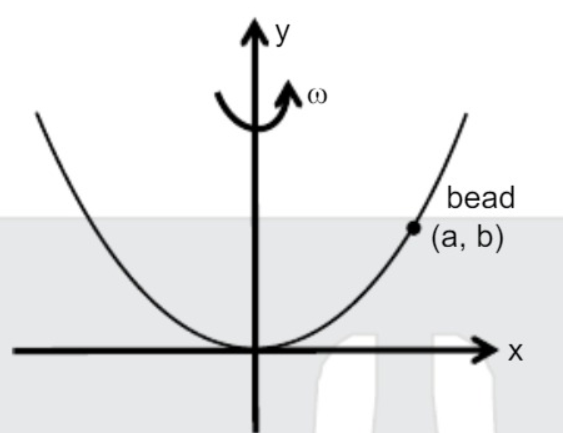
Angular velocity of smooth parabolic wire y = 4c(x)^(2) about axis of parabola in vertical plane if bead of mass m does not slip at (a,b) will be

A

(2gc)^1/2

B

2((2gc/b)^1/2)

C

2((2gc/ab)^1/2)

D

2((2gc)^1/2)

Text Solution

Verified by Experts

The correct Answer is:

D
Promotional Banner

Topper's Solved these Questions

  • JEE MAINS

    JEE MAINS PREVIOUS YEAR ENGLISH|Exercise Chemistry|1 Videos

Similar Questions

Explore conceptually related problems

A small body is released from point A of smooth parabolic path y=x^(2) , where y is vertical axis and x is horizontal axis at ground, as shown. The body leaves the surface from point B. If g = 10ms^(-2) then what is the value of d (in m)?

A smooth wire frasme is in the shape of a parabola y = 5x^(2) . It is being rotated about y-axis with an angular velocity omega . A small bead of mass (m = 1 kg) is at point P and is in equilibrium with respect to the frame. Then the angular velocity omega is (g = 10 m//s^(2))

A piece of wire is bent in the shape of a parabola y=kx^(2) (y-axis vertical) with a bead of mass m on it. The bead can slide on the wire without friction. It stays at the lowest point of the parabola when the wire is at rest. The wire is now accelerated parallel to the x-axis with a constant acceleration a. The distance of the new equilibrium position of the bead, where the bead can stay at rest with respect to the wire, from the y-axis is:

A piece of wire is bent in the shape of a parabola y=kx^(2) (y-axis vertical) with a bead of mass m on it. The bead can slide on the wire without friction. It stays at the lowest point of the parabola when the wire is at rest. The wire is now accelerated parallel to the x-axis with a constant acceleration a. The distance of the new equilibrium position of the bead, where the bead can stay at rest with respect to the wire, from the y-axis is:

A piece of wire is bent in the shape of a parabola y=kx^(2) (y-axis vertical) with a bead of mass m on it. The bead can slide on the wire without friction. It stays at the lowest point of the parabola when the wire is at rest. The wire is now accelerated parallel to the x-axis with a constant acceleration a. The distance of the new equilibrium position of the bead, where the bead can stay at rest with respect to the wire, from the y-axis is:

A piece of wire is bent in the shape of a parabola y = kx^2 (y axis vertical) with a bead of mass mon it. The bead can slide on the wire without friction. It stays at the lowest point of the parabola when the wire is at rest. The wire is now accelerated paralle to the x-axis with a constant acceleration a. The distance of the the new equilibrium position of the bead. Find the x-coordinate where the bead can stay at rest with respect to the wire ?

In the given figure, a smooth parabolic wire track lies in the xy -plane (vertical). The shape of track is defined by the equation y=x^(2) . A ring of mass m which can slide freely on the wire track, is placed at the position A (1,1) . The track is rotated with constant angular speed omega such that there is no relative slipping between the ring and the track. The value of omega is

A particle is placed at the lowest point of a smooth wire frame in the shape of a parabola, lying in the vertical xy-plane having equatioin x^(2) =5y(x,y are in meter). After slight displacement, the particle is set free. Find angular frequency of osciallation (in rad/sec) (Take g=10 m/ s^(2))

A bead of mass m is located on a parabolic wire with its axis vertical and vertex at the origin as shown in figure and whose equastion is x^(2) =4ay . The wire frame is fixed and the bead is released from the point y=4a on the wire frame from rest. The tangential acceleration of the bead when it reaches the position given by y=a is

A bead of mass m is located on a parabolic wire with its axis vertical and vertex at the origin as shown in figure and whose equastion is x^(2) =4ay . The wire frame is fixed and the bead is released from the point y=4a on the wire frame from rest. The tangential acceleration of the bead when it reaches the position given by y=a is

JEE MAINS PREVIOUS YEAR ENGLISH-JEE MAIN-All Questions
  1. A block of mass m start slipping from top of inclined plane at B and c...

    Text Solution

    |

  2. Stopping potential of emitted photo electron is V when monochromatic l...

    Text Solution

    |

  3. Angular velocity of smooth parabolic wire y = 4c(x)^(2) about axis of ...

    Text Solution

    |

  4. Fundamental frequency of two identical strings x and y are 450Hz and 3...

    Text Solution

    |

  5. In a standard YDSE slit width is 1mm and distance of screen from the s...

    Text Solution

    |

  6. A proton enter in a uniform magnetic field of 2.0 mT at an angle of 60...

    Text Solution

    |

  7. Amplitude of carrier wave and message wave are 5 unit and 3 unit resp....

    Text Solution

    |

  8. A rod is heated from 0^@ to 10^@, its length is changed by 0.02%. By w...

    Text Solution

    |

  9. Magnetic moment of the lap

    Text Solution

    |

  10. If area(A), time(T) and momentum(P) is assume as fundamental quantitie...

    Text Solution

    |

  11. vecE & vecB in an electromagnetic wave oscillate along the directionha...

    Text Solution

    |

  12. A charge Q is distributed over two concentric conducting thin spherica...

    Text Solution

    |

  13. A capillary of radius 0.15mm is dipped in liquid of density 'rho' = 66...

    Text Solution

    |

  14. In given potentiometer circuit 1.02 V is balanced at 5.1cm from A. Fin...

    Text Solution

    |

  15. In hydrogen atom electron jumps from (n+1)th state to nth state the fr...

    Text Solution

    |

  16. Displacement time graph of particle performing SHM is as shown in figu...

    Text Solution

    |

  17. A closed box contains an ideal gas if temperature of gas increased whi...

    Text Solution

    |

  18. R1 = R2 = R3 = R4 = 2ohm. Find voltage across capacitor at steady stat...

    Text Solution

    |

  19. Two disc having moment of inertias I1 & I2 and angle velocities omega1...

    Text Solution

    |

  20. A particle of mass m and charge -q is projected from the origin with a...

    Text Solution

    |
