

Home
Class 12
PHYSICS
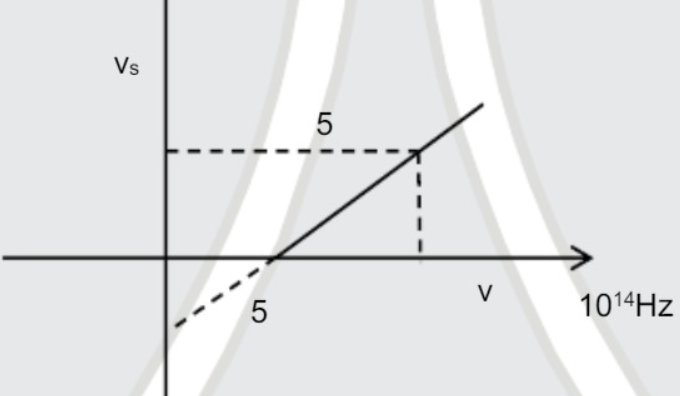
Graph between stopping potential and fre...

Graph between stopping potential and frequency of light as shown find the work function

A

4.01 ev

B

2.07 ev

C

5.01 ev

D

2.09 ev

Text Solution

Verified by Experts

The correct Answer is:
B
Promotional Banner

Topper's Solved these Questions

  • JEE MAINS

    JEE MAINS PREVIOUS YEAR ENGLISH|Exercise Chemistry|1 Videos

Similar Questions

Explore conceptually related problems

Graph between stopping potential and frequency of photon is given in figure Find out work function of metal:

The slope of the graph drawn between stopping potential and frequency of incident radiation will be

In the study of a photoelectric effect the graph between the stopping potential V and frequency nu of the incident radiation on two different metals P and Q is shown in fig. (i) which one of two metals have higher threshold frequency (ii) Determine the work function of the metal which has greater value (iii) Find the maximum kinetic energy of electron emitted by light of frequency 8xx10^(14) Hz for this metal.

In photoelectric effect the slope of straight line graph between stopping potential (V_(s)) and frequency of incident light (v) gives

The figure shows different graphs between stopping potential (V_(0)) and frequency (v) for photosensitive surface of cesium , potassium , sodium and lithium. The plots are parallel. Correct ranking of the targets according to their work function greatest forst will be

A light is incidence on a metallic surface. Graph etween stopping potential V_s and 1/lambda is as shown in figure. when intensity of ligh is increases at given frequency then:

When a high frequency electromagnetic radiation is incident on a metallic surface, electrons are emitted from the surface. Energy of emitted photoelectrons depends only on the frequency of incident electromagnetic radiation and the number of emitted electrons depends only on the intensity of incident light. Einstein's protoelectron equation [K_(max)=hv-phi} correctly explains the PE, where upsilon= frequency of incident light and phi= work function. Q. The slope of the graph between stopping potential and frequency is [here h is the Planck's constant and e is the charge of an electron] is

The graph between 1//lambda and stopping potential (V) of three metals having work- functions Phi_1 , Phi_2 and Phi_3 in an experiment of photoelectric effect is plotted as shown in the figure. Which of the following statement(s) is/are correct? (Here, lambda is the wavelength of the incident ray).

Three metals have work functions in the ratio 2 3:4. Graphs are drawn for all connecting stopping potential and incident frequency. The graphs have slopes in the ratio

The emission of electrons from a metal surface exposed rto light radaition of appropriate wavelength is called photoelectric effect .The emmited electron are called photo=-weklectron work function of threshold energy may be defined as the minimum amount of energy required to ejected electron from a most surface .According to Einstein Maximum kinetic energy of ejected electron = Absorbed energy - Work function (1)/(2) mv_(max)^(2) = h(v) - h(v_(n)) = hv [(1)/(lambda) - (1)/(lambda_(n))] Where v_(n) and lambda_(0) are thereshold frequency and threshold wavelength respectively Sopping potential : it is the miximum potential at which the photoelectric current becomes zero if V_(0) is the stopping potential eV_(0) = h(v- v_(0)) In the photoelectric currect effect the shape of strainght line graph between stopping potential (V_(0)) and frequency of incident light (V) gves

JEE MAINS PREVIOUS YEAR ENGLISH-JEE MAIN-All Questions
  1. Two infinitely large charged planes having uniform surface change dens...

    Text Solution

    |

  2. Gravitational field intensity is given by E = Ax/((A^2 + x^2)^(3/2)) t...

    Text Solution

    |

  3. Graph between stopping potential and frequency of light as shown find ...

    Text Solution

    |

  4. Terminal voltage of cell (emf = 3V & internal resistance = r) is equal...

    Text Solution

    |

  5. A particle at origin (0,0) moving with initial velocity u = 5 m/s hatj...

    Text Solution

    |

  6. For a transverse wave travelling along a straight line , the distance ...

    Text Solution

    |

  7. Intensity of plane polarized light is 3.3 W/m. Area of plane 3 x 10^(-...

    Text Solution

    |

  8. In compound microscope final image formed at 25 cm from eyepiece lens....

    Text Solution

    |

  9. 0.1 mole of gas at 200K is mixed with 0.05 mole of same gas at 400K. I...

    Text Solution

    |

  10. Correct graph of voltage across zener diode will be

    Text Solution

    |

  11. A bar magnet moves with constant velocity as shown in figure through a...

    Text Solution

    |

  12. Two disc made of same material and same thickness having radius R and ...

    Text Solution

    |

  13. Bus moving with speed v forwards a stationary wall. it produces sound ...

    Text Solution

    |

  14. The given circuit behaves like a following single gate

    Text Solution

    |

  15. In the given circuit calculate the potential difference points A and B...

    Text Solution

    |

  16. Find current through 4 ohm resistance

    Text Solution

    |

  17. Force on a particle varies with position (x) of particle as shown, cal...

    Text Solution

    |

  18. A capacitor of capacitance C0 is charged to potential V0. Now it is co...

    Text Solution

    |

  19. Find the ratio of moment of inertia about axis perpendicular to rectan...

    Text Solution

    |

  20. Find the loss in gravitational potential energy of cylinder when value...

    Text Solution

    |