

Home
Class 12
PHYSICS
Which of the following graph represents ...

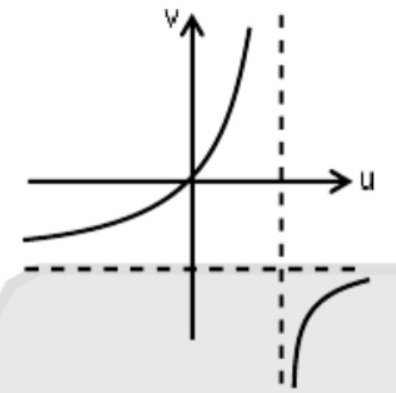
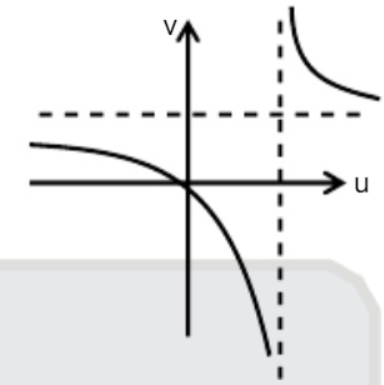
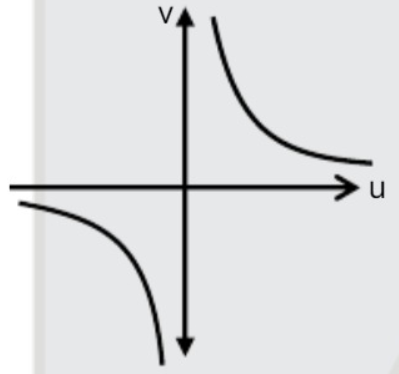
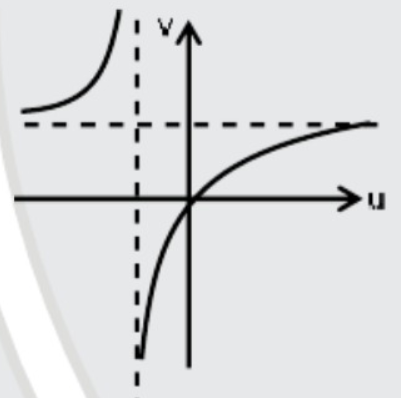
Which of the following graph represents relation between the image position (v) and object position (u) from the concave lens.

A

Option1

B

Option2

C

Option3

D

Option4

Text Solution

AI Generated Solution

The correct Answer is:
To solve the problem of determining which graph represents the relationship between the image position (v) and object position (u) for a concave lens, we will follow these steps: ### Step 1: Understand the Lens Formula The lens formula is given by: \[ \frac{1}{v} - \frac{1}{u} = \frac{1}{f} \] where: - \( v \) = image distance - \( u \) = object distance - \( f \) = focal length of the lens ### Step 2: Identify the Sign Convention For a concave lens: - The focal length \( f \) is negative. - The object distance \( u \) is taken as negative when the object is placed in front of the lens (which is the usual case). ### Step 3: Rewrite the Lens Formula Substituting \( f \) as negative in the lens formula, we get: \[ \frac{1}{v} - \frac{1}{u} = -\frac{1}{|f|} \] This can be rearranged to: \[ \frac{1}{v} = \frac{1}{u} - \frac{1}{|f|} \] This indicates that as \( u \) increases (becomes less negative), \( v \) will also change. ### Step 4: Analyze the Relationship From the rearranged formula, we can see that: - As \( u \) approaches \( -\infty \) (object far away), \( v \) approaches \( -f \) (image position approaches the focal point). - As \( u \) approaches \( 0 \) (object at the focal point), \( v \) approaches \( -\infty \) (image moves further away). ### Step 5: Graphical Representation To plot the graph: - The x-axis represents the object position \( u \) (negative values). - The y-axis represents the image position \( v \) (also negative values). - The graph will start from the point where \( u \) is at \( -\infty \) and \( v \) approaches \( -f \). - As \( u \) increases towards \( 0 \), \( v \) will drop towards \( -\infty \). ### Conclusion The graph representing the relationship between image position \( v \) and object position \( u \) for a concave lens will be a hyperbola that approaches the x-axis and y-axis but never touches them, indicating that both \( v \) and \( u \) are negative. ### Final Answer The correct option is the one that shows a hyperbolic curve representing this relationship.
Promotional Banner

Topper's Solved these Questions

  • JEE MAINS

    JEE MAINS PREVIOUS YEAR ENGLISH|Exercise Chemistry|1 Videos

Similar Questions

Explore conceptually related problems

Which of the following graph(s) represent retardation ? [v : velocity, t : time, x : position]

Which of the following form(s) a virtual and erect image for all position of the object?

Which graph represents positive acceleration ?

Which of the following graph represents v/f vs u/f graph for a virtual erect image by a diverging lens?

Which of the following graph represents v/f vs u/f graph for a virtual erect image by a diverging lens?

A ball thrown vertically upward with initial velocity u. Which of the following graphs represent the velocity of ball correctly as function of time? (Take upward direction as positive)

Which of the following position-time graphs correctly represents two moving objects A and B with zero relative velocity ?

A concave mirrorr of focal length 15 cm forms an image having twice the linear dimensions of the object. The position of the object when the image is virtual will be

Graph of position of image vs position of point object from a convex lens is shown. Then, focal length of the lens is

A linear object is placed on the axis of a lens. An image is formed by refraction in the lens. For all positions of the object on the axis of the lens, the positions of the image are always between the lens and the object. (i) Name the lens. (ii) Draw a ray diagram to show the formation of the image of an object placed in front of the lens at any position of your choice except infinity.

JEE MAINS PREVIOUS YEAR ENGLISH-JEE MAIN-All Questions
  1. In photoelectric effect experiment potential difference between plates...

    Text Solution

    |

  2. A uniformly charged sphere of charge Q and radius R is placed at some ...

    Text Solution

    |

  3. Which of the following graph represents relation between the image pos...

    Text Solution

    |

  4. velocity time graph of a particle is shown in figure. Find displacemen...

    Text Solution

    |

  5. A light of 4 eV incident on metal surface of work function phi eV . An...

    Text Solution

    |

  6. A ring-1 oscillate with period T1 about tangential axis in the plane o...

    Text Solution

    |

  7. A car is moving towards a fixed wall, it blows form of frequency of 44...

    Text Solution

    |

  8. Given that x= (1/sqrt(epsilon0 mu0)), y= E/B & z=(1/RC) . which of the...

    Text Solution

    |

  9. There are two rods of length l1 and l2 and coefficient of linear expan...

    Text Solution

    |

  10. A rod having length l and resistance R is moving with velocity v on a ...

    Text Solution

    |

  11. There are two bodies A and B of same mass. A is placed near equator of...

    Text Solution

    |

  12. Radioactive nucleus A decays into B with half-life 10sec. A also conve...

    Text Solution

    |

  13. Find charge on 5 microF

    Text Solution

    |

  14. An ideal diatomic gas is taken through an adiabatic process in which d...

    Text Solution

    |

  15. A body of mass 2kg at rest is supplied constant power 1J/sec, the dist...

    Text Solution

    |

  16. A dielectric having dielectric constant k =4 is filled in a capacitor ...

    Text Solution

    |

  17. There is prism of refractive index 1.5 and prism angle 2 degree. Find ...

    Text Solution

    |

  18. There is an iron core solenoid of turn density 10 turns/cm and volume ...

    Text Solution

    |

  19. A ball is dropped from height h. If falls on liquid surface. Its veloc...

    Text Solution

    |

  20. A rocket moving in free space has varying mass due to fuel exhausted d...

    Text Solution

    |