

Home
Class 12
CHEMISTRY
For the equilibrium AhArrB , the variati...

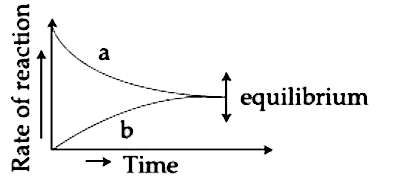
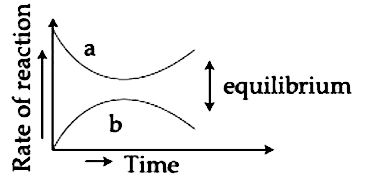
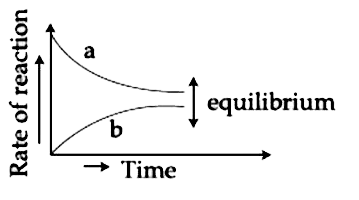
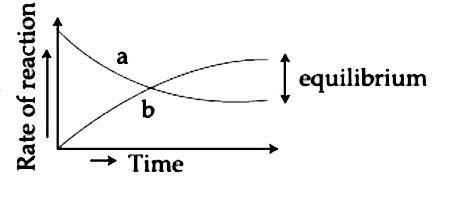
For the equilibrium `AhArrB` , the variation of the rate of the forward (a) and reverse (b) reaction with time is given by :

A

B

C

D

Text Solution

AI Generated Solution

The correct Answer is:
To solve the problem regarding the equilibrium of the reaction \( A \rightleftharpoons B \) and the variation of the rates of the forward and reverse reactions with time, we can follow these steps: ### Step-by-Step Solution: 1. **Understand the Reaction Dynamics**: - The reaction \( A \rightleftharpoons B \) involves the conversion of reactant \( A \) into product \( B \) and vice versa. - Initially, the concentration of reactants \( [A] \) is higher than that of products \( [B] \). **Hint**: Consider how the concentrations of reactants and products change over time. 2. **Rate of Forward and Reverse Reactions**: - The rate of the forward reaction is proportional to the concentration of reactants: \[ \text{Rate}_{\text{forward}} = k_f [A] \] - The rate of the reverse reaction is proportional to the concentration of products: \[ \text{Rate}_{\text{reverse}} = k_r [B] \] **Hint**: Remember that the rates depend on the concentrations of the respective species involved in the reaction. 3. **Initial Conditions**: - At the beginning of the reaction, since \( [A] \) is greater than \( [B] \), the rate of the forward reaction will be greater than that of the reverse reaction. - This means that the forward reaction will dominate initially, leading to a decrease in \( [A] \) and an increase in \( [B] \). **Hint**: Think about how the reaction progresses and how the concentrations change over time. 4. **Approaching Equilibrium**: - As the reaction proceeds, the concentration of \( A \) decreases while the concentration of \( B \) increases. - Eventually, the concentrations will reach a point where the rate of the forward reaction equals the rate of the reverse reaction. **Hint**: Consider what happens to the rates as the concentrations approach a balance. 5. **Equilibrium Condition**: - At equilibrium, the rates of the forward and reverse reactions are equal: \[ k_f [A] = k_r [B] \] - This indicates that the system has reached a state where the concentrations of \( A \) and \( B \) remain constant over time. **Hint**: Recall the definition of chemical equilibrium and how it is characterized by constant concentrations. 6. **Conclusion**: - The correct interpretation of the variation of rates with time indicates that the forward reaction rate decreases while the reverse reaction rate increases until they become equal at equilibrium. ### Final Answer: The best option that describes the variation of the rates of the forward and reverse reactions with time is that initially, the forward reaction rate is greater than the reverse reaction rate, and at equilibrium, both rates are equal.
Promotional Banner

Topper's Solved these Questions

  • JEE MAINS 2020

    JEE MAINS PREVIOUS YEAR ENGLISH|Exercise CHEMSITRY|23 Videos
  • JEE MAINS

    JEE MAINS PREVIOUS YEAR ENGLISH|Exercise QUESTION|1 Videos

Similar Questions

Explore conceptually related problems

For the equilibrium, A(g) rarr B(g) , DeltaH is -40 KJ/mol. If the ratio of the activation energies of the forward (E_(f)) and reverse (E_(b)) reactions is (2)/(3) then:

A reaction having equal energies of activation for forward and reverse reactions has

A reaction having equal energies of activation for forward and reverse reactions has

For the reversible reaction, A+BhArrC , the specific reaction rates for forward and reverse reactions are 1.25xx10^(3) "and" 2.75xx10^(4) respectively. The equilibrium constant for the reaction is:

The free energy change for a reversible reaction at equilibrium is

Mass action rato or reaction quotient Q for a reaction can be calculate using the law of masss action A(g)+B(g) hArr C(g)+D(g) Q=([C][D])/([A][B]) The value of Q decides whether the reaction is at equilibrium or not. At equilibrium, Q=K For an equilibrium process, Q ne K when Q gt K , reaction will favour backward direction and when Q lt K , it will favour direction. Answer the following questions: In the reaction: NH_(4)Cl(g) hArr NH_(3)(g)+HCl(g) a graph is plotted to show that the variation or the rate of forward and backward reaction against time. Which of following is correct?

For the reaction A+B hArr C , the rate constants for the forward and the reverse reactions are 4xx10^(2) and 2xx10^(2) respectively. The value of equilibrium constant K for the reaction would be

Draw a representative reaction curve for an exothermic reaction and (i) label the activation energies for the forward and reverse reaction (ii) enthalpy for the forward and reverse reactions. How will the curve change with the addition of a catalyst ?

For an equilibrium reaction, the rate constants for the forward and the backward reaction are 2.38xx10^(-4) and 8.15xx10^(-5) , respectively. Calculate the equilibrium constant for the reaction.

For the physical equilibrium ice hArr water, the forward reaction is not favoured by

JEE MAINS PREVIOUS YEAR ENGLISH-JEE MAINS 2020-CHEMSITRY
  1. For the equilibrium AhArrB , the variation of the rate of the forward ...

    Text Solution

    |

  2. The correct statement with respect to dinitrogen is :

    Text Solution

    |

  3. The major product obtained from the following reaction is :

    Text Solution

    |

  4. A solution of two components containing n1 moles of 1^(st) component a...

    Text Solution

    |

  5. The INCORRECT statement is :

    Text Solution

    |

  6. Consider the Assertion and Reason given below. Assertion (A) : Ethe...

    Text Solution

    |

  7. Arrange the following solutions in the decreasing order of pOH : (A...

    Text Solution

    |

  8. Among the sulphates of alkaline earth metals the solubilities of BeSO4...

    Text Solution

    |

  9. The major products of the following reaction are : CH3 -overset(CH...

    Text Solution

    |

  10. The major product of the following reaction is :

    Text Solution

    |

  11. A sample of toothpaste weighing 500 g, on analysis was found to contai...

    Text Solution

    |

  12. Which of the following compounds shows geometrical isomerism ?

    Text Solution

    |

  13. The set that contains atomic numbers of only transition elements , is ...

    Text Solution

    |

  14. The variation of equilibrium constant with temperature is given below ...

    Text Solution

    |

  15. Kraft temperature is the temperature :

    Text Solution

    |

  16. For the reaction Fe2N(s)+(3)/(2)H2(g)=2Fe(s)+NH3(g)

    Text Solution

    |

  17. The species that has a spin -only magnetic moment of 5.9 BM , is : (...

    Text Solution

    |

  18. Which of the following Lanthanides element do not show stable +4 oxida...

    Text Solution

    |

  19. Consider the following reaction A to P1, B to P2 , C to P3 , D to P4...

    Text Solution

    |

  20. In an estimation of bromine by Carius method , 1.6 g of an organic co...

    Text Solution

    |

  21. Potassium chlorate is prepared by the electrolusis of KCl in basic med...

    Text Solution

    |