Identify the correct molecular picture showing what happens at the critical micellar concentration (CMC) of an aqueous solution of a surfactant ( polar head , non - polar tail , water ) .
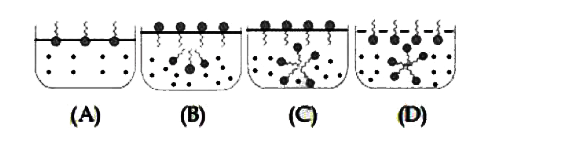
Identify the correct molecular picture showing what happens at the critical micellar concentration (CMC) of an aqueous solution of a surfactant ( polar head , non - polar tail , water ) .
A
(D)
B
(B)
C
(A)
D
(C)
Text Solution
Verified by Experts



Topper's Solved these Questions
Similar Questions
Explore conceptually related problems
Assertion (A): Micelles are formed by surfactant molecules above the critical micellization concentration (CMC) . Reason(R): The conductivity of a solution having surfactant molecules decreases sharply at the CMC . (a)If both (A) and (R) are correct, and (R) is the correct explanation of (A). (b)If both (A) and (R) are correct, but (R) is not the correct explanation of (A). (c)If (A) is incorrect, but (R) is correct. (d)If both (A) and (R) are incorrect.
There are certain substances which behave as normal, strong electrolyte at low concentration but at higher concentration they behave as colloidal solutions due to the formation of aggeregated particles. Such colloidals called associated colloids and the aggeregated particles are called micelles. The formation of micelles take place above certain concentration called critical micelization concentration called critical micellization concentration (CMC) and a characteristic temperature. Above CMC, the surfactant molecules undergo (more than one correct)
Molar conductivity (L) m of aqueous solution of sodium stearate, which behaves as a strong electrolyte, is recorded at varying concentrations (c) of sodium stearate. Which one of the following plots provides the correct representation of micelle formation in the solution? (Critical micelle concentration (CMC) is marked with an arrow in the figures)
I_(2) has less solubility in water and its solubility increase on adding KI solution. When KI and I_(2) react then a species 'X' is formed by which solubility of I_(2) increases. Which of the following of the is the correct characteristic of anionic part of 'X' ? [Polar and non-polar nature to be considered on the basis of dipole moment] (I) Planar (II) non-planar (III) polar (IV) non-polar
The colloidal particles are electrically charged as a indicated by their migration towards cathode or anode under the applied electric field. In a particular colloidal system, all particles carry either positive charge or negative charge. The electric charge on colloidal particles orginate in several ways. According to preferential adsorption theory, the freshly obtained precipitate particles adsorb ions from the dispersion medium, which are common to their lattice and acquire the charge of adsorbed ions. For example, For example, freshly obtained Fe(OH)_(3) precipitated is dispersed, by a little FeCl_(3) , into colloidal solution owing to the adsorption of Fe^(3+) ions in preference. Thus sol particles will be positively charged. In some cases the colloidal particles are aggregates of cations or anions having ampiphilic character. When the ions posses hydrophobic part (hydrocarbon end) as well as hydrophilic part (polar end group), they undergo association in aqueous solution to form particles having colloidal size. The formation of such particles, called micelles plays a very important role in the solubilization of water insoluble substances, (hydrocarbon, oils, fats, grease etc.). In micelles, the polar end groups are directed towards water and the hydrocarbon ends into the centre. The charge on sol particles of proteins depends on the pH. At low pH, the basic group of protein molecule is ionized (protonated) and at higher pH (alkaline medium), the acidic group is ionized. At isoelectric pH, characteristic to the protein, both basix and acidic groups are equally ionized. The stability of colloidal solution is attributed largely to the electric charge of the dispersed particles. This charge causes them to be coagulated or precipitated. On addition of small amount of electrolytes, the ions carrying oppiste charge are adsorbed by sol particles resulting in the neutralization of their charge. When the sol particles either with no charge or reduced charge, come closer due to Brownian movement, they coalesce to form bigger particles resulting in their separation from the dispersion medium. This is what is called coagulating or precipitation of the colloidal solution. The coagulating power of the effective ion, which depend on its charge, is expressed in terms of its coagulating value, defined as its minimum concentration (m mol/L) needed to precipitate a given sol. Under the influence of an electric field, the particles in a sol migrate towards cathode. The coagulation of the same sol is studied using NaCl, Na_(2)SO_(4) and Na_(3)PO_(4) solutions. Their coagulating values will be in the order :
The colloidal particles are electrically charged as a indicated by their migration towards cathode or anode under the applied electric field. In a particular colloidal system, all particles carry either positive charge or negative charge. The electric charge on colloidal particles orginate in several ways. According to preferential adsorption theory, the freshly obtained precipitate particles adsorb ions from the dispersion medium, which are common to their lattice and acquire the charge of adsorbed ions. For example, For example, freshly obtained Fe(OH)_(3) precipitated is dispersed, by a little FeCl_(3) , into colloidal solution owing to the adsorption of Fe^(3+) ions in preference. Thus sol particles will be positively charged. In some cases the colloidal particles are aggregates of cations or anions having ampiphilic character. When the ions posses hydrophobic part (hydrocarbon end) as well as hydrophilic part (polar end group), they undergo association in aqueous solution to form particles having colloidal size. The formation of such particles, called micelles plays a very important role in the solubilization of water insoluble substances, (hydrocarbon, oils, fats, grease etc.). In micelles, the polar end groups are directed towards water and the hydrocarbon ends into the centre. The charge on sol particles of proteins depends on the pH. At low pH, the basic group of protein molecule is ionized (protonated) and at higher pH (alkaline medium), the acidic group is ionized. At isoelectric pH, characteristic to the protein, both basix and acidic groups are equally ionized. The stability of colloidal solution is attributed largely to the electric charge of the dispersed particles. This charge causes them to be coagulated or precipitated. On addition of small amount of electrolytes, the ions carrying oppiste charge are adsorbed by sol particles resulting in the neutralization of their charge. When the sol particles either with no charge or reduced charge, come closer due to Brownian movement, they coalesce to form bigger particles resulting in their separation from the dispersion medium. This is what is called coagulating or precipitation of the colloidal solution. The coagulating power of the effective ion, which depend on its charge, is expressed in terms of its coagulating value, defined as its minimum concentration (m mol/L) needed to precipitate a given sol. Which of the following ions would have the minimum coagulating value for sol obtained on peptizing Sn(OH)_(4) by little NaOH solution?
The colloidal particles are electrically charged as a indicated by their migration towards cathode or anode under the applied electric field. In a particular colloidal system, all particles carry either positive charge or negative charge. The electric charge on colloidal particles orginate in several ways. According to preferential adsorption theory, the freshly obtained precipitate particles adsorb ions from the dispersion medium, which are common to their lattice and acquire the charge of adsorbed ions. For example, For example, freshly obtained Fe(OH)_(3) precipitated is dispersed, by a little FeCl_(3) , into colloidal solution owing to the adsorption of Fe^(3+) ions in preference. Thus sol particles will be positively charged. In some cases the colloidal particles are aggregates of cations or anions having ampiphilic character. When the ions posses hydrophobic part (hydrocarbon end) as well as hydrophilic part (polar end group), they undergo association in aqueous solution to form particles having colloidal size. The formation of such particles, called micelles plays a very important role in the solubilization of water insoluble substances, (hydrocarbon, oils, fats, grease etc.). In micelles, the polar end groups are directed towards water and the hydrocarbon ends into the centre. The charge on sol particles of proteins depends on the pH. At low pH, the basic group of protein molecule is ionized (protonated) and at higher pH (alkaline medium), the acidic group is ionized. At isoelectric pH, characteristic to the protein, both basix and acidic groups are equally ionized. The stability of colloidal solution is attributed largely to the electric charge of the dispersed particles. This charge causes them to be coagulated or precipitated. On addition of small amount of electrolytes, the ions carrying oppiste charge are adsorbed by sol particles resulting in the neutralization of their charge. When the sol particles either with no charge or reduced charge, come closer due to Brownian movement, they coalesce to form bigger particles resulting in their separation from the dispersion medium. This is what is called coagulating or precipitation of the colloidal solution. The coagulating power of the effective ion, which depend on its charge, is expressed in terms of its coagulating value, defined as its minimum concentration (m mol/L) needed to precipitate a given sol. A gelatin sol at pH less than the isoelectric value is subjected to an electric field. The sol particles migrate toward :
The colloidal particles are electrically charged as a indicated by their migration towards cathode or anode under the applied electric field. In a particular colloidal system, all particles carry either positive charge or negative charge. The electric charge on colloidal particles orginate in several ways. According to preferential adsorption theory, the freshly obtained precipitate particles adsorb ions from the dispersion medium, which are common to their lattice and acquire the charge of adsorbed ions. For example, For example, freshly obtained Fe(OH)_(3) precipitated is dispersed, by a little FeCl_(3) , into colloidal solution owing to the adsorption of Fe^(3+) ions in preference. Thus sol particles will be positively charged. In some cases the colloidal particles are aggregates of cations or anions having ampiphilic character. When the ions posses hydrophobic part (hydrocarbon end) as well as hydrophilic part (polar end group), they undergo association in aqueous solution to form particles having colloidal size. The formation of such particles, called micelles plays a very important role in the solubilization of water insoluble substances, (hydrocarbon, oils, fats, grease etc.). In micelles, the polar end groups are directed towards water and the hydrocarbon ends into the centre. The charge on sol particles of proteins depends on the pH. At low pH, the basic group of protein molecule is ionized (protonated) and at higher pH (alkaline medium), the acidic group is ionized. At isoelectric pH, characteristic to the protein, both basix and acidic groups are equally ionized. The stability of colloidal solution is attributed largely to the electric charge of the dispersed particles. This charge causes them to be coagulated or precipitated. On addition of small amount of electrolytes, the ions carrying oppiste charge are adsorbed by sol particles resulting in the neutralization of their charge. When the sol particles either with no charge or reduced charge, come closer due to Brownian movement, they coalesce to form bigger particles resulting in their separation from the dispersion medium. This is what is called coagulating or precipitation of the colloidal solution. The coagulating power of the effective ion, which depend on its charge, is expressed in terms of its coagulating value, defined as its minimum concentration (m mol/L) needed to precipitate a given sol. How would you obtain a sol of AgI, the particles of which migrate towards cathode under the electric field?
The colloidal particles are electrically charged as a indicated by their migration towards cathode or anode under the applied electric field. In a particular colloidal system, all particles carry either positive charge or negative charge. The electric charge on colloidal particles orginate in several ways. According to preferential adsorption theory, the freshly obtained precipitate particles adsorb ions from the dispersion medium, which are common to their lattice and acquire the charge of adsorbed ions. For example, For example, freshly obtained Fe(OH)_(3) precipitated is dispersed, by a little FeCl_(3) , into colloidal solution owing to the adsorption of Fe^(3+) ions in preference. Thus sol particles will be positively charged. In some cases the colloidal particles are aggregates of cations or anions having ampiphilic character. When the ions posses hydrophobic part (hydrocarbon end) as well as hydrophilic part (polar end group), they undergo association in aqueous solution to form particles having colloidal size. The formation of such particles, called micelles plays a very important role in the solubilization of water insoluble substances, (hydrocarbon, oils, fats, grease etc.). In micelles, the polar end groups are directed towards water and the hydrocarbon ends into the centre. The charge on sol particles of proteins depends on the pH. At low pH, the basic group of protein molecule is ionized (protonated) and at higher pH (alkaline medium), the acidic group is ionized. At isoelectric pH, characteristic to the protein, both basix and acidic groups are equally ionized. The stability of colloidal solution is attributed largely to the electric charge of the dispersed particles. This charge causes them to be coagulated or precipitated. On addition of small amount of electrolytes, the ions carrying oppiste charge are adsorbed by sol particles resulting in the neutralization of their charge. When the sol particles either with no charge or reduced charge, come closer due to Brownian movement, they coalesce to form bigger particles resulting in their separation from the dispersion medium. This is what is called coagulating or precipitation of the colloidal solution. The coagulating power of the effective ion, which depend on its charge, is expressed in terms of its coagulating value, defined as its minimum concentration (m mol/L) needed to precipitate a given sol. 100 ml each of two sols of AgI, one obtained by adding AgNO_(3) to slight excess of KI and another obtained by adding KI to slight excess of AgNO_(3) , are mixed together. Then :
Read the assertion and reason carefully to mark the correct option in question. Assertion: In the cell membrane , the non-polar tail of saturated hydrocarbons is protected from the aqueous environment. Reason: The lipids are arranged within the membrane with polar head towards the outer sides and the hydrophobic tail towards the inner part.
JEE MAINS PREVIOUS YEAR ENGLISH-JEE MAINS 2020-CHEMSITRY
- Identify the correct molecular picture showing what happens at the cri...
Text Solution
|
- The correct statement with respect to dinitrogen is :
Text Solution
|
- The major product obtained from the following reaction is :
Text Solution
|
- A solution of two components containing n1 moles of 1^(st) component a...
Text Solution
|
- The INCORRECT statement is :
Text Solution
|
- Consider the Assertion and Reason given below. Assertion (A) : Ethe...
Text Solution
|
- Arrange the following solutions in the decreasing order of pOH : (A...
Text Solution
|
- Among the sulphates of alkaline earth metals the solubilities of BeSO4...
Text Solution
|
- The major products of the following reaction are : CH3 -overset(CH...
Text Solution
|
- The major product of the following reaction is :
Text Solution
|
- A sample of toothpaste weighing 500 g, on analysis was found to contai...
Text Solution
|
- Which of the following compounds shows geometrical isomerism ?
Text Solution
|
- The set that contains atomic numbers of only transition elements , is ...
Text Solution
|
- The variation of equilibrium constant with temperature is given below ...
Text Solution
|
- Kraft temperature is the temperature :
Text Solution
|
- For the reaction Fe2N(s)+(3)/(2)H2(g)=2Fe(s)+NH3(g)
Text Solution
|
- The species that has a spin -only magnetic moment of 5.9 BM , is : (...
Text Solution
|
- Which of the following Lanthanides element do not show stable +4 oxida...
Text Solution
|
- Consider the following reaction A to P1, B to P2 , C to P3 , D to P4...
Text Solution
|
- In an estimation of bromine by Carius method , 1.6 g of an organic co...
Text Solution
|
- Potassium chlorate is prepared by the electrolusis of KCl in basic med...
Text Solution
|