

Home
Class 11
PHYSICS
A particle moves in a circle of radius 4...

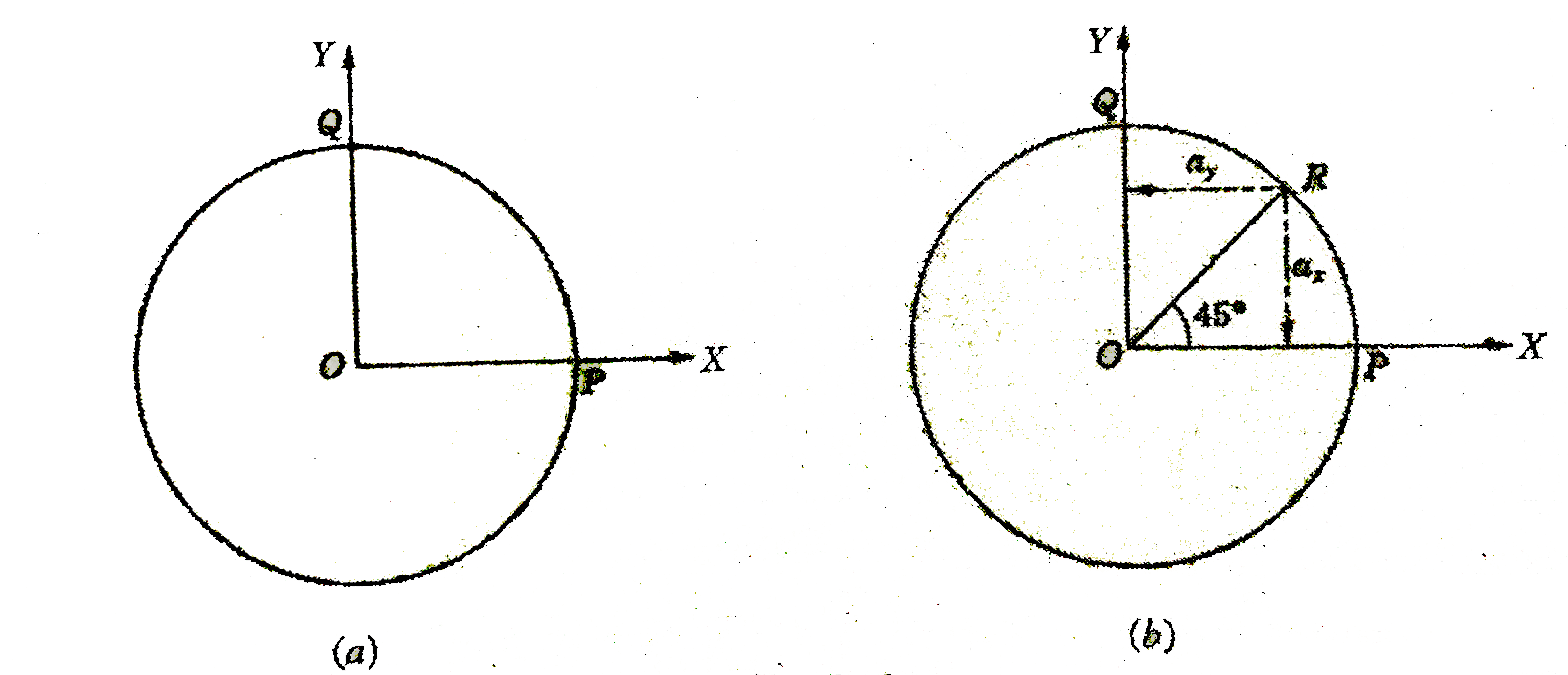
A particle moves in a circle of radius 4.0 cm clockwise at constant speed of `2 ms^(-1)`. If `hat(x)` and `hat(y)` are unit acceleration vectors along X-axis and Y-axis respectively (in `cms^(-2)`), find the acceleration of the particle at the instant half way between P and Q. Refer to Fig.5.14 (a).

Promotional Banner

Topper's Solved these Questions

  • Motion in a Plane

    SL ARORA|Exercise Excercise|397 Videos
  • Motion in a Plane

    SL ARORA|Exercise Excercise|397 Videos
  • MECHANICS

    SL ARORA|Exercise Exercise|341 Videos
  • MOTION IN ONE DIMENSION

    SL ARORA|Exercise problems for self practice|66 Videos

Similar Questions

Explore conceptually related problems

A particle moves in a circle of radius 4.0 cm clockwese at constant speed of 2cm S^(-1) . If hat x and hat y ar unit accleration vectors along X- asis and Y-axis respectively, find the accleration of the particle at the instant half way between PQ. Fig. 2 ( d) . 38. .

A particle is moving on a circular track of radius 30 cm with a constant speed of 6ms^(-1) . Its acceleration is

A particle moves in a circle of radius 5 cm with constant speed and time period 0.2pi . The acceleration of the particle is:

A particle moves in a circle of radius 5 cm with constant speed and time period 0.2pis . The acceleration of the particle is

A particle moves in a circle of radius 5 cm with constant speed and time period 0.2pis . The acceleration of the particle is

If hat i and hat j are unit vectors along X - and Y -axis respectively,then what is the magnitude and direction of hat i+hat j and hat i-hat j?

If hat(i), hat(j) and hat(k) are unit vectors along x,y and z-axis respectively, the angle theta between the vector hat(i) + hat(j) + hat(k)" ""and vector" hat(j) is given by

The displacement of a particle moving along x-axis is given by : x = a + bt + ct^2 The acceleration of the particle is.

Assertion: If hat(i) and hat(j) are unit Vectors along x-axis and y-axis respectively, the magnitude of Vector hat(i)+hat(j) will be sqrt(2) Reason: Unit vectors are used to indicate a direction only.

The angle which the vector vec(A)=2hat(i)+3hat(j) makes with the y-axis, where hat(i) and hat(j) are unit vectors along x- and y-axis, respectively, is

SL ARORA-Motion in a Plane-Example
  1. A ball is thrown at angle theta and another ball is thrown at an angle...

    Text Solution

    |

  2. If R is the horizontal range for theta inclination and h is the maximu...

    Text Solution

    |

  3. There are two angles of projection for which the horizontal range is t...

    Text Solution

    |

  4. Show that there are two values of time for which is projectile is at t...

    Text Solution

    |

  5. Two projectiles are thrown with different velocities and at different ...

    Text Solution

    |

  6. A hunter aims his fun and fires a bullet directly at a monkey on a tre...

    Text Solution

    |

  7. A machine gun is mounted on the top of a tower of height h. At what an...

    Text Solution

    |

  8. At what angle should a body be projected with a velocity 24 ms^(-1). J...

    Text Solution

    |

  9. A target is fixed on the top of a pole 13 metre high. A person standin...

    Text Solution

    |

  10. A particle is projected over a traingle from one end of a horizontal b...

    Text Solution

    |

  11. A shell is fired from a gun from the bottom of a hill along its slope....

    Text Solution

    |

  12. Which is greater : the angular velocity of hour hand of a watch or ang...

    Text Solution

    |

  13. Calculate the angular speed of flywheel making 420 revolutions per min...

    Text Solution

    |

  14. A body of mass 10 kg revolves in a circle of diameter 0.40 m, making 1...

    Text Solution

    |

  15. Find the magnitude of the centripetal acceleration of a particle on th...

    Text Solution

    |

  16. An insect trapped in a circular groove of radius, 12 cm moves along th...

    Text Solution

    |

  17. An insect trapped in circular groove of radius 12 cm moves along the g...

    Text Solution

    |

  18. An insect trapped in a circular groove of radius, 12 cm moves along th...

    Text Solution

    |

  19. The radius of the earth's orbit around the sun is 1.5 xx 10^(11)m. Cal...

    Text Solution

    |

  20. A particle moves in a circle of radius 4.0 cm clockwise at constant sp...

    Text Solution

    |