

Home
Class 11
PHYSICS
Consider the decay of a free neutron at ...

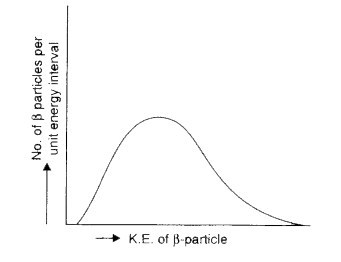
Consider the decay of a free neutron at rest: n`top+e^(-)` Show that the tow-body dacay of this type must necessarily give an electron of fixed energy and, therefore, cannot for the observed continous energy distribution in the `beta`-decay of a neutron or a nucleus.

Promotional Banner

Topper's Solved these Questions

  • Work, Energy and power

    SL ARORA|Exercise EXERCISE|415 Videos
  • Waves

    SL ARORA|Exercise EXERCISE|558 Videos
  • WORK, POWER AND ENERGY

    SL ARORA|Exercise Type F Based on Collisions|6 Videos

Similar Questions

Explore conceptually related problems

Draw the graph showing distribution of kinetic energy of electrons emitted during beta decay.

STATEMENT-1 : In the decay of a free neutron at rest, into a proton and electron, it has been predicated that a third particle must also be emitted because the emitted electrons do not have a definite kinetic energy. and STATEMENT-2 : For the simple decay of a stationary particle into two moving particles, the kinetic energies of the particle must have a sharply defined value.

Before the neutrino hypothesis the beta decay process was throught to be the transition. n to p+bar(e) If this was true show that if the neutron was at rest the proton and electron would emerge with fixed energies and calculate them. Experimentally the electron energy was found to have a large range.

The beta -decay process, discovered around 1900 , is basically the decay of a neutron (n) , In the laboratory, a proton (p) and an electron (e^(-)) are observed as the decay products of the neutron. Therefore, considering the decay of a neutron as a tro-body dcay process, it was observed that the electron kinetic energy has a continuous spectrum. Considering a three-body decay process i.e., n rarr p + e^(-)+overset(-)v_(e ) , around 1930 , Pauli explained the observed electron energy spectrum. Assuming the anti-neutrino (overset(-)V_(e )) to be massless and possessing negligible energy, and neutron to be at rest, momentum and energy conservation principles are applied. From this calculation, the maximum kinetic energy of the electron is 0.8xx10^(6)eV . The kinetic energy carried by the proton is only the recoil energy. What is the maximum energy of the anti-neutrino?

The beta -decay process, discovered around 1900 , is basically the decay of a neutron (n) , In the laboratory, a proton (p) and an electron (e^(-)) are observed as the decay products of the neutron. Therefore, considering the decay of a neutron as a tro-body dcay process, it was observed that the electron kinetic energy has a continuous spectrum. Considering a three-body decay process i.e., n rarr p + e^(-)+overset(-)v_(e ) , around 1930 , Pauli explained the observed electron energy spectrum. Assuming the anti-neutrino (overset(-)V_(e )) to be massless and possessing negligible energy, and neutron to be at rest, momentum and energy conservation principles are applied. From this calculation, the maximum kinetic energy of the electron is 0.8xx10^(6)eV . The kinetic energy carried by the proton is only the recoil energy. If the anti-neutrino has a mass of 3eV//c^(2) (where c is the speed of light) instead of zero mass, what should be the range of the kinetic energy, K of the electron?

One of the fundamental laws of physics is that matter is most stable with the lowest possible energy. Thus, the electron in a hydrogen atom usually moves in the n=1 orbit, the orbit in which it has the lowest energy. When the electon is in this lowest energy orbit, the atom is said to be in its ground electronic state. If the atom receives energy from an outside source, it is possible for the electron to move ot an orbit with a higher n value, in which case the atoms is in an excited state with a higher energy. The law of conservation of energy says that we cannot create or destroy energy. Thus, if a certain amount of external energy is required to excite an electron from one energy level to another, then that same amount of energy will be liberated when the electron returns to its initial state. Lyman series is observed when the electron returns to the lowest orbit while Balmer series is formed when the electron returns returns to second orbit. Similarly, Paschen, Brackett and Pfund series are formed when electrons returns to the third, fourth and fifth orbits from higher energy orbits respectively. When electrons return form n_(2) " to " n_(1) state, the number of lines in the spectrum will equal to ((n_(2)-n_(1))(n_(2)-n_(1)+1))/(2) If the electon comes back from energy level having energy E_(2) to energy level having energy E_(1) , then the difference may be expressed in terms of energy of photon as : E_(2)-E_(1)=DeltaE, deltaE implies (hc)/(lambda) Since, h and c are constant, deltaE corresponds to definite energy. Thus, each transition from one energy level to another will produce a radiatiob of definite wavelength. This is actually Wave number of a spectral line is given by the formula barv=R((1)/(n_(1)^(2))-(1)/(n_(2)^(2))) . where R is a Rydberg's constant (R=1.1xx10^(7) m^(-1)) An electron in H-atom in M-shell on de-excitation to ground state gives maximum ........... spectrum lines.

SL ARORA-Work, Energy and power-EXERCISE
  1. Consider the decay of a free neutron at rest: ntop+e^(-) Show that the...

    Text Solution

    |

  2. What is the work done is crrrying a suitcase wighting 10 kg f on his h...

    Text Solution

    |

  3. What is the work done is crrrying a suitcase wighting 10 kg f on his h...

    Text Solution

    |

  4. Calculate the amount of work done by a labourer who carries n bricks, ...

    Text Solution

    |

  5. A man moves on a straight horizontal road with a block of mass 2 kg i...

    Text Solution

    |

  6. A force F = (2hati-6 hatj) N is applied on a body. which is sliding ov...

    Text Solution

    |

  7. A force vecF=hat i+5 hat j+7 hat k acts on a particle and displaces it...

    Text Solution

    |

  8. A particle is acted upon by constant forces vecF=-2hati+3hatj+4hatk an...

    Text Solution

    |

  9. A man weighing 50kg f supports a body of 25 kg f on his head. What is ...

    Text Solution

    |

  10. Explain how work done by a variable force may be measured.

    Text Solution

    |

  11. A force F=(15+0.50x) acts on a particle in the X-directation ,where F ...

    Text Solution

    |

  12. A force F=a+b x acts on a particle in the X-direction, where a and b a...

    Text Solution

    |

  13. The relation between the displacement x and the time t for a body of m...

    Text Solution

    |

  14. Figrue shows the F-x graph. Where F is the force applied x is the dist...

    Text Solution

    |

  15. Calculate work done in moving the object from x=2 to x=3m from the gr...

    Text Solution

    |

  16. The momentum of a body of masss of 5kg is 500kg ms^(-1). Find the its...

    Text Solution

    |

  17. A bullet of mass 20g is found is found to pass two points 30cm apart i...

    Text Solution

    |

  18. A body of mass 2kg is resting on rough horizontal surface. A force 20N...

    Text Solution

    |

  19. A body of mass 2kg is resting on a rough horizontal surface. A force o...

    Text Solution

    |

  20. A electron and a proton are detected in a cosmic ray experiment, the e...

    Text Solution

    |

  21. A neutron of mass 1.66xx10^(-27)kg is moving with a speed of 7xx10^(5)...

    Text Solution

    |