

Home
Class 11
PHYSICS
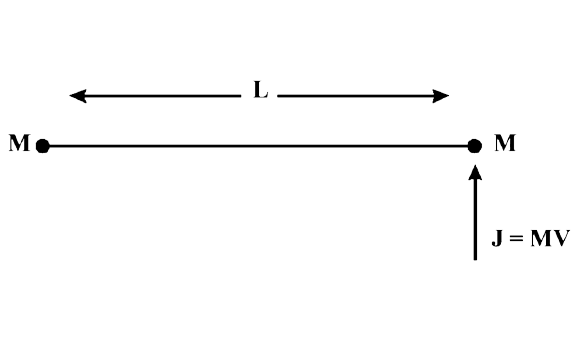
Consider a body, shown in figure, consis...

Consider a body, shown in figure, consisting of two identical balls, each of mass M connected by a light rigid rod. If an impulse J = MV is imparted to the body at one of its ends what would be it angular velocity?

Promotional Banner

Topper's Solved these Questions

  • System of particles & rotational Motion

    SL ARORA|Exercise EXERCISE|353 Videos
  • ROTATIONAL MOTION

    SL ARORA|Exercise Problem for self practice|90 Videos
  • Thermal Properties of Matter

    SL ARORA|Exercise Exercise|449 Videos

Similar Questions

Explore conceptually related problems

Consider a system consisting of two identical balls each of mass M connected by a light rigid rod as shown in figure. An impulse J=MV is imparted to the system at one of its ends. The angular velocity of the system would be

Two identical rods each of mass m and length are connected as shown. Locate c.m.

Two small balls, each of mass m are connected by a light rigid rod of length L. The system is suspended from its centre by a thin wire of torsional constant k. The rod is rotated about the wire through an angle theta_0 and released. Find the tension in the rod as the system passes through the mean position.

Figure a rigid body consisting of two particles of mass m connected by a rod of length L and negligible mass. (a) What is the rotational inertia I_(com) about an axis through the center of mass, perpendicular to the rod as shown? (b) What is the rotational inertia I of the body about an axis through the left end of the rod and parallel to the first axis.

A uniform rod of length L and mass M is lying on a frictionless horizontal plane and is pivoted at one of its ends as shown in Fig. There is no friction at the pivot. An inelastic ball of mass m is fixed with the rod at a distance L//3 from O . A horizontal impulse J is given to the rod at a distance 2L//3 from O in a direction perpendicular to the rod. Assume that the ball remains in contact with the rod after the collision and impulse J acts for a small time interval /_\t . Now answer the following questions: Find the resulting instantaneous angular velocity of the rod after the impulse.

A uniform rod of length L and mass M is lying on a frictionless horizontal plane and is pivoted at one of its ends as shown in Fig. There is no friction at the pivot. An inelastic ball of mass m is fixed with the rod at a distance L//3 from O . A horizontal impulse J is given to the rod at a distance 2L//3 from O in a direction perpendicular to the rod. Assume that the ball remains in contact with the rod after the collision and impulse J acts for a small time interval /_\t . Now answer the following questions: Find the impulse acted on the ball during the time /_\t

In the figure, a ball of mass m is tied with two strings of equal as shown. If the rod is rotated with angular velocity omega_(1) when

SL ARORA-System of particles & rotational Motion-EXERCISE
  1. Consider a body, shown in figure, consisting of two identical balls, e...

    Text Solution

    |

  2. Two bodies of masses 1 kg and 2 kg are located at (1,2) and (-1,3), r...

    Text Solution

    |

  3. The distance between the centres of carbon and oxygen atoms in the car...

    Text Solution

    |

  4. Three blocks of uniform thickness and masses m, m and 2m are placed at...

    Text Solution

    |

  5. Find the centre of mass of three particle at the vertices of an equila...

    Text Solution

    |

  6. A gridstone has a constant acceleration of 4 rad s^-1. Starting from r...

    Text Solution

    |

  7. The speed of a motor increases from 600 rpm to 1200 rpm in 20 s. What ...

    Text Solution

    |

  8. On the application of a constant torque, a wheel is turned from rest t...

    Text Solution

    |

  9. The motor of an engine is erotating about its axis with an angular vel...

    Text Solution

    |

  10. A car is moving at a speed of 72 kmh^(-1). The diameter of its wheel i...

    Text Solution

    |

  11. A wheel starting from rest via rotating with a constant angular veloci...

    Text Solution

    |

  12. Determine the angular momentum of a car of mass 1500 kg moving in a ci...

    Text Solution

    |

  13. Mass of an electron is 9.0xx10^(-31) kg. It revolves around the nucleu...

    Text Solution

    |

  14. Find the moment fo inertia of the hydrogen molecules about an axis pas...

    Text Solution

    |

  15. Three particles each of mass 100 g are placed at the vertices of an eq...

    Text Solution

    |

  16. Four point masses of 20 g each are placed at the corners of a square A...

    Text Solution

    |

  17. The point masses of 0.3 kg, 0.2 kg and 0.1 kg are placed at the corner...

    Text Solution

    |

  18. Three particles of masses 0.50 kg, 1.0 kg and 1.5 kg are placed at the...

    Text Solution

    |

  19. Three particles, each of mass m are situated at the vertices of an equ...

    Text Solution

    |

  20. Four particles each of mass m are kept at the four corners of a square...

    Text Solution

    |

  21. What is the moment of inertia of a ring of mass 2kg and radius 50 cm a...

    Text Solution

    |