

Home
Class 11
PHYSICS
A cubical block of side L rests on a rou...

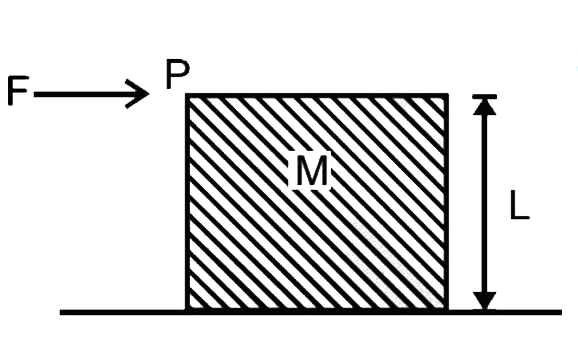
A cubical block of side L rests on a rough horizonta surface with coefficient of friction `mu`. A horizontal force F is applied on the block as shown. If the coefficient of friction is sufficiently high so that the block does not slide before toppling, the minimum force required to topple the block is

Promotional Banner

Topper's Solved these Questions

  • System of particles & rotational Motion

    SL ARORA|Exercise EXERCISE|353 Videos
  • ROTATIONAL MOTION

    SL ARORA|Exercise Problem for self practice|90 Videos
  • Thermal Properties of Matter

    SL ARORA|Exercise Exercise|449 Videos

Similar Questions

Explore conceptually related problems

A cubical block of side L rests on a rough horizontal surface with coefficient of friction mu . A horizontal force F is applied on the block as shown. If the coefficient of frictions sufficienty high so that the block does not slide before toppling, the minimum force required to topple the block is : .

An equilateral prism of mass m rests on a rough horizontal surface with coefficient of friction mu . A horizontal force F is applied on the prism as shown in figure. If the coefficient of friction is sufficiently high so that the prism does not slide before toppling, the minimum force required to topple the prism is

An equilateral prism of mass m rests on a rough horizontal surface with coefficient of friction mu . A horizontal force F is applied on the top of prism as shown in figure. If the coefficient of friction is sufficiently high so that the prism does not slide before topping, the minimum force required to topple the prism is

A cubical block of edge length 1 m and density 800 kg m^-3 rests on a rough horizontal surface with coefficient of friction mu . A horizontal force F is applied on the block as shown in figure. If the coefficient of friction is sufficiently large so that the block does not slide bofore toppling, then the minimum value of F to topple the block is [Take g = 10 ms^-2 ]

An equilateral prism of mass m rests on a rough horizontal surface with cofficent of friction mu . A horizontal force F is applied on the prism as shown in the figure. If the cofficent of the friction is sufficently high so that the prism does not slide before toppling, then the minimum force required to topple the prism is

A cubical box of side length L rests on a rough horizontal surface having coefficient of friction mu . A variable horizontal force F=alpha t is applied on the top of the block as shown in figure, where alpha is a constant and t is time. The coefficient of friction is sufficient so that the block does not slide before toppling. The graph between torque due to normal reaction about end B and time before toppling start is

SL ARORA-System of particles & rotational Motion-EXERCISE
  1. A cubical block of side L rests on a rough horizonta surface with coef...

    Text Solution

    |

  2. Two bodies of masses 1 kg and 2 kg are located at (1,2) and (-1,3), r...

    Text Solution

    |

  3. The distance between the centres of carbon and oxygen atoms in the car...

    Text Solution

    |

  4. Three blocks of uniform thickness and masses m, m and 2m are placed at...

    Text Solution

    |

  5. Find the centre of mass of three particle at the vertices of an equila...

    Text Solution

    |

  6. A gridstone has a constant acceleration of 4 rad s^-1. Starting from r...

    Text Solution

    |

  7. The speed of a motor increases from 600 rpm to 1200 rpm in 20 s. What ...

    Text Solution

    |

  8. On the application of a constant torque, a wheel is turned from rest t...

    Text Solution

    |

  9. The motor of an engine is erotating about its axis with an angular vel...

    Text Solution

    |

  10. A car is moving at a speed of 72 kmh^(-1). The diameter of its wheel i...

    Text Solution

    |

  11. A wheel starting from rest via rotating with a constant angular veloci...

    Text Solution

    |

  12. Determine the angular momentum of a car of mass 1500 kg moving in a ci...

    Text Solution

    |

  13. Mass of an electron is 9.0xx10^(-31) kg. It revolves around the nucleu...

    Text Solution

    |

  14. Find the moment fo inertia of the hydrogen molecules about an axis pas...

    Text Solution

    |

  15. Three particles each of mass 100 g are placed at the vertices of an eq...

    Text Solution

    |

  16. Four point masses of 20 g each are placed at the corners of a square A...

    Text Solution

    |

  17. The point masses of 0.3 kg, 0.2 kg and 0.1 kg are placed at the corner...

    Text Solution

    |

  18. Three particles of masses 0.50 kg, 1.0 kg and 1.5 kg are placed at the...

    Text Solution

    |

  19. Three particles, each of mass m are situated at the vertices of an equ...

    Text Solution

    |

  20. Four particles each of mass m are kept at the four corners of a square...

    Text Solution

    |

  21. What is the moment of inertia of a ring of mass 2kg and radius 50 cm a...

    Text Solution

    |