Home
Class 11
PHYSICS
A uniform thin cylindrical disk of mass ...

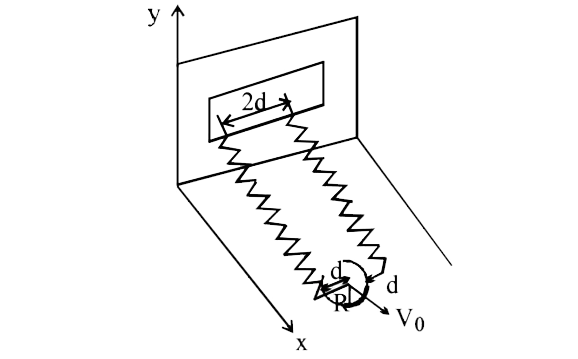
A uniform thin cylindrical disk of mass M and radius R is attaached to two identical massless springs of spring constatn k which are fixed to the wall as shown in the figure. The springs are attached to the axle of the disk symmetrically on either side at a distance d from its centre. The axle is massless and both the springs and the axle are in horizontal plane. the unstretched length of each spring is L. The disk is initially at its equilibrium position with its centre of mass (CM) at a distance L from the wall. The disk rolls without slipping with velocity `vecV_0 = vacV_0hati.` The coefficinet of friction is `mu.`

The centre of mass of the disk undergoes simple harmonic motion with angular frequency `omega` equal to -

A

`sqrt(k/M)`

B

`sqrt(2k/M)`

C

`sqrt(2k/3M)`

D

`sqrt(4k/3M)`

Text Solution

Verified by Experts

Promotional Banner

Topper's Solved these Questions

  • System of particles & rotational Motion

    SL ARORA|Exercise EXERCISE|353 Videos
  • ROTATIONAL MOTION

    SL ARORA|Exercise Problem for self practice|90 Videos
  • Thermal Properties of Matter

    SL ARORA|Exercise Exercise|449 Videos

Similar Questions

Explore conceptually related problems

A uniform thin cylindrical disk of mass M and radius R is attaached to two identical massless springs of spring constatn k which are fixed to the wall as shown in the figure. The springs are attached to the axle of the disk symmetrically on either side at a distance d from its centre. The axle is massless and both the springs and the axle are in horizontal plane. the unstretched length of each spring is L. The disk is initially at its equilibrium position with its centre of mass (CM) at a distance L from the wall. The disk rolls without slipping with velocity vecV_0 = vacV_0hati. The coefficinet of friction is mu. The maximum value of V_0 for whic the disk will roll without slipping is-

A uniform thin cylindrical disk of mass M and radius R is attaached to two identical massless springs of spring constatn k which are fixed to the wall as shown in the figure. The springs are attached to the axle of the disk symmetrically on either side at a distance d from its centre. The axle is massless and both the springs and the axle are in horizontal plane. the unstretched length of each spring is L. The disk is initially at its equilibrium position with its centre of mass (CM) at a distance L from the wall. The disk rolls without slipping with velocity vecV_0 = vacV_0hati. The coefficinet of friction is mu. The net external force acting on the disk when its centre of mass is at displacement x with respect to its equilibrium position is.

Two identical springs of spring constant k are attached to a block of mass m and to fixed supports as shown in the figure. The time period of oscillation is

A particle of mass m is attached to three identical springs of spring constant k as shwon in figure. The time period of vertical oscillation of the particle is

A mass m is attached to the free end of a massless spring of spring constant k with its other end fixed to a rigid support as shown in figure. Find out the time period of the mass, if it is displaced slightly by an amount x downward.

A block of mass m is connected to another .block of mass M by a massless spring of spring constant k. A constant force f starts action as shown in figure, then:

Two identical massless springs A and B consist spring constant k_(A) and k_(B) respectively. Then :

A body of mass 0.4 kg is held between two massless springs whose ends are fixed to rigid walls as shown in the figure. The spring constants are 8 N/m and 2 N/m. If the body is displaced along the direction of the lengths of the springs and released, the time period (in second) of the oscillations will be (ignore vertical oscillation, if any )

SL ARORA-System of particles & rotational Motion-EXERCISE
  1. Satement-1: two cylinder one hollow (metal) and the other side (wood) ...

    Text Solution

    |

  2. The equations x^2 +5x^2 +px +q=0 and x^3+ 7xa+ px+ r =0have two roots ...

    Text Solution

    |

  3. Two discs A and B are mounted coaxiallay on a vertical axle. The discs...

    Text Solution

    |

  4. Two discs A and B are mounted coaxially on a vertical axle. The discs ...

    Text Solution

    |

  5. A uniform thin cylindrical disk of mass M and radius R is attaached to...

    Text Solution

    |

  6. A uniform thin cylindrical disk of mass M and radius R is attaached to...

    Text Solution

    |

  7. The general motion of a rigid body can be considered to be a combinati...

    Text Solution

    |

  8. The general motion of a rigid body can be considered to be a combinati...

    Text Solution

    |

  9. Two blocks A and B, each of mass m, are connected by a spring of force...

    Text Solution

    |

  10. A frame of reference that is accelerated with respect to an inertial f...

    Text Solution

    |

  11. One twirls a circular ring (of mass and radius ) near the tip of one’s...

    Text Solution

    |

  12. A ring of mass 1kg and radius 1m is moving with a velocity of 1m//s by...

    Text Solution

    |

  13. Four solid sphereas each of diameter sqrt(5) cm and mass 0.5 kg are pl...

    Text Solution

    |

  14. A binary star consists of two stars A(mass 2.2 Ms) and B (mass 11 Ms)...

    Text Solution

    |

  15. A uniform circular disc of mass 50kg and radius 0.4 m is rotating wi...

    Text Solution

    |

  16. A lamina is made by removing a small disc of diameter 2R from a bigg...

    Text Solution

    |

  17. A horizontal circular platform of radius 0.5 m and mass axis. Two mass...

    Text Solution

    |

  18. The densitis of two solid spheres A and B of the same radii R very wit...

    Text Solution

    |

  19. In the List-I below, four different paths of a particle are given as f...

    Text Solution

    |

  20. A ring and a disc are initially at rest, side by side, at the top of a...

    Text Solution

    |

