Home
Class 12
BIOLOGY
In the diagram given below, show the pat...

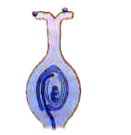
In the diagram given below, show the path of a pollen tube from the pollen on the stigma into the embryo sac. Name the components of egg apparatus

Text Solution

Verified by Experts

After properly suitable pollination, pollen grain germinates on anther and out of all germpores, pollen tube is produced in one of the germpore. The fluid of pollen grain along with two nuclei located in pollen grain reaches to pollen tube. Pollen tube grows by passing from the tissue of anther. When it enters into embryo sac by micropyle at that time pollen tube enters by filiform appraratus then a synergid cell decomposes. Pollen tube breaks to release its material located in pollen tube. Two male gametes are released.
Among them one does syngamy with egg cell and other male gemete perform syngamy with central cell thus is gets fertilised. Two synergid cells, an egg cell and filiforms apparatus are present as parts of egg apparatus located in embryo sac
Promotional Banner

Topper's Solved these Questions

  • SEXUAL REPRODUCTION IN FLOWERING PLANTS

    KUMAR PRAKASHAN|Exercise Section -E (Solution of NCERT Exemplar)(Short Answer Type Questions)|10 Videos
  • SEXUAL REPRODUCTION IN FLOWERING PLANTS

    KUMAR PRAKASHAN|Exercise Section -E (Solution of NCERT Exemplar)(Long Answer Type Question)|3 Videos
  • SEXUAL REPRODUCTION IN FLOWERING PLANTS

    KUMAR PRAKASHAN|Exercise Section -E (Solution of NCERT Exemplar)(Multiple Choice Questions)|20 Videos
  • REPRODUCTIVE HEALTH

    KUMAR PRAKASHAN|Exercise Section - F Multiple Choice Questions (MCQs)|102 Videos
  • STRATEGIES FOR ENHANCEMENT IN FOOD PRODUCTION

    KUMAR PRAKASHAN|Exercise SECTION -F (Multiple Choice Questions (MCQs)) (MCQs Asked In Competition Exam)|63 Videos

Similar Questions

Explore conceptually related problems

Name the component cells of the egg apparatus in an embryo sac

Pollen tube develops from

From the diagram given below name the parts A and B . Also write the function of part A and Part B .

In the diagram (given below), the broken lines represent the paths followed by particles W, X, Y and Z respectively through the contant field E. The number below the field represent meters. Suppose that the field strength E is 10 N//C and particle Y has a charge of -10 C . When is the mass of particle Y

In the diagram (given below), the broken lines represent the paths followed by particles W, X, Y and Z respectively through the contant field E. The number below the field represent meters. If the particles are positively charged, which particles increased their electric potential energy constant, none of the particle increased their electric potential energy

In the diagram (given below), the broken lines represent the paths followed by particles W, X, Y and Z respectively through the contant field E. The number below the field represent meters. Suppose particle Z has a charge of +2C , and is begins and end at rest. If E is 5N//C , how much work is done on particle Z

From among the sets of terms given below, identify those that are associated with the gynoecium (A) Stigma, ovule, embryo sac, placenta (B) Thalamus, pistil, style, ovule (C) Ovule, ovary, embryo sac, tapetum (D) Ovule, stamen, ovary, embryo sac

A narrow beam PQ of white light passes through a glass prism ABC as shown in the diagram. Trace it on your answer sheet and show the path of the emergent beam as observed on the screen DE. (1) Write the name and cause of the phenomenon observed. (2) Where else in nature is this phenomenon observed ? (3) Based on this observation, state the conclusion which can be drawn about the constituents of white light.

KUMAR PRAKASHAN-SEXUAL REPRODUCTION IN FLOWERING PLANTS-Section -E (Solution of NCERT Exemplar)(Very Short Answer Type Questions)
  1. Name the component cells of the egg apparatus in an embryo sac

    Text Solution

    |

  2. Name the part of gynoecium that determines the compatible nature of po...

    Text Solution

    |

  3. Name the common function that cotyledons and nucellus perform

    Text Solution

    |

  4. Complete the following flow chart Pollen Mother cell rarr Pollen tetra...

    Text Solution

    |

  5. Indicate the stages where meiosis and mitosis occur (1, 2 or 3) in the...

    Text Solution

    |

  6. In the diagram given below, show the path of a pollen tube from the po...

    Text Solution

    |

  7. Name the parts of pistil which develop into fruit and seeds

    Text Solution

    |

  8. In case of polyembryony, if an embryo develops from the synergid and a...

    Text Solution

    |

  9. Can an unfertilised, apomictic embryo sac give rise to a diploid embry...

    Text Solution

    |

  10. Which are the three cells found in a pollen grain when it is shed at t...

    Text Solution

    |

  11. What is self-incompatibility ? Why does self pollination not lead to s...

    Text Solution

    |

  12. Name the type of pollination in self-incompatiable plants

    Text Solution

    |

  13. With a neat diagram explain the 7-celled, 8-nucleate nature of the fem...

    Text Solution

    |

  14. Which is the triploid tissue in a fertilised ovule? How is the triploi...

    Text Solution

    |

  15. Are pollination and fertilisation necessary in apomixis ? Give reasons

    Text Solution

    |

  16. Identify the type of carpel with the help of diagrams given below

    Text Solution

    |

  17. How is pollination carried out in water plants?

    Text Solution

    |

  18. What is the function of the two male gametes produced by each pollen g...

    Text Solution

    |
