Home
Class 12
BIOLOGY
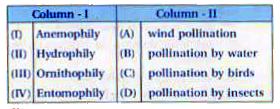
Match the two columns: (A) (I-A), ...

Match the two columns:

(A) (I-A), (II-B), (III-C), (IV-D)
(B) (I-B), (II-A), (III-C), (IV-D)
(C) (I-A), (II-C), (III-B), (IV-D)
(D) (I-D), (II-B), (III-C), (IV-A)

A

(I-A), (II-B), (III-C), (IV-D)

B

(I-B), (II-A), (III-C), (IV-D)

C

(I-A), (II-C), (III-B), (IV-D)

D

(I-D), (II-B), (III-C), (IV-A)

Text Solution

Verified by Experts

The correct Answer is:

A
Promotional Banner

Topper's Solved these Questions

  • SEXUAL REPRODUCTION IN FLOWERING PLANTS

    KUMAR PRAKASHAN|Exercise Section -E (Solution of NCERT Exemplar)(Long Answer Type Question)|3 Videos
  • REPRODUCTIVE HEALTH

    KUMAR PRAKASHAN|Exercise Section - F Multiple Choice Questions (MCQs)|102 Videos
  • STRATEGIES FOR ENHANCEMENT IN FOOD PRODUCTION

    KUMAR PRAKASHAN|Exercise SECTION -F (Multiple Choice Questions (MCQs)) (MCQs Asked In Competition Exam)|63 Videos

Similar Questions

Explore conceptually related problems

Match the two columns: (A) (I-A),(II- B), (III- D), (IV- C) (B) (I-B), (II-A), (III-D), (IV - C) (C) (I- A), (II-B), (III-C), (IV- D) (D) (I- D), (II- A), (III-C), (IV-B)

Match the two columns: (A) (I-C), (II-D), (III-B), (IV-A) (B) (I-D), (II-C), (III-A), (IV-B) (C) (I-C), (II-B),(III-D), (IV-A) (D) (I-B),(II-D),(III-C),(IV-A)

Match the column I, II and III

Match Column A with Column B (A) (P-i), (Q-ii), (R-iv), (S-iii) (B) (P-ii), (Q-i), (R-iii), (S-iv) (C) (P-ii), (Q-iii), (R-iv), (S-i) (D) (P-iv), (Q-iii), (R-ii), (S-i)

Match the following (A) (i-P), (ii-S), (iii-R), (iv-Q) (B) (i-Q), (ii-S), (iii-P), (iv-R) (C) (i-Q), (ii-P), (iii-R), (iv-S) (D) (i-P), (ii-R), (iii-Q), (iv-S)

Match the followings and choose the correct answer. (A) (a - ii), (b - iii), (c - iv), (d - i) (B) (a - iii), (b - ii), (c - iv), (d - i) (C) (a - i), (b - iii), (c - ii), (d - iv) (D) (a - ii), (b - iv), (c - iii), (d - i)

Match the following with reference to cockroach and choose the correct option. (A) (a - iii), (b - iv), (c - ii), (d - i) (B) (a - iv), (b - iii), (c - ii), (d - i) (C) (a - iv), (b - ii), (c - iii), (d - i) (D) (a - ii), (b - iv), (c - iii), (d - i)

Match the followings and choose the correct answer. (A) (a - iii), (b - i), (c - ii), (d - iv) (B) (a - ii), (b - i), (c - iv), (d - iii) (C) (a - iii), (b - iv), (c - ii), (d - i) (D) (a - iii), (b - i), (c - iv), (d - ii)

Match the following column . {:(" Column -I "," Column-II "),("(a) Molecular oxygen ","(i) "alpha - " ketoglutaric acid "),("(b) Electron acceptor ","(ii) Hydrogen acceptor "),("(c) Pyruvate dehydrogenase ","(iii) Cytochrome -C "),("(d) Decarboxylation ","(iv) Acetyl Co-A "):} (A) (a-ii),(b-iii),(c-iv),(d-i) (B) (a-iii),(b-iv),(c-ii),(d-i) (C) (a-ii),(b-i),(c-iii),(d-iv) (D) (a-iv),(b-iii),(c-i),(d-ii)

Write proper option by matching column I, II and III. (A) (i-R-C)(ii-S-A) (iii-Q-D) (iv-P-B) (B) (i-R-C) (ii-S-A) (iii - Q- B) (iv-P-D) (C) (i-S-D) (ii-R-C) (iii - P- B) (iv - Q-A) (D) (i-Q-A) (ii - P-C) (iii - R - B) (iv-S-D)

KUMAR PRAKASHAN-SEXUAL REPRODUCTION IN FLOWERING PLANTS-Section -F (Multiple Choice Questions)
  1. Match the two columns: (A) (I-A),(II- B), (III- D), (IV- C) (B) ...

    Text Solution

    |

  2. Match the two columns: (A) (I-C), (II-D), (III-B), (IV-A) (B) ...

    Text Solution

    |

  3. Match the two columns: (A) (I-A), (II-B), (III-C), (IV-D) (B...

    Text Solution

    |

  4. Match Column-I with Column-II and choose the correct answer

    Text Solution

    |

  5. Filiform apparatus is a characteristic feature of

    Text Solution

    |

  6. What would be the number of chromosomes of aleurone cell of a plant wi...

    Text Solution

    |

  7. Wind pollination is common in (A) lilies (B) grasses (C) orchids ...

    Text Solution

    |

  8. Nucellar polyembryony is reported in species of (A) grossypium (B)...

    Text Solution

    |

  9. In which one of the following pollination is autogamous? (A) Xenogamy...

    Text Solution

    |

  10. In a flowering plant the pollen tube first arrives in (A) egg (B) a...

    Text Solution

    |

  11. Which one of the following would not lead to formation of clones? (A)...

    Text Solution

    |

  12. Which of the following statement is wrong? (A) Pollen grains remain v...

    Text Solution

    |

  13. Testa of a seed is produced from (A) ovary wall (B) hilum (C) out...

    Text Solution

    |

  14. Study the following statement and choose the option: (I) Tapetum nou...

    Text Solution

    |

  15. How many nuclei are involved in double fertilization?

    Text Solution

    |

  16. Which is the characteristics of the flower in plants possessing wind p...

    Text Solution

    |

  17. Transfer of pollen to the stigma of another flower of the same plant i...

    Text Solution

    |

  18. What does the filiform apparatus do at the entrance into the ovule? (...

    Text Solution

    |

  19. The arrangement of the nuclei in a normal embryosac in the dicot plant...

    Text Solution

    |

  20. The contrivances shown by jasmine flower for cross-pollination is (A)...

    Text Solution

    |
