Home
Class 11
CHEMISTRY
Explain photoelectric effect....

Explain photoelectric effect.

Text Solution

Verified by Experts

Photoelectric effect : Electrons (ro electric current ) were ejected when certain metals (for example potassium rubidium caesium etc) were exposed to a beam of light . The phenomenon is called photoelectric effect.
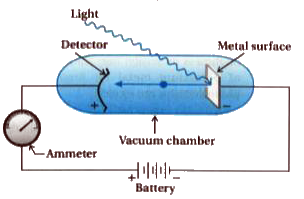
Light of a particular frequency strikes a clean metal surface inside a vacuum chamber Electrons are ejected from the metal and are counted by a detector that measures their kinetic energy.
Experimental results and assumption :
(i) The electrons are ejected from the metal surface as soon as the beam of ligth strikes the surface
Assumption : There is no time lg between the striking of light beam and the ejection of electrion from the metal surface
Assumption : (number of electron `prop` intensity
(iii) Threshold frequency : There is a characteristic minimum frequency `v_(0)` below which photoelectric effect is not observed is
Assumption : Below `v_(0)` photoelectric effect is come out with certain kinetic energy The kinetic energies of these electrons increase with the increase of frequency of the light used.
Example of threshold energy
Red light `(v= 4.3 xx 10^(4) Hz)` of any brightness (intensity ) may shine on a piece of potassium metal for hours but not photoelectrons are ejected.
A very weak yellow light `(v=5.1 ` to `5.2 xx 10^(4))` photoelectric effect is observed.
The threshold frequency `(v_(0))` for potassium metal is `5.0 xx 10^(4) Hz`
Note : The energy content of the beam of light number of electric ejected does depend upon the brightness of light the kinetic energy of the ejected electrons does not.


Promotional Banner

Topper's Solved these Questions

  • STRUCTURE OF ATOM

    KUMAR PRAKASHAN|Exercise Section -A (Try Your Self -1)|4 Videos
  • STRUCTURE OF ATOM

    KUMAR PRAKASHAN|Exercise Section -A (Try Your Self -2)|5 Videos
  • STATES OF MATTER

    KUMAR PRAKASHAN|Exercise QUESTION PAPER FROM MODULE (SECTION - A)|4 Videos
  • THE P-BLOCK ELEMENTS

    KUMAR PRAKASHAN|Exercise SECTION-D NCERT EXEMPLAR SOLUTION (MCQs) LONG ANSWER|25 Videos

Similar Questions

Explore conceptually related problems

Consider a 20 W bulb emitting light of wavelength 5000 Å and shining on a metal surface kept at a distance 2m.Assume that the metal surface has work function of 2eV and that each atom on the metal surface can be treated as a circular disk of radius 1.5 Å. (i)Estimate no. of photons emitted by the bulb per second.[Assume no other losses] (ii)Will much time would be required by the atomic disk to receive energy equal to work function (2eV)? (iv)How many photons would atomic disk receive within time duration calculated in (iii)above? (v) Can you explain how photoelectric effect was observed instantaneously?

The figure shows the results of an experiment involving photoelectric effect. The graphs A, B,C and D relate to a light beam having different wavelengths. Select the correct alternative.

The ejection of the photoelectron from the silver metal in the photoelectric effect experiment can be stopped by applying the voltage of 0.35 eV with the radiation 256.7 nm is used .Calculated the work function silver metal.

Explain effect of frequency of incident radiation in th experiment of photoelectric effect.

Explain effect of potential on photoelectric current in experiment of photoelectric effect.

Describe Hallwach's and Lenard's observation regarding photoelectric effect in short.

Work function of metal in photoelectric effect is 3.5 eV for -1.2 V potential photoelectric current become zero,Hence…….

In experiment of photoelectric effect width of slit is equal to de-Broglie wavelength.Beam of light is incident normal to plane and by using detector D it is detected.Which of the following best represent number of electron (N) and position of detector (y)?

In an experiment on photoelectric effect.the slope of the cutoff voltage versus frequency incident light is found to be 4.12xx10^(-15) V sec calculate the value of Planck's constant.