Home
Class 11
CHEMISTRY
Using s,p,d f notations describe th...

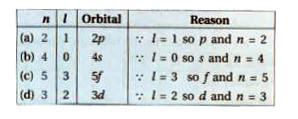
Using s,p,d f notations describe the orbital with the following quantum number
`(a ) n=2,l =1 ( b) n=4,l =0`
(c ) n=5,l =3 (d ) n=3 , l= 2

Text Solution

Verified by Experts
Promotional Banner

Topper's Solved these Questions

  • STRUCTURE OF ATOM

    KUMAR PRAKASHAN|Exercise Section -A (Try Your Self -1)|4 Videos
  • STRUCTURE OF ATOM

    KUMAR PRAKASHAN|Exercise Section -A (Try Your Self -2)|5 Videos
  • STATES OF MATTER

    KUMAR PRAKASHAN|Exercise QUESTION PAPER FROM MODULE (SECTION - A)|4 Videos
  • THE P-BLOCK ELEMENTS

    KUMAR PRAKASHAN|Exercise SECTION-D NCERT EXEMPLAR SOLUTION (MCQs) LONG ANSWER|25 Videos

Similar Questions

Explore conceptually related problems

Using s, p, d, f notations, describe the orbital with the following quantum numbers (a) n=2, l = 1 (b) n = 4, l = 0 (c) n = 5, l = 3 (d) n = 3, l = 2.

using s,p,d notations describle the orbital with the following quantum numbers . ( a) n= 1, l =0 ( b) n = 3, l = 1 ( c) n= 4,l =2 ( d) n=4, l =3

Using the s, p, d, notation, describe the orbital with the following quantum numbers? (a) n = 1, l=0, (b) n = 2,l = 0, (c) n = 3, l = 1, (d) n = 4, l =3.

How many electron in an atom may have the following quantum number ? (a ) n=4, m_(s )= - (1)/(2) ( b) n=3, l =0

Explain giving reasons which of the following sets of quantum number are not possible (a ) n=0, l =0 m_(l) = 0, m_(s ) =+ (1)/(2) ( b) n=1 , l = 0 m_(l) = 0, m_(s ) = - (1)/(2) ( c) n=1 , l = 1, m_(l ) = 0, m_(s ) = + (1)/(2) (d ) n= 2, l = 1, m_(l ) = 0, m_(s ) = (1) /(2) ( e) n=3, l = 3, m_(l) = 3, m_(s ) = + (1)/(2) (f ) n=3, l = 1, m_(l) = 0, m_(s) l = + (1)/(2)

State the name of orbitals as per quantum number, magnetic quantum number and no of oribitals . (i) n=3,l=2 (ii) n=4,l=3 (iii) n= 2, l = 0 (iv) n=5,l=1

What is shape of the orbital with (i) n = 2 and l = 0 , (ii) n = 2 and l = 1?

