Home
Class 11
CHEMISTRY
What is photoelectric effect ? State the...

What is photoelectric effect ? State the result of photoelectric effect experiment that could not be explained on the basis of laws of classical physics. Explain this effect on the basis of quantum theory of electromagnetic radiations.

Text Solution

Verified by Experts
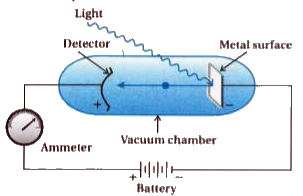
Photoelectric effect : When radiation with certain minimum frequency (p0) strike the surface of a metal, the electrons are ejected from the metal surface. This phenomenon is called photoelectric effect. The electrons emitted are called photoelectron

Equipment for studying the photoelectric effect. Light of a particular frequency strikes a clean metal surface inside a vacuum chamber. Electrons are ejected from the metal and are counted by a detector that measures their kinetic energy. The result observed in this experiment were (i) The electrons are ejected from the metal surface as soon as the beam of light strikes the surface, i.e., there is no time lag between the striking of light beam and the ejection of electrons from the metal surface. (ii) The num ber of electrons ejected is proportional to the intensity or brightness of light. (iii) For each metal, there is a characteristic minimum frequency, vQ (also known as threshold frequency) below w hich photoelectric effect is not observed. At a frequency , the ejected electrons come out with certain kinetic energy. The kinetic energies of these electrons increases with the increase of frequency of the light used. The above observation cannot be explained by the electromagnetic wave theory. According to this theory, since radiations were continuous, therefore, it should be possible to accumulate energy on the surface of the metal, irrespective of its frequency and thus, radiations of all frequencies should be able to eject electrons. Similarly, according to this theory, the energy of the electrons ejected should depend upon the intensity of the incident radiation. Particle Nature of Electromagnetic Radiation : To explain the phenom ena of ‘black body radiation’ and ‘photoelectric effect’, Max Planck in 1900, put forward a theory known after his name as Planck.s quantum theory. This theory was further extended by Einstein in 1905. The important points of this theory are as follows : (i) The radiant energy is emitted or absorbed not continuously but discontinuously in the form of small discrete packets of energy. Each such packet of energy is called a ‘quantum’. In case of light, the quantum of energy is called a ‘photon’. (ii) The energy of each quantum is directly proportional to the frequency of the radiation, i.e., E v or E = hv where, h is a proportionality constant, called Planck.s constant, Its value is approximately equal to `6.626 xx 127 erg s or 6.626 xx 10^(34)` JS. (iii) The total amount of energy emitted or absorbed by a body will be some whole number quanta.
Hence, E = nhv (where, n is any integer),
Promotional Banner

Topper's Solved these Questions

  • STRUCTURE OF ATOM

    KUMAR PRAKASHAN|Exercise QUESTINS PAPER FROM MODULE (SECTION -A)|6 Videos
  • STRUCTURE OF ATOM

    KUMAR PRAKASHAN|Exercise QUESTINS PAPER FROM MODULE (SECTION -B)|3 Videos
  • STRUCTURE OF ATOM

    KUMAR PRAKASHAN|Exercise Section -C(MCQ asked in Board Exam )|53 Videos
  • STATES OF MATTER

    KUMAR PRAKASHAN|Exercise QUESTION PAPER FROM MODULE (SECTION - A)|4 Videos
  • THE P-BLOCK ELEMENTS

    KUMAR PRAKASHAN|Exercise SECTION-D NCERT EXEMPLAR SOLUTION (MCQs) LONG ANSWER|25 Videos

Similar Questions

Explore conceptually related problems

Explain photoelectric effect.

Explain : Photoelectric effect.

What phenomena of light can be explained on the basis of wave theory of light

What phenomena of light can be explained on the basis of particle theory of light?

Explain effect of potential on photoelectric current in experiment of photoelectric effect.

Write Einstein's proposed a new theory to explain photoelectric effect.

Photoelectric effect can not be explain by using wave theory of light why?

KUMAR PRAKASHAN-STRUCTURE OF ATOM-SECTION -D (MULTIPLE CHOICE QUESTIONS)
  1. A hypothetical electromagnetic wave is shown in Figure. Find out the w...

    Text Solution

    |

  2. Chlorophyll present in green leaves of plants absorbs light at 4.620 x...

    Text Solution

    |

  3. What is the difference between the terms orbit and orbital ?

    Text Solution

    |

  4. Table-tennis ball has a mass 10 g and a speed of 90 m/s. If speed can ...

    Text Solution

    |

  5. The effect of uncertainty principle is significant only for motion of ...

    Text Solution

    |

  6. Hydrogen atom has only one electron, so mutual repulsion between elect...

    Text Solution

    |

  7. Match the following species with their corres­ponding ground state ele...

    Text Solution

    |

  8. Match the quantum numbers with the information provided by these

    Text Solution

    |

  9. Match the following rules with their statements

    Text Solution

    |

  10. Match the following

    Text Solution

    |

  11. Match the following

    Text Solution

    |

  12. Match species given in Column-I with the electronic configuration give...

    Text Solution

    |

  13. Assertion (A) : All isotopes of a given element show the same type of ...

    Text Solution

    |

  14. Assertion (A) : Black body is an ideal body that emits and absorbs rad...

    Text Solution

    |

  15. Assertion (A) : It is impossible to determine the exact position and e...

    Text Solution

    |

  16. What is photoelectric effect ? State the result of photoelectric effec...

    Text Solution

    |

  17. Threshold frequency, v(0) is the minimum frequency which a photon must...

    Text Solution

    |

  18. When an electric discharge is passed through hydrogen gas, the hydroge...

    Text Solution

    |

  19. Calculate radiation from n = 3 t o n = 2 i n a hydrogen atom.

    Text Solution

    |

  20. Why was a change in the Bohr Model of atom required ? Due to which imp...

    Text Solution

    |

