Home
Class 11
CHEMISTRY
The compounds A and B are mixed in equim...

The compounds A and B are mixed in equimolar proportion to from the products, `A+B harr C+D`. At equilibrium, one third of A and B are consumed. The equilibrium constant for the reaction is

A

0.5

B

4

C

2.5

D

0.25

Text Solution

Verified by Experts

The correct Answer is:
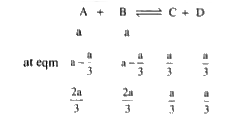
D


`K_(C)=((a)/(3) xx (a)/(3))/((2a)/(3) xx (2a)/(3))=(1)/(4)`
Promotional Banner

Similar Questions

Explore conceptually related problems

Write the expression for the equilibrium constant for the reaction 2A+B leftrightarrow C+D

The compound ratio of a: b and c:d is

For the reaction A + B hArr C + D , the concentrations of A and B are equal . The equilibrium concentration of C is twice that of A . K_(C) of the reaction is

1.1 mole of A and 2.2 moles of B reach an cquilibrium in I lit container according to the reaction. A + 2B hArr 2C + D. If at equilibrium 0.1 mole of D is present, the equilibrium constant is:

In the equilibrium reaction, A(g) + 2B(g) + (g), the equilibrium constant, K_(c) is given by the expression

Passage: When all the coefficients in a balanced chemical equation are multiplied by a constant factor X the equilibrium constant (originally K) becomes K^J . Similarly, when balanced equations are added together, the equilibrium constant for the combined process is equal to the product of the equilibrium constants for each step. Equilibrium constant of the reversed reaction is numerically equal to the reciprocal of the equilibrium constant of the original equation. Unit of K_p = ("atm")^(Deltan) , Unit of K_c =("mol" L^(-1))^(Deltan) Consider the two reactions: XeF_(6(g))+H_(2)O_((g)) harr XeOF_(4(g))+2HF_((g)), K_(1)" "XeO_(4(g))+XeF_(6(g)) harr XeOF_(4(g))+XeO_(3)F_(2(g)), K_(2) Then the equilibrium constant for the following reaction will be XeO_(4(g))+2HF_((g)) harr XeO_(3)F_(2(g))+H_(2)O_((g))

The initial concentrations of A and B are same for A +2B harr 3C and when equilibrium concentrations of B and C are same then K_(c) is

Delta G^(0) for the reaction x + y hArr z is -4.606 kcal. The value of equilibrium constant of the reaction at 227^(@)C

a:b and c:d are in proportion then

For the hypothetical reactions, the equilibrium constant (K) values are given A harr B, K_1=2.0 B harr C, K_2=4.0 C harr D, K_3=3.0 The equilibrium constant for the reaction A harr D is

