Home
Class 11
CHEMISTRY
For the reaction N2O4 harr 2NO(2(g)), th...

For the reaction `N_2O_4 harr 2NO_(2(g))`, the degree of dissociation at equilibrium is 0.2 at 1 atm. Then `K_p` will be

A

`1//2`

B

`1//4`

C

`1//6`

D

`1//8`

Text Solution

Verified by Experts

The correct Answer is:
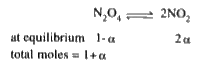
C


`K_(P)=([P((2alpha)/(1+alpha))]^(2))/(P((1-alpha)/(1+alpha)))=P xx (4alpha^(2))/(1-alpha^(2))`
`K_(P)=1 xx (4 xx (0.2)^(2))/(1-(0.)^(2))=(1)/(6)`
Promotional Banner

Similar Questions

Explore conceptually related problems

For the following reaction NH_(4)HS_((s)) harr NH_(3(g))+H_(2)S_((g)) the total pressure at equilibrium is 30 atm. The value of K_(P) is

1.2 moles of SO_(3) are allowed to dissociate in a 2 litre vessel the reaction is 2SO_(3(g)) hArr 2SO_(2(g)) +O_(2(g)) and the concent ration of oxygen at equilibrium is 0.1 mole per litre. The total number of moles at equilibrium will be

For which of the following reactions, the degree of dissociation (alpha) and equilibrium constant (K_(p)) are related as K_(p) = (4 alpha^(2) p)/((1 - alpha^(2)))

For the reaction CO_((g))+CI_(2(g)) harr COCI_(2(g)) . The K_p // K_c is equal to

18.4 g N_(2)O_(4) was placed in 1 L vessel at 400 K and allowed to attain the following equilibrium N_(2)O_(4)(g) hArr 2NO_(2)(g) . IF the total pressure at equilibrium was 10.64 bar, approximate K_(p) is (R = 0.083 L bar K^(-1) mol^(-1) ) (Assume N_(2)O_(4), NO_(2) as ideal gases)

The equilibrium constant for the reaction N_(2(g)) +O_(2(g)) hArr 2NO_((g)) is 4 xx 10^(-4) at 200K. In presence of a catalyste, equilibrium is attaincd ten times faster. Therefore, the equilibrium constant in the presence of the catalyst at 200K is

The equilibrium constant for the given reaction is 100. N_(2)(g) + 2O_(2)(g) hArr 2NO_(2)(g) What is the equilibrium constant for the reaction given below? NO_(2)(g) hArr 1/2 N_(2)(g) + O_(2)

For the reaction N_(2)O_(4(g)) hArr 2NO_(2(g)) . which of the following factors will have no cffect on the value of equilibrium constant ?

