Home
Class 11
CHEMISTRY
The equilibrium constant K (in atm) for ...

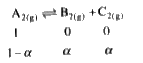
The equilibrium constant K (in atm) for the reactio is 9 at 7 atm and 300 K, `A_(2(g)) hArr B_(2(g)) + C_(2(g))`. calcuate the average molar mass (in gnm/mol) of an equilibrium mixture.
Given: Molar mass of `A_(2) B_(2) and C_(2)` are 70, 49 and 21 gm/mol fespectively.

A

50

B

45

C

40

D

37.5

Text Solution

Verified by Experts

The correct Answer is:
A


Total moles = `1-alpha`
`K_(P)=(P_(B_(2)).P_(C_(2)))/(P_(P_(2))) implies 9=(((alpha)/(1+alpha).7)((alpha)/(1+alpha)7))/(((1-alpha)/(1+alpha)) xx 7)`
`= alpha=3//4 implies alpha=(3)/(4) implies alpha=(D-d)/(d(n-1)) implies d = 40`
Promotional Banner

Similar Questions

Explore conceptually related problems

The equilibrium constant Kp for the reaction N_(2)O_(4(g)) hArr 2NO_(2(g)) is 4.5. What would be the average molar naSs (in g/mol) of an eyuilibriunm mixture of N_(2)O_(4) and NO_(2) formed by the dissociation of pure V_(2) O_(4) at a total pressure of 2 atm ?

At a certain temperature the equilibrium constant K_c is 0.25 for the reaction A_(2(g))+B_(2(g)) harr C_(2(g))+D_(2(g)) If we take 1 mole of each of the four gases in a 10 litre container, what would be equilibrium concentration of A_(2(g)) ?

If the equilibrium constant for the reaction 2AB hArr A_(2) + B_(2) is 49 what is the value of equilibrium constant for AB hArr 1/2 A_(2) + 1/2 B_(2) ?

The gascous reaction A_((g)) + B_((g)) hArr 2C_((g)) + D_((g)) + q kJ is most favoured at :

The equilibrium constant for the given reaction is 100. N_(2)(g) + 2O_(2)(g) hArr 2NO_(2)(g) What is the equilibrium constant for the reaction given below? NO_(2)(g) hArr 1/2 N_(2)(g) + O_(2)

If the equilibrium constant for the reaction, H_(2)(g) +I_(2)(g) hArr 2HI(g) is K What is the equilibrium constant of HI(g) rarr 1/2 H_(2)(g) + 1/2I_(2)(g) ?

For the reaction at 298K: A_((g)) +B_((g)) hArr C_((g)) + D_((g)) Delta H^(@) + 29.8kcal and Delta S^(@) = 100cal K^(-1) . Find the value of equilibrium constant.

Units of K_c for xA_((g)) harr yB_((g)) is lit^2-mol^(-2) , then the values of x & y cannot be

The yield of product in the reaction 2A_((g)) + B_((g)) hArr 2C_((g)) + Q K J would be lower at :

