Home
Class 11
CHEMISTRY
10 moles of each N(2) and H(2) are made ...

10 moles of each `N_(2) and H_(2)` are made to react in a closed chamber. At equilibrium 40% of `H_(2)` was left. The total moles in the chamber are :

A

16

B

12

C

8

D

10

Text Solution

Verified by Experts

The correct Answer is:
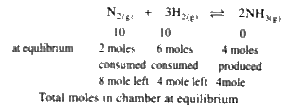
A


Total moles in chamber at equilibrium = 8+4+4=16
Promotional Banner

Similar Questions

Explore conceptually related problems

One mole of H_(2)O and one mole of CO are taken in 10L vessel and heated to 725K . At equlibrium 40% of water (by mass) reacts with CO according to the equation. H_(2)O(g)+CO(g)hArrH_(2)(g)+CO_(2)(g) Calculate the equilibrium constant for the reaction.

A mixture of 2 moles of N_(2) and 8 moles of H_(2) are heated in a 2 lit vessel, till equilibrium is established. At equilibrium, 04 moles of N_(2) was present. The equilibrium concentration of H_(2) will be

3 moles of NH_3 are allowed to dissociate in a 5 litre vessel and the equilibrium concentration of N_2 is 0.2 mole/lit . Then the total number of moles at equilibrium is

Consider the following reaction equilibrium N_(2)(g)+ 3H_(2)(g) hArr 2NH_(3) Initially, 1 mole of N_(2) and 3 moles of H_(2) are taken in a 2 2L flask. At equilibrium state, if the number of moles of N_(2) is 0.6, what is the total number of moles of all gases present in the flask?

4.5 mol each of H_(2) and I_(2) are present in a 10 lit vessel . At equilibrium the mixture contains 3 mole . HI , Kp for H_(2) + I_(2) hArr 2 HI and mass of I_(2) at equilibrium (in g) respectively are

4.5 moles, each of hydrogen and iodine was heated in a sealed 10 L vessel. At equilibrium, 3 moles of HI were found. The equilibrium constant for H_(2) (g) + I_(2) (g) rarr 2HI (g) , is

When 1 mole of N_2 and 1 mole of H_2 is enclosed in a 5 L vessel and reaction is allowed to attain equilibrium . It is found that at equilibrium there is x mole of H_2 . The number of moles of NH_(3) formed would be

1 mole of each of Ca(OH)_(2) and H_(3) PO_(4) are allowed to react under dilute conditions . The maximum number of moles of Ca_(3) (PO_(4))_(2) formed is

