Home
Class 11
CHEMISTRY
A hydrogen-like atom (atomic number Z) i...

A hydrogen-like atom (atomic number Z) is in a higher excited state of quantum number n. This excited atom can make a transition to the first excited state by successively emitting two photons of energies 10.20 eV and 17.00 eV respectively. Alternatively the atom from the same excited state can make a transition to the second excited state by snccessively emitting two photons of energies 4.25 eV and 5.95 eV respectively. Determine the values of n and Z (ionization energy of hydrogen atom = 13.6 eV)

A

n=5

B

z=2

C

n=6

D

z=3

Text Solution

Verified by Experts

The correct Answer is:
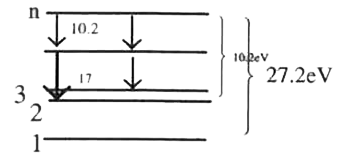
C, D


`E= (-2^2)/(n^2) (13.6eV)`
`implies R.hc.z^2 (1/9 - 1/n^2) = 27.2 ….. (1)`
`implies R.hc.z^2 (1/9 - 1/n^2) = 10.2 eV…(2)`
`((1))/((2))= (((n^2 - 4)/(4n^2)))/(((n^2 - 9 )/(9n^2))) = (27.2)/(10.2) = 2.66`
`9(n^2 - 4)xx 4 (n^2 - 9) (2.66)`
`implies 9n^2 - 36 = 10 . 66 n^2 - 96`
`therefore 1.66 n^2 = 60 implies n^2 =(60)/(1.66) = 36`
Promotional Banner

Similar Questions

Explore conceptually related problems

In excited state a carbon atom gets its one of the 2s electrons to

The maximum oxidation state that can be exhibited by a halogen in its second excited state

The maximum oxidation state that can be exhibited by a halogen in its second excited state

The value of the energy for the first excited state of hydrogen will be

Does the electron retain the energy at excited state forever ?

The number of unpaired electrons present in the first excited state of chlorine atom is

The number of unpaired electrons present in the first excited state of chlorine atom is

Consider a hydrogen-like atom whose energy in n^(th) excited state is given by E_(n) = (13.6Z^(2))/(n^(2)) When this excited atom makes transition from excited state to ground state most energetic photons have energy E_(max) = 52.224eV and least energetic photons have energy E_(min) = 1.223eV. find the atomic number of atom and the state of excitation.

