Home
Class 12
PHYSICS
Refer to fig. The arm PQ of the rectangu...

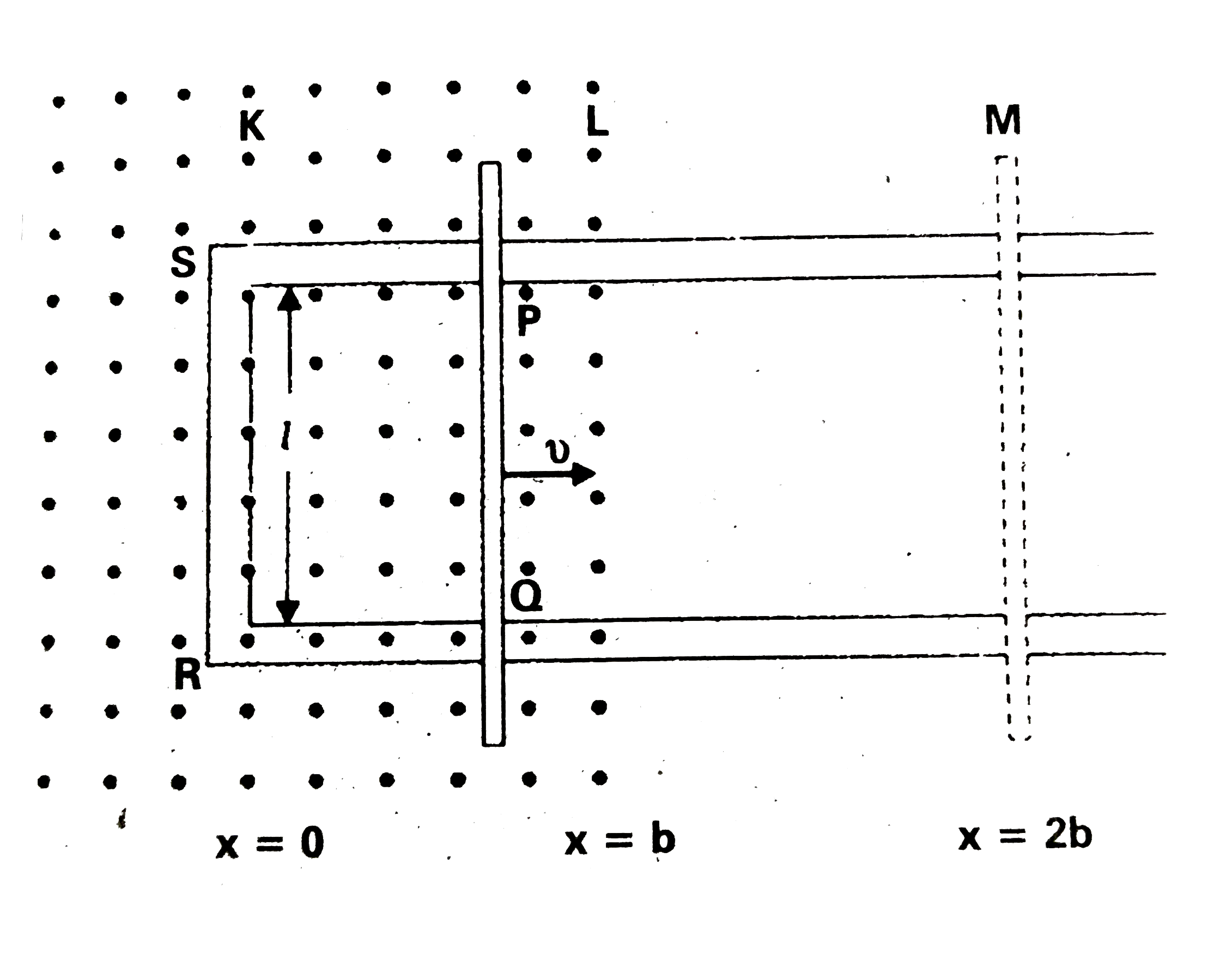
Refer to fig. The arm PQ of the rectangular conductor is moved from x=0 outwards. The uniform magnetic field is perpendicular to the plane and extends from x=0 to x=b and is zero for `x gt b`. Only the arm PQ possesses substantial resistance r. Consider the situation when the arm PQ is pulled outwards from x=0 to x=2b, and is then moved back x=0 with constant speed `upsilon`. Obtain expressions for the flux the induced emf, the force necessary to pull the arm and the power dissipated as Joule heat. Sketch the variation of these quantities with distance.

Text Solution

Verified by Experts
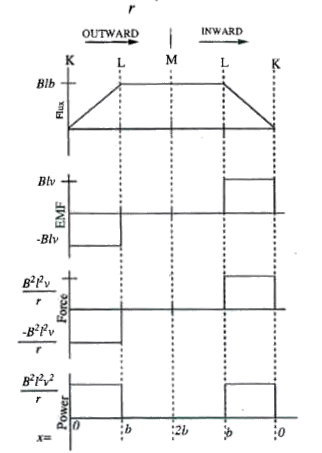
Let us first consider the forward motion from x = 0 to x = 2b The flux `phi_(B)` linked with the circuit SPQR is `phi_(B) = Blx" "0 le x lt b= Blb" "b le x lt 2b`
The induced emf is, `epsilon = -(d phi_(B))/(B) = - Blv" "0 le x lt b` `epsilon=0" "b le x lt 2b`
When the induced emf is nonzero, the current I is `I =(Bl v)/(r)` (in magnitude)

The force required to keep the arm PQ in constant motion is I lB. Its direction is to the left.
`F=(B^(2)l^(2)v)/(r)" "0 le x lt b: F=0" "b le x lt 2b`
The Joule heating loss is
`P_(J)=I^(2)r=(B^(2)l^(2)v^(2))/(r)" "0 le x lt b`
`P_(j)=0" "b le x lt 2b`
One obtains similar expressions for the inward motion from x=2b to x=0. One can appreciate the whole process by examining the sketch of various quantities displayed in Fig.
Promotional Banner

Topper's Solved these Questions

  • ELECTROMAGNETIC INDUCTION

    AAKASH SERIES|Exercise EXERCISE-IA|33 Videos
  • ELECTROMAGNETIC INDUCTION

    AAKASH SERIES|Exercise EXERCISE-IB|18 Videos
  • ELECTRIC FIELD AND POTENTIAL

    AAKASH SERIES|Exercise PROBLEMS (LEVEL-II)|32 Videos
  • ELECTROMAGNETIC WAVES

    AAKASH SERIES|Exercise EXERCISE -II|20 Videos

Similar Questions

Explore conceptually related problems

The plane x =0, x =a, y =0, y =a , z = and z =a from a

From a point (2, 0) the feet of perpendiculars to the lines of the pair 2y^2 - 3xy + x^2 = 0 are P and Q then find the equation of the line PQ.

The perpendicular distance from the origin to the plane x + y + Z+3 =0 is

Figure shows a conducting rod PQ in contact with metal rails RP and SQ, which are 0.25m apart in a uniform magnetic field of flux density 0.4T acting perpendicular to the plane of the paper. Ends R and S are connected through a 5Omega resistance. What is the emf when the rod moves to the right with a velocity of 5ms^(-1) ? What is the magnitude and direction of the current through the 5Omega resistance? If the rod PQ moves to the left with the same speed, what will be the new current and its direction?

If the sum of the two roots of x^3 +px^2 +qx +r=0 is zero then pq=

A conducting rod PQ of length L = 1.0m is moving with a uniform speed v= 2.0 m/s in a uniform magnetic field B = 4.0 T directed into the paper. A capacitor of capacity C = 10 mu F is connected as shown in the figure. Then what are the charges on the plates A and B of the capacitor.

A particle of specific charge alpha starts moving from (0,0,0) under the action of electric field E = chati and magnetic field vecB = B_(0)hatk . Its velocity at (x, 0, 0) is 4hati + 3hatj . Find the value of x

The abscissae of two points P,Q are the roots of the equation 2x^2+4x-7=0 and their ordinates are the roots of the equation 3x^2-12x-1=0 . Then the centre of the circle with PQ as a diameter is

If X is a random variable with the following distribution where p+q=1 then show that the variance of X is pq(a-b)^(2) .

