Home
Class 12
CHEMISTRY
What is the final product of the followi...

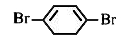
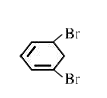
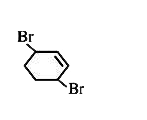
What is the final product of the following reaction sequence?
Cyclohexanol `{:((i) conc. H_2SO_4//Delta),((ii) NBS//C Cl_4//hv),(to),((iii) Alc KOH //Delta),((iv) Br_2 //40^@C):}`

A

B

C

D

Text Solution

AI Generated Solution

The correct Answer is:

To determine the final product of the given reaction sequence starting from cyclohexanol, we will analyze each step of the reaction: ### Step 1: Dehydration of Cyclohexanol - **Reaction**: Cyclohexanol is treated with concentrated sulfuric acid (H₂SO₄) and heated. - **Mechanism**: The hydroxyl group (-OH) of cyclohexanol is protonated by H₂SO₄, forming an oxonium ion. This ion is unstable and loses a water molecule (H₂O), resulting in the formation of a carbocation. The most stable carbocation is formed, which is a secondary carbocation in this case. - **Product**: The carbocation then loses a hydrogen ion (H⁺) to form cyclohexene (C₆H₁₁). ### Step 2: Bromination using NBS - **Reaction**: Cyclohexene is treated with N-bromosuccinimide (NBS) in the presence of carbon tetrachloride (CCl₄) and light (hv). - **Mechanism**: NBS generates bromine radicals (Br•) under light. The double bond in cyclohexene reacts with the bromine radical to form an allylic radical. This radical can stabilize through resonance. - **Product**: The allylic radical then reacts with Br• to form allylic bromide (1-bromo-cyclohexene). ### Step 3: Elimination with Alcoholic KOH - **Reaction**: The allylic bromide is treated with alcoholic potassium hydroxide (KOH) and heated. - **Mechanism**: KOH acts as a base and abstracts a proton from the carbon adjacent to the bromine, leading to the elimination of HBr and formation of a conjugated diene. - **Product**: The product is a conjugated diene (cyclohexadiene). ### Step 4: Bromination of the Conjugated Diene - **Reaction**: The conjugated diene is treated with bromine (Br₂) at 40°C. - **Mechanism**: The π electrons of the diene attack bromine, leading to the formation of a bromonium ion intermediate. The bromide ion then attacks the more stable position (due to resonance), leading to the formation of a dibrominated product. - **Product**: The final product is 1,4-dibromocyclohexene, which is a thermodynamically controlled product. ### Final Product The final product of the reaction sequence is **1,4-dibromocyclohexene**. ---

To determine the final product of the given reaction sequence starting from cyclohexanol, we will analyze each step of the reaction: ### Step 1: Dehydration of Cyclohexanol - **Reaction**: Cyclohexanol is treated with concentrated sulfuric acid (H₂SO₄) and heated. - **Mechanism**: The hydroxyl group (-OH) of cyclohexanol is protonated by H₂SO₄, forming an oxonium ion. This ion is unstable and loses a water molecule (H₂O), resulting in the formation of a carbocation. The most stable carbocation is formed, which is a secondary carbocation in this case. - **Product**: The carbocation then loses a hydrogen ion (H⁺) to form cyclohexene (C₆H₁₁). ### Step 2: Bromination using NBS ...
Promotional Banner

Similar Questions

Explore conceptually related problems

What is the final product of the following reaction sequence? cyclohexanol overset((i) conc. H_2 SO_4//Delta ) overset((ii) NB S//C Cl_4 //hv)underset((iv) Br_2//40^@ C) underset((iii) Alc KOH//Delta ) to

The major product of the following reaction overset((1) t_(Bu) OK)underset((2) Conc. H_(2)SO_(4)//Delta)to

The number of the following reagents can be used for the above conversion is (i). Conc. H_(2)SO_(4)//Delta (ii). Al_(2)O_(3)//Delta (iii). ThO_(2)//Delta

The major product of the following reaction is : overset((i)NaNO_2//H^+)undersetunderset((iii)H_2SO_4("conc".),Delta)((ii)CrO_3//H^+)to

The final product (X) in the following reaction is overset((i)conc.H_2SO_4)rarroverset(conc.HNO_3)rarroverset(Delta)rarroverset(H_2"O"//"OH"^(-))rarr(X)

What is the product of the following reactions? Me - overset(Me) overset(|)underset(Me ) underset(|) C-C=CHoverset({:((i)H_(2)SO_(4//HgSO_(4))), ((ii) NaBH_(4)):})underset({:((iii) Conc. H _(2) SO_(4)), ((iv) O _(3) ZnH_(2) O ):})to
